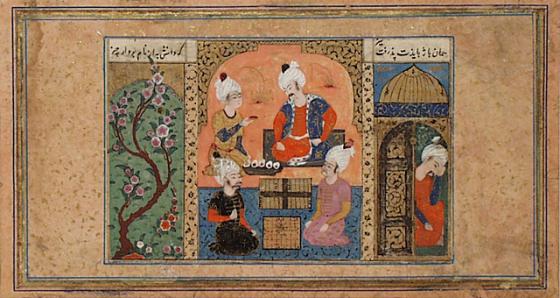

Naushirwan the Just
An analysis of the character and genius of Naushirwan the Just will serve several purposes. It will illustrate the methods of certain writers in misreading or misconstruing Persian history, and…
From: 531 C.E. To: 579 C.E.
Location: Persepolis, Iran

Note: This article has been excerpted from a larger work in the public domain and shared here due to its historical value. It may contain outdated ideas and language that do not reflect TOTA’s opinions and beliefs.
From Studies in Ancient Persian History by P. Kershasp, 1905.
An analysis of the character and genius of Naushirwan the Just will serve several purposes. It will illustrate the methods of certain writers in misreading or misconstruing Persian history, and also throw into relief the real greatness of that king.
Naushirwan, who is styled Chosroes by the Greeks, and Kasrâ by the Arabs, reigned from A.D. 531 to 579. He was the most remarkable personality of his time. He is perhaps the greatest of Asiatic monarchs, with the inevitable exception of Darius I., who endowed Persia with a civil constitution and a military organisation, and created its financial system.
His consummate military abilities are acknowledged with one accord. For nearly the whole period of his rule he was plunged in incessant warfare, and was uniformly victorious over the Romans, with the exception of a slight reverse. He similarly triumphed over the Abyssinians, Epthalites, and Turks, and his sway was owned by dozens of nations. At the age of eighty, he beat back the Roman legions; he also captured the fortress of Dara and plundered Syria. In a score of fights, which he conducted in person, he was defeated but once, and then, too, in a minor engagement.
The Persian Empire attained the zenith of its glory and power under him. It extended from the shores of the Mediterranean to the banks of the Indus, from the Red Sea to the Caspian, and from the Euxine to the Jexartes.
Naushirwan's fame as the living embodiment of justice resounded through the East during his lifetime, and its echoes reverberate across centuries in tales and romances. However, the evidence of his contemporaries is rated very low by the modern judges of the West, and efforts have been made to belittle him.
His enlightened and liberal-minded statesmanship and his modern methods of administration are attested by his internal arrangements, the details of which can be gleaned even from the books in European languages. The spirit of his rule is announced in his very first speech addressed to the nobles, which is reported in almost all Moslem histories. When they proffered him the diadem he refused it at first, protesting that he would be unable to reform abuses. He lamented that the offices were filled by worthless and despicable men, and inquired who in such days would make a vain attempt to govern according to the principles of wisdom and justice.
"If I do my duty,” he continued, “I must make great changes; the result of these may be blood-shed; my sentiments towards many of you would perhaps alter, and families for whom I have now a regard may be ruined. I have no desire to enter info such scenes; they are neither suited to my inclination nor my character, and I must avoid them."
He accordingly disclaimed any intention of undertaking the task, whereupon the nobles took an oath to support him in all his measures. Here he sounded the keynote of his future policy, and his reign is one long fulfilment of the promises.
On a later occasion, he also proclaimed to the assembled courtiers the following sound principles:
“The authority which I derive from my office is established over your persons, not over your hearts. God alone can penetrate into the secret thoughts of men, I desire that you should understand from this that my vigilance and control shall extend only over your actions, not over your consciences; my judgments shall always be founded on the principles of immutable justice, not on the dictates of my individual will or caprice; and when by such a proceeding I shall have remedied the evils which have crept into the administration of the state, the empire will be powerful and I shall merit the applause of posterity."
Naushirwan in this way enunciated an excellent maxim of juridical import, making a near approach to a doctrine which has crystallised in recent years. Law is concerned only with the externals, or overt acts, it is beginning to be felt, and should abandon all attempt to fathom the inward mental state.
The full significance of this far-reaching innovation of Naushirwan is lost on the historians; it is taken to breathe a spirit of toleration, which it also does in a narrower sense. The doctrine really goes further and brushes aside metaphysical cobwebs, setting up an external standard of conduct to which all should conform.
Kaushirwan's beneficent activity was pushed in every direction, and public service and justice were gainers by it. He did his utmost to eradicate corruption from the courts of justice, and in the choice of judges, prefects, and counselors, he strove to seek out natural talents, disregarding distinctions of rank and fortune.
He preferred the men who ''carried the poor in their bosoms,” and though Gibbon sneers at this profusion of his, it was perfectly sincere, and of a piece with his upright and noble candour. He appointed four viziers to exercise superintendence over the multitude of Satraps who ruled the provinces. He employed a staff of inspectors, whose duty it was to bring to the royal notice the sufferings of the oppressed and the misdeeds of public officials.
On the occurrence of suspicious circumstances, he appointed commissions of inquiry to collect evidence, and to make careful reports of the defaults and malpractices of those in authority. Wrongdoers were visited with swift and signal retribution. He himself journeyed from one end of the empire to another, at short intervals, inquiring into the condition of his subjects.
What is still more startling in its modernity is, that education and agriculture were sedulously fostered by him, or, as we should now say, he created the departments of Public Education and Agriculture, In every city of Persia, orphans and the children of the poor were maintained and instructed at the public expense. The girls among these were married to the richest citizens in their own station of life, and the boys were provided for as mechanics or with more respectable berths. Of course, in those days the Persian monarchy was a paternal government.
To the destitute farmers he distributed cattle, seeds, and implements of husbandry. The irrigation canals were improved, and storage reservoirs constructed, The water supply was economically regulated and controlled. In fact, these are some of the functions to which the Indian Government of the twentieth century is devoting its serious attention. Naushirwan restored depopulated villages, built and repaired caravanserais, schools, and colleges, and laid out bazaars, bridges, and other public edifices. Roads and communications were kept in perfect order, and on the main routes guardhouses were established and garrisons posted to watch the safety of travellers.
Naushirwan's humanity and benevolence are manifest at every turn. The poor, especially those infirm and disabled, were relieved from his privy purse. Mendicancy was forbidden, and idleness made an offence. The priests were charged with the supervision of receivers of taxes and the preventing of undue exactions. Liberal exemptions were granted from the public burdens on the score of age and sex. No females were liable, whilst males above fifty years of age, and those under twenty, were likewise let off scot-free.
Nauahirwan's revision of the land-tax, and his re-adjustment of the general taxation, mark a triumph of generous and large-minded administrative skill. The annals of Tabari (A.D. 838-923), a great authority, contain an interesting history of the land-tax, and of the incidents preluding the inauguration of Naushirwan’s scheme. Naushirwan made a signal departure from the ordinary methods of absolutism, when introducing his system of taxation.
He summoned a representative assembly of the leaders of different classes, principal landed proprietors, generals, warriors, and secretaries. He laid his proposals before them in a remarkable discourse, expounding his motives and policy, and demanded their consent.
On this, the land tax was named "hamdâstân” ie. one to which the popular consent had been obtained. His scheme permanently lightened the burdens of the peasantry, and Khalif Omar dared not upset it, saying that no institution was juster than the incidence of the land tax. At the date of Tabari’s book, no changes had been made in it.
The revenue derived from land is the sheet-anchor of the Indian budget, even under latter-day conditions- Ancient Persia, like India, was an agricultural country, and machinery, which can turn out manufactures on a large scale, it goes without saying, was non-existent. The prosperity of Persia depended on a wise distribution of the fiscal dues, and to have placed the financial system on a sound and equitable footing was no contemptible feat.
The crown share of the produce was, in olden times, a fluctuating item, varying between a fourth and a twentieth, and depending on the productiveness of the soil, the distance from the water supply, and the abundance or scarcity of water, and, further, subject to the condition that the division of harvest was to be effected on the land. For these clumsy arrangements, Naushirwan substituted a tax moderate in amount, payable partly in money, and partly in kind.
The quantity of land, which could be tilled with one plough-team, was rated at one dirhem and one measure of produce. The demand of the state was also fixed in perpetuity at a uniform rate on all lands. Uncultivated land, and land lying fallow, paid no tax, and a recurring annual survey with the annual registration of cultivators and their holdings was set on foot.
The intelligibility and simplicity of the system, which is really free from the complications imagined by Rawlinson, and which is partially enforced in some provinces of India, must have been a great boon to the cultivator; and it speaks volumes for Naushirwan’s sagacity that the principle of levying a prescribed rate on each holding was only adopted by the Indian Government after long and anxious debates and several tentative experiments.
An invariable assessment is still an unattained ideal in India. Turgot, one of the greatest administrators Europe has produced, was in favour of the land-tax being a fixed charge. and, with all the scientific resources of the eighteenth century at his disposal, at last recoiled from the task of determining the assets of each estate whereon to base a graded tax.
The Indian Government classifies the soils, with reference to the inherent fertility, &c., but there are rival schemes, and the advocates of one scoff at the other.
Nausbirwan’s plan was therefore on the whole an equitable one. Inferior soils, on which it would have pressed hardly, might not have been brought under the plough, and that was not an unmixed evil. Payments were to be made in quarterly instalmeats, and notices were published in each province, town, and village, specifying each individual’s liabilities in respect of all the imposts. There was also a small tax on each fruit tree, which is not yet abolished everywhere in India.
A graduated property-tax on the personalty of each citizen, ranging from six dirhems up to a maximum of forty-eight dirhems, or twenty-seven shillings, and a capitation or poll-tax on Jews and Christians, round off the whole category of taxes.
Thus the taxation in the empire was not oppressive, and can challenge favourable comparison with the modern complicated systems of rates and taxes. It had no tendency to hamper or strangle industries or trade,vice so common in past history to financial systems. Multiplicity of taxes has no charms for some modern economists, and has frequently been the refuge of bad governments. Backward countries, it is worthy of remark, draw up, in their greed for revenue, long schedules of dutiable articles.
The administration of the army was thoroughly overhauled by Naushirwan. Paper armies were not unknown even in those days, and there were soldiers without accoutrements or the full complement of arms. Frauds and make-believe had crept in. The Augean stables were cleansed, and discipline was rigorously enforced. Naushirwan's reforms were best tested in the battlefield, where his army reaped the glory of an unbroken series of victories.
Naushirwan was a patron of science and learning, and, to his lasting honour, afforded a hospitable asylum to a party of seven Greek sages, who were persecuted by Justinian, and had fled from their own country. His most notable achievement in this line was the establishment at Jund-i-Shahpoor of a medical school, which insensibly expanded into and acquired the status of a university, where philosophy, rhetoric, and poetry were taught. This had momentous consequences; it initiated the movement which culminated in the rise of the so called Arab philosophy, and kept the torch of learning aglow in the Dark Ages of Europe.
As Huart says, this Academy disseminated in the East a knowledge of Greek science and the taste for philosophic and medical studies. Renan finds that the Aristotelian studies pursued in that Academy brought forth the Arab lexicology. By Naushirwan's order, the most celebrated writers in Greek and Sanscrit were translated into Pehlavc, and a history of the Persian kings was also compiled.
Kershasp, P. Studies in Ancient Persian History. Kegan Paul, Trench, Trubner & C0, 1905.
About TOTA
TOTA.world provides cultural information and sharing across the world to help you explore your Family’s Cultural History and create deep connections with the lives and cultures of your ancestors.