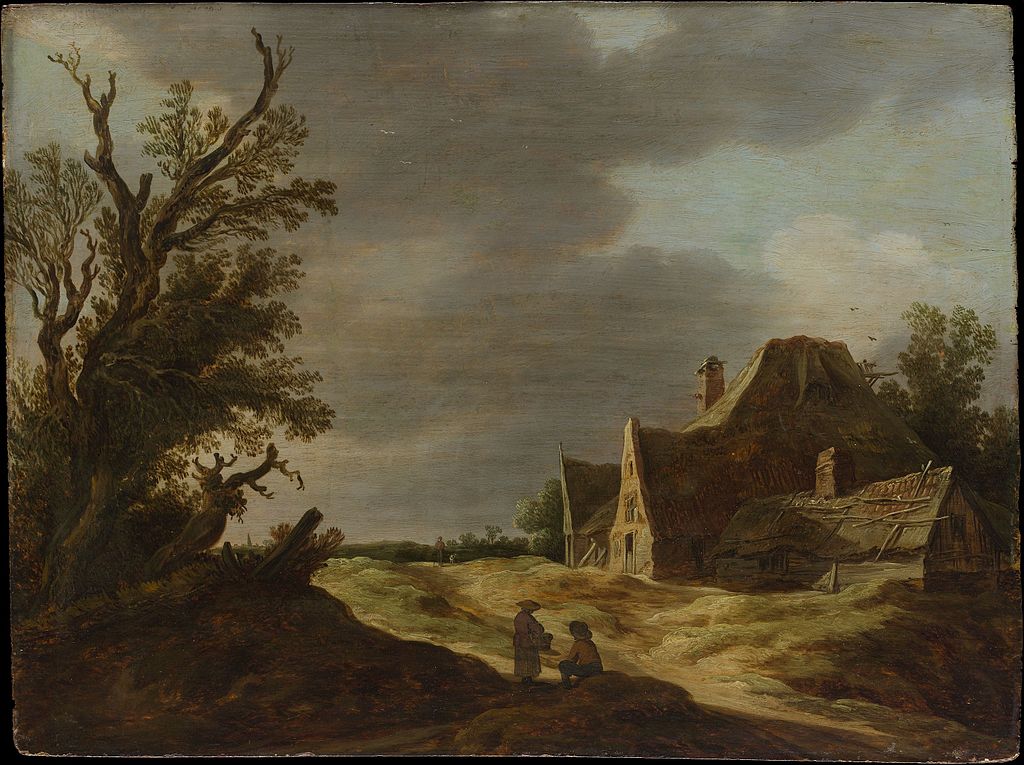

Dutch Farmhouses, 1902
The farmhouses in most parts of the country are neat and more or less of a pattern, although they differ in minor details. Outside their appearance is very quaint and…
From: 1902 C.E. To: 1902 C.E.
Location: The Netherlands

Note: This article has been excerpted from a larger work in the public domain and shared here due to its historical value. It may contain outdated ideas and language that do not reflect TOTA’s opinions and beliefs.
From Dutch Life in Town and Country by P. M. Hough, 1902.
The farmhouses in most parts of the country are neat and more or less of a pattern, although they differ in minor details. Outside their appearance is very quaint and picturesque, and the roofs are either thatched or tiled. In Groningen they now hardly resemble farms. They are, indeed, little country seats and the interior is decidedly modern.
Some of the very poorest-looking houses are to be found in Overyssel and Drenthe. These are built of clay, and stand half-way in the ground. The roofs are covered, with sods taken from the Drentsche veengronden. Some of these plaggewoningen, as they are called, are not more than twelve feet square and eight feet high. The ceiling of the room inside the dwelling is only four or five feet high, and above this the stores of hay and corn are kept. A hole in the roof serves as chimney, and in the floor—which is nothing but hard clay—a hole is dug to serve as fireplace.
On the larger farms in Overyssel the main building is generally divided into two parts. The back part is for the cattle which stand in rows on either side, with a large open space in the centre, called the deel where the carts are kept. A large arched double door leads into it, while the thatched roof comes down low on either side.
Leading from the deel, or stable, into the living-room, is a small door, with a window to enable the inhabitants to see what is going on among their friends of the fields. Against the wall which forms the partition between the stable and living-room is the fire-place. You will sometimes find an open fire on the floor, though in the more modern houses stoves are used. The chimney-piece is in the shape of a large overhanging hood with a flounce of light print schoorsteenval round it, and a row of plates on a shelf above serves for ornament. The much-prized linen-press, which has already been mentioned, is usually placed at right-angles to the outer door, so as to form a kind of passage.
In some farmhouses there is no partition at all between the stable and living-room, but the cattle are kept at the back, and the people live at the other end, near the window. This is called a loshuis, or open house, and very picturesque it is to look at. The smell of the cows is considered to be extremely healthy, and consumptive patients have been completely cured (so it is popularly believed) by sleeping in the cowsheds. Besides being healthy, this primitive system is also cheap, for the cows give out so much warmth that it is almost unnecessary to have fires except for cooking purposes.
Some of these open houses have no chimneys, the smoke finding its way out between the tiles of the roof or through the door. There is a hayloft above the part occupied by the cattle, while over the heads of the family hams, bacon, and sausages of every description hang from the rafters. Smoke is very useful in curing these stores, and this may account for the absence of a chimney.
In Brabant, however, where there are chimneys, the farmer hangs his stores in them, so that when looking up through the wide opening to the sky beyond, numerous tiers of dangling sausages meet one's admiring gaze.
The living-room is a living-room in every sense of the word, for the family work, eat, and sleep there. Sometimes a larger farm has a wing attached to it containing bedrooms, but this is not general, and even so, most of the family sleep in the living-room. The beds are placed round the room. They are, in fact, cupboards, and by day are fixed in the wall. Green curtains are hung before the beds, and are always drawn at night, completely concealing the beds from view. Some have doors like ordinary cupboards, but this is more general in North Holland.
In Hindeloopen (Friesland) one or two beds in the living-room are kept as* pronkbedden* (show-beds). They are decked out with the finest linen the farmers' wives possess, the sheets gorgeous with long laces, and the pillow-slips beautifully embroidered. These beds are never slept in, and the curtains are kept open all day long, so that anyone who enters the room can at once admire their beauty. Some of the more wealthy have a “best bedroom," which they keep carefully locked. They dust it every day, and clean it out once a week, but never use it.
In South Holland it is more customary to have a pronk-kamer (show-room), which is not a bedroom, but a kind of parlour. This room is never entered by the inhabitants of the house except at a birth or a death, and in the latter case they put the corpse there.
In Hindeloopen the dead are put in the church to await burial, and there they rest on biers specially made for the occasion. A different bier is used to represent the trade or profession or sex of the dead person. These biers are always most elaborately painted (as, indeed, are all things in Hindeloopen), with scenes out of the life of a doctor, a clergyman, a tradesman, or a peasant.
Hough, P. M. Dutch Life in Town and Country. G. P. Putnam's Sons, 1902.
About TOTA
TOTA.world provides cultural information and sharing across the world to help you explore your Family’s Cultural History and create deep connections with the lives and cultures of your ancestors.