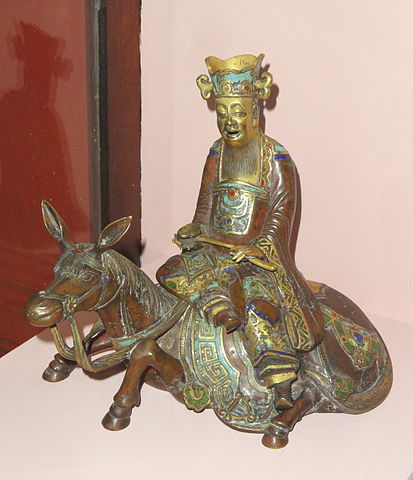

The Life of Lao-tzŭ
The life of Lao-tzŭ, like the book which he wrote, is enveloped in mystery; and one might almost be excused for doubting whether such a person ever actually existed. One…
From: 601 B.C.E. To: 531 B.C.E.
Location: Luyi, Zhoukou, Henan, China

Note: This article has been excerpted from a larger work in the public domain and shared here due to its historical value. It may contain outdated ideas and language that do not reflect TOTA’s opinions and beliefs.
From Lao-Tzŭ, A Study in Chinese Philosophy by Thomas Watters, 1870.
The Life of Lao-tzŭ
The life of Lao-tzŭ, like the book which he wrote, is enveloped in mystery; and one might almost be excused for doubting whether such a person ever actually existed. One author, indeed, has even gone the length of saying that Lao-tzŭ was made out of space or vacuity.
The most reliable account of him which has come down to us is that by Szŭ Ma-chien, or Sze-ma-thsien, in the Shi-chi, and this is very brief and unsatisfactory. We have also occasional notices of him in other old books, but the stories told about him in the Records of Spirits and Fairies and works of a like nature are, as Julien observes, only a tissue of falsehoods which all sensible men reject.
Szu Ma-chien says Lao-tzŭ was a native of the hamlet Ch'ü-jen of the parish Lai or Li in the district K'u, a town of the state Ch'u: his surname was Li, his name Erh, his style Po-yang and his posthumous designation Tan.
He was in office at the court of Chou as Shou-tsang-shǐ-chǐ-shǐ which Julien translates "gardien des archives." I have been unable to obtain from Chinese sources any reliable statement as to the date of Lao-tzŭ's birth; though Pauthier asserts positively that he was born on the 14th day of the 9th moon, in the year B.C. 604. In this he is followed by Julien, who, however, says candidly—"cette date (the 3rd year of king Ting of the Chou dynasty, corresponding to B.C. 604) que nous inserons ioi, est conforme a la tradition historique la mieux etablie mais elle ne se trouve point dans la notice du Sze-ma-thsien dont nous donnons la traduction."
There is nothing improbable in this date, as we know from other sources that Lao-tzŭ was a contemporary of Confucius, though very much his senior; and as Confucius was born about B.C. 550, Lao-tzŭ must apparently have been born about the beginning of the sixth century B.C. The latter sage indeed, is usually represented as having attained to a very great age, and as having been alive much more than fifty years before the birth of Confucius. Ch'ao, a well known author, quoted by Ma Tuan-lin, says that it was in the forty-second year of the reign of king P'ing that Lao-tzŭ gave his book to the keeper of the Pass. This would carry him up to the eighth century B.C., king P'ing having commenced to reign about the year B.C. 770. Others mention two teachers of Tao as having lived during the Chou dynasty, one Lao-tan and another named Lao-lai-tzŭ.
It is by the name Lao-tan that Confucius usually refers to Lao-tzŭ, while later authors often use his surname Li or his name Erh. It must be remembered also that the Lao-tan mentioned by Confucius is regarded by a few commentators as a different person from the author of the Tao-tê-ching.
Nearly all authorities seem to agree with Szŭ Ma-chien as to the place of Lao-tzŭ's birth in the feudal dependency Ch'u. Under this word Biot has the following remarks—"Nom d'un ancien royaume de la Chine centrale, a I'epoque du Tchun-thsieou. Le centre etait dans I'arrondissement de Tchi-kiang; la limite nord etait entre le Kiang et le Hoang-ho; la limite sud etait au midi du Kiang, mais non bien determinée."
The district city K'u is also said to have belonged to the principality of Ch'en. It stood near the present Kwei-tê-foo, the most easterly of the cities of Honan; and the present K'u-yang preserves the house of Lao-tzŭ and a temple dedicated to his memory. Another account, however, represents him as having been born in the district city Po in the province of Honan. The chief of Ch'u, like the chiefs of many other states, was at the time of Lao-tzŭ and Confucius only nominally a feudal dependent of the king. He was originally a Tzŭ or Viscount, but the title Wang or king was now usurped in the degenerate days of the Chou rulers who were unable to maintain a strong government.
Of the parents of Lao-tzŭ and of his early years I have not found any record in Chinese books; but Pauthier says that according to historic data his father was a poor peasant who had remained a bachelor up to his seventieth year, when he married a peasant woman of the unromantic age of forty years. Whatever were his circumstances, however, I think we may conclude that Lao-tzŭ was in early life a diligent student of the past history and the institutions of the country, and his obtaining office at the court of Chou was probably a consequence of his learning and abilities.
As to the nature of this office I cannot agree with Pauthier and Julien in calling it that of historiographer, or keeper of the State Archives. The word tsang means a granary or storehouse, and in a note to a passage in the Li-chi, or Record of Ceremonies, it is explained as the Imperial or National Museum.The Shou-tsang-shǐ would accordingly be the officer in charge of the Museum, and we must remember that when Confucius went to the Capital of Chou to Lao-tzŭ, he saw in the palace the portraits of the early kings, along with many other relics of antiquity, which possessed him strongly with an idea of the magnificence of the first princes of the dynasty.
Dr. Legge also, I find, translates the expression by "Treasury-keeper." The legend in the Records of Spirits and Fairies states that Lao-tzŭ was in the time of king WSn a Shou-tsang-shi and under king Wu a Chu-hsia-shi this latter term meaning assistant historiographer; and it is not improbable that he may have actually held both these offices in succession under king or king Chien, who reigned in the 6th century B. C.
During the time of Lao-tzŭ's residence at the court of Chou, he was visited by two young gentlemen who had come in a carriage and pair from the distant state of Lu. Their names were Ching-shu and K'ung chiu or Confucius, and they had come to learn from the venerable sage the rites and manners of the olden times.
The latter of the two, namely, Confucius, had already been a pupil of Lao-tzŭ, and still remembered his former master with affection and respect. According to Chwang-tzu, however, it was not until he was fifty-one years old that Confucius went to see Lao-tzŭ. He himself when little more than a youth had set out on a convertings tour, thinking to induce rulers and people throughout the kingdom to cease from their evil ways and turn to the good old paths of primitive virtue. He did not succeed, however, and henow told his master the sorrowful tale of his disappointment. Lao-tzŭ said to him, "If it be known that he who talks errs by excess in arguing, and that he who hears is confused by too much talk, the way (Tao) can never be forgot."
According to Szu Ma-chien, the Master on another occasion lectured his ambitious disciple as follows: "The men of whom you speak, Sir, have with their bones already all mouldered into dust, and only their sayings abide. Moreover if the superior man gets his time, he mounts [his car and takes office]: if he does not get his time, he goes through life like a wisp of straw rolling over sand. I have heard that a good merchant with his treasure house deeply stored seems devoid of resources, and that the superior man of perfect excellence has an outward semblance of stupidity. Do you. Sir, put away your haughty airs and many desires, your flashy manner and extravagant will; these are all unprofitable to you. Sir; and this is all I have to say to you."
In the Family Sayings we read that when Confucius was about to leave Chou, Lao-tzŭ gave him as his parting gift a warning against going too far in the public reproval of those who were in authority. From this and the other references made to the intercourse between Confucius and Lao-tzŭ in the Family Sayings and the Record of Rites it will be seen that they were on terms of intimate friendship; and though Confucius may have deserved the reproof which, according to Szu Ma-chien, Lao-tzŭ administered to him, yet this speech has in it so little of the spirit in which allusion is made to Lao-tzŭ by Confucius or his disciples that I am almost tempted to doubt the story.
I have been unable to find in the Chinese works on this subject a statement of the length of time during which Lao-tzŭ served the king of Chou, of the manner in which he performed his duties, or of the immediate reason of his retirement from office. Szu Ma-chien simply says, "He cultivated Tao and virtue, learned to live in seclusion and oblivion as the important thing, resided for a long time in Chou; when he saw the fortunes of the dynasty going to ruin, he left the country and came to the Pass. The keeper of the Pass, by name Yin-hsi said to him, 'Since you are about to go into seclusion, Sir, you must make me a book.' Hereupon Lao-tzŭ produced his book in two sections containing more than 5,000 characters and declaring the meaning of Tao and Te. He then went away, and no one knows his end."
In order to understand the conduct of Lao-tzŭ, in retiring from office in Chou and going into seclusion when he saw its fortunes broken, we must know something of the state of the country at the time. Now the reader of the historical and other works relating to this dynasty will remember what a miserable picture of the kingdom is given in most of them. The hard won territories of king Wu were now subject to his degenerate descendants only in name.
The whole country was torn up into petty states, which were always warring with each other. Year by year, army after army, with flaunting banners and gay pennons, passed and repassed through the fields of the people, and left desolation and misery in their track. Fathers and husbands, sons and brothers, were taken away from their homes and their work, and kept in long military service far away from their families. Laxity of morals accompanied this state of civil confusion.
Chiefs forgot their allegiance to their princes, and wives their duties to their husbands—usurpers were in the state, and usurpers were in the family. Every little chief was striving with his neighbour for the mastery, and the weak and wicked princes of Chou were unable to overcome them and reduce them to peace and obedience. Men of shining abilities and inordinate ambition rose to power in each state, and, wishing to satisfy their ambition, increased the anarchy of the kingdom.
The decree of Heaven was slowly changing, and already, in the time of Lao-tzŭ, "Ichabod" was written up for the princes of Chou. We can now easily see why the philosopher taught that men should not strive, but ever give way; that they should be humble and satisfied with a low condition; that men of virtue and integrity should retire from the dangers and vices of a wicked government; and that no honour should be attached to specious abilities or rare acquisitions.
True to his principles, he himself, when the prestige of Chou was lost, and the evil days and evil tongues were becoming more and more evil, withdrew from the court and retired into unenvied obscurity. For this course of action, Confucianists and others have severely censured Lao-tzŭ.
We must remember, however, that Confucius himself taught (what he had probably learnt from Lao-tzŭ) that when good principles prevail in a country, the superior man, takes office; and that he retires when bad government takes their place. There seem to have been at the time only two courses which an upright and faithful public servant could elect to pursue. He might either take his life in his hands, and try by strong measures to recall his rulers to the path of virtue; or he might establish his own good character, and then withdraw from temptation and corruption. Confucius chose the former course, and ended in disappointment; Lao-tzŭ and many others, as we know from the Lun Yü chose the latter course.
The Pass to which Szu Ma~chien represents Lao-tzŭ as going, and where he met with Yin-hsi, is said in a note to this passage to be probably Han-ku-kwan the present Ling-pao, in the extreme west of Honan, and on the south bank of the Yellow River. The Pass and its keeper have since become famous in the legendary and poetic literature of China.
This is the last historical notice that we have of Lao-tzŭ. He left the Pass, having enriched the keeper with the 81 chapters he had composed on Tao and Virtue, and went away. " No one knows his end." We may hope, however, that he died a peaceful, happy death, in a good old age, having attained a clear insight into the nature of Tao and Tê.
According to the Lao-tzŭ Lie Chuan of Szu Ma-chien, Lao-tzŭ left a son named Ts'ung, who became a high military officer under the chief of Wei and was appointed to the feudal dependency Tuan-kan. His descendants were living in the time of the Han dynasty in the 2nd century B. C.
Such is the sum of the probably true information which I have succeeded in obtaining about this remarkable man. Many things that we would have liked to know about him are wanting, and part of what we have seems uncertain. In his birth and in his death he was mysterious, and through all his life he seems to have courted obscurity. He tells us himself that he appeared to mankind stupid and helpless, but that he had within himself precious treasures of which the world did not know.
To me he seems to have been a kind and gentle old philosopher, who thought more of what was beyond this world than about what was in it. I cannot find in him those traits of moroseness and cynicism which others have found, nor any trace of the jealousy and spite with which he is said to have regarded Confucius. Chu-hsi or Chu fu tzŭ, represents him as a man standing aloof from the ordinary ways of men, loving neither their sounds nor their sights, and not living an official life.
Confucius himself refers to Lao-tzŭ with affectionate respect, and quotes his opinions as sufficient answers to the questions of his own disciples. He speaks of him as extensively read in antiquity and acquainted with the present, as having penetrated to the sources of Rites and Music, and as understanding what belonged to Tao and Tê.
The old man who thought that in troubled times, like those in which they were living, men of wisdom and virtue ought not to make a display of those qualities, but rather to appear to the world destitute of them, when he found his former pupil parading the kingdom with a crowd of disciples (one of whom acted as his car driver), going from court to court admonishing and scolding the chiefs, thought it his duty to give the youthful reformer a sharp reproof and an earnest warning. His advice was excellent, and Confucius found out at last that the restoration of peace and good government to a country was not to be effected so easily as he had thought, even though the preacher of reform dressed unimpeachably, ate and drank only the best he could get, had an excellent ear for music, and knew the decrees of Heaven.
Watters, Thomas. Lao-Tzŭ, A Study in Chinese Philosophy. Williams & Norgate, 1870.
About TOTA
TOTA.world provides cultural information and sharing across the world to help you explore your Family’s Cultural History and create deep connections with the lives and cultures of your ancestors.