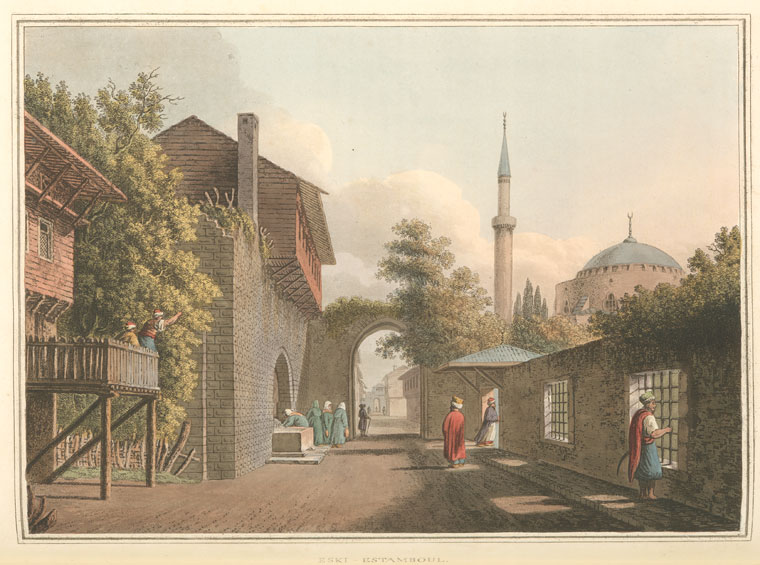

Urban Homes in Turkey, 1911
From Turkey and the Turks by Z. Duckett Ferriman, 1911.
Location: Istanbul, Turkey

Note: This article has been excerpted from a larger work in the public domain and shared here due to its historical value. It may contain outdated ideas and language that do not reflect TOTA’s opinions and beliefs.
From Turkey and the Turks by Z. Duckett Ferriman, 1911.
I wished to say something about the home life of the Turks, and sought the advice of one who has resided for more than thirty years at Constantinople, whose works dealing with its history have taken rank as classics, and who certainly knows more about Turkey than any other living Englishman. “Home life?" exclaimed the amused historian. “It will be like writing about snakes in Ireland. There is no home life."
I went to a Turk, a gentleman of culture and a travelled man, who might easily pass for an Englishman, so thorough is his mastery of the language. “You see," said the Bey, “we have no home in your sense of the word." I referred to his own. “Ah! you must not take me as a type," he replied. “As a nation, we are still nomads at heart. The term we use for a mansion (konak) means literally a stage or halting-place on a journey."
We were sitting in what might have been an English drawing-room of the most refined type, with a good bronze here and there, and a few good water-colours. The note of colour in the adjoining study was a quiet Turkey red, harmonizing with the mahogany furniture.
“There are no pictures in the average Turkish house," continued my host. A vision of bygone years came to me, a vision of a princely dwelling on the Bosphorus and the glowing canvases on its walls. But I knew that neither that nor the house I was in represented the average Turkish home. And it is just the average home that the stranger is least likely to see. More than this, a man is at a disadvantage, for he cannot see the person who makes the home—its mistress.
In those very rare instances where he can, the home is an exception to the average. His information as to the harem and its inhabitants is necessarily vicarious. It must be gleaned from ladies of his acquaintance who have access to harems. It need not be said, therefore, that what follows does not pretend to be either complete or authoritative. It is derived partly from the author's personal recollections extending over many years and divers regions, and partly from what others have told him.
“In my father's time," said the Bey, “when a young couple got married, they had bedding enough for fifty people. That was because they were expected to put up whole families of their relatives, who would arrive without notice, as a matter of course, and sometimes bring a few friends with them. Hence the size of those vast rambling konaks you see in Stamboul and elsewhere. The konak was the residence, not of a single family, but of a family community. That is a thing of the past, except in some remote districts.”
“The old Dere-beys still keep up a sort of feudal state in Albania and Kurdistan. No; I cannot say that I liked the old system. For one thing, there was no privacy. Our homes were never our own; we only shared them with others. Besides, it meant keeping up a small army of servants and slaves involving needless expense and much waste."
So it is that the picturesque old konaks are gradually disappearing, replaced by mansions less spacious and of modern design. Most of the new houses in Constantinople are only distinguished from those of Europeans by the latticed windows of the haremlik. The towns are becoming less picturesque, but what they lose in that respect they gain in comfort. The dictates both of that and of economy have caused the Turks to gravitate towards the single family as the unit of the home, and the Bey's views on the matter are undoubtedly right.
But the Turkish quarters of Constantinople and of other towns are still chiefly built of wood. They are slight structures, for the Turk does not build for posterity, and many of them have an unfinished appearance, for he only builds enough for the moment, adding more as required. The nomadic instinct shows itself in this, as in the interior of his dwelling, which is bare of furniture. In the more pretentious houses there may be a few chairs set against the wall, but they are not used.
There are no tables, and curtains take the place of doors. There are no bedsteads. The bedding is stowed away in capacious cupboards in the walls. When it is wanted it will be brought out, unrolled, and spread on the floor. The cooking is probably being done on a brazier in the garden if it is summer. The whole arrangements give one the idea of camping out, and the illusion is intensified by a remarkable peculiarity in the construction of the rooms.
Wherever it is possible, two sides of them consist of windows, with a space of only a few inches between each. This comes of the Turk's liking for light and air. If he is lucky enough to have a room projecting from the building, three sides will be windows. The result is a kind of bird-cage where there is far too much air in winter, for the windows are ill-fitting as a rule; whilst in summer the bird-cage becomes a forcing-house. The author can speak from experience of both. The Turk enjoys it, however.
It is a compromise between a tent and a substantial habitation, and it reconciles him to the latter. But let us leave the town-dweller for a moment to glance at Turkish homes and Turkish life under more elementary conditions. These are to be found in Anatolia, not in the cities, but in the valleys, on the mountain side, and on the high plateaus where the people have been less subject to extraneous influences than elsewhere.
Ferriman, Z. Duckett. Turkey and the Turks. James Pott & Co., 1911.
About TOTA
TOTA.world provides cultural information and sharing across the world to help you explore your Family’s Cultural History and create deep connections with the lives and cultures of your ancestors.