
Soviet Farms in 1927
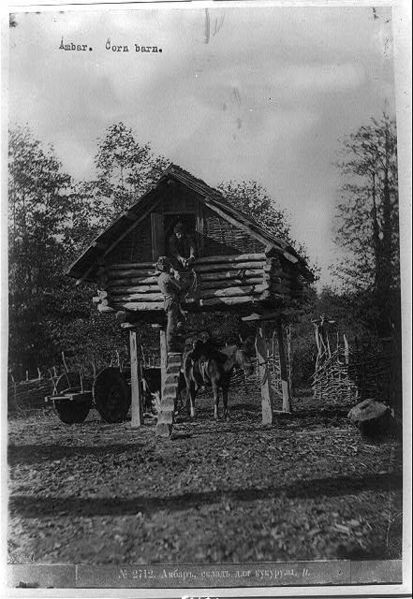
The granaries are, if possible, built of logs carefully joined with bins on either side of the room for the grains which will vary with the section of the country.…
From: 1927 C.E. To: 1927 C.E.
Location: Russia

Note: This article has been excerpted from a larger work in the public domain and shared here due to its historical value. It may contain outdated ideas and language that do not reflect TOTA’s opinions and beliefs.
From Village Life Under the Soviets by Karl Borders, 1927.
In the Barnyard
Let us now have a look at the outbuildings.
The granaries are, if possible, built of logs carefully joined with bins on either side of the room for the grains which will vary with the section of the country. It has from time immemorial been the ideal of the peasant to keep on hand a good supply of bread, as both the grain and the prepared loaf are called. The good farmer will never see the bottom of his bin.
The horses and other stock are stabled in buildings of either mud brick or willow basketwork plastered with clay. In general, more attention is given to warmth and shelter than to ventilation and light in the stables as well as in the house. The stalls are not cleaned with the regularity expected of a good farmer in America, but care is taken to save the manure for fuel. The medium class farmer of the south will have a pair of horses, at least, a cow, a few sheep, and perhaps a half dozen pigs. As we shall see later, the classification of peasants into wealth categories is purely a matter of local comparison and differs widely in different sections of the country.
Under the sheds of the courtyard will be found the farming implements and means of conveyance. Here are plow, harrow, seeder, grain cleaner and reaper.
The usual summer means of conveyance is the one-horse springless road-wagon built with narrow running gear and a flaring bed that extends over the wheels and is supported by an iron brace resting on the end of the axle. The shafts are fastened independently to the front axle, which makes necessary the queer bow over the collar in harnessing the horse, which is used as a spring to keep the collar and shafts from pressing against the neck of the animal.
In the greater part of Russia, the sleigh is the exclusive means of winter transportation. The usual form is a simple pair of village-made runners surmounted by a wedge-shaped frame which acts as an outrigger in the rear spread to prevent overturning. A well-to-do farmer may own a vehicle with springs for summer service, and even a light sleigh of the kind we know in America. But most of them are accustomed to consider the freight carrying value of their conveyance rather than its comfort, and depend on a liberal amount of hay or straw for the cushioning of the passenger.
The bath house will be located as conveniently as possible to the water supply. If the courtyard borders the river, it will, of course, be at the rear of the quadrangle. On account of the scarcity of fuel, several families may share a bath house. But every Russian considers it practically a religious duty to have his Saturday bath and will often go great distances for this luxury, if he does not possess a bath of his own.
The principle of the bath is very simple: Some means of heating a small, low ceilinged room to the highest degree bearable for human beings, filling this purgatory with steam and vapor by throwing water over hot stones or pieces of iron; two or three tiers of ascending steps whereon the devotee may sit or recline, and a tub of hot and one of cold water.
The event of the bath is more than a mere cleansing process. It is a ceremony in which the devotee luxuriates in prolonged steaming while a friend or member of the family beats his broiling body with a bunch of birch twigs, or, failing this assistance, he climbs to the topmost tier and sweats himself to the point of collapse. Here as in the washing of the hands, the water is always poured over the body, hot water first, and after the broiling a dash of cold.
I remember very well how on my first acquaintance with such a bath in a little village of Samara Government, I quickly sought refuge like a good soldier by lying flat on the floor. One of the women workers of the Quaker Unit was carried out of another bath of the same sort in a dead faint. I was reared on a Kentucky farm, and I am ready to testify that for the cleansing power, the village bath is far more effective than the washtub on Saturday night.
All of the foregoing concerns a middle class farmer in the southern grain country. In the same town of Maslov Kut there are also many houses of the poor, with one clay-floored room, one horse or none, and practically no implements. On the other hand, one of the richer families owns a tractor, three horses, two cows, and twenty sheep.
Figures for 4,636 families, secured from the county statistical bureau of Archangelskoe county, in which this village is located, reveal the following distribution of horses, which is the best comparative index of peasant wealth: 1,845, without horses; 669, one horse; 1,107, two horses; 539, three; 476, four or more. On the other hand, in a small village of forty houses which I visited in Leningrad Gubernia, one horse to the family is the general rule, and I was told by an informed official of the district that throughout the entire section the man with two horses is the rich exception. This is also true of the central agricultural districts of the heavily populated country around Moscow. But a visitor from Siberia informs me that the middle farmer of that section owns two pairs of oxen and two or three horses.
Borders, Karl. Village Life Under the Soviets. Vanguard Printings, 1927.
About TOTA
TOTA.world provides cultural information and sharing across the world to help you explore your Family’s Cultural History and create deep connections with the lives and cultures of your ancestors.