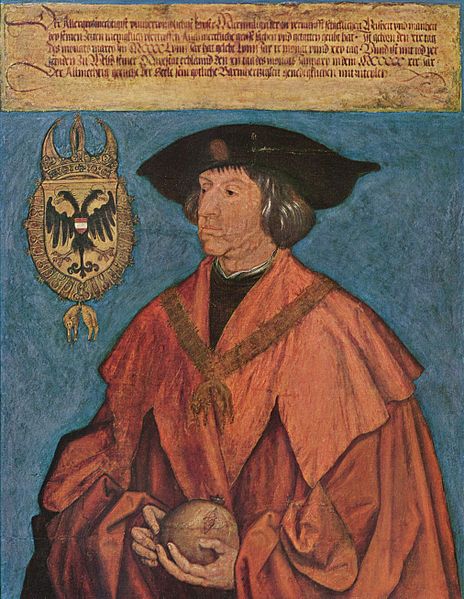

Germany in the time of Maximilian I
It would be difficult indeed to give a clearer or more comprehensive account of the conditions in Germany than that submitted by the Venetian ambassador, Quirini, on his return from…
From: 1507 C.E. To: 1507 C.E.
Location: Germany

Note: This article has been excerpted from a larger work in the public domain and shared here due to its historical value. It may contain outdated ideas and language that do not reflect TOTA’s opinions and beliefs.
From Readings in European History by James Robinson, 1906.
Germany in the time of Maximilian I
It would be difficult indeed to give a clearer or more comprehensive account of the conditions in Germany than that submitted by the Venetian ambassador, Quirini, on his return from the court of Maximilian in 1507. Maximilian was just then contemplating an expedition to Italy, and consequently Quirini opens his report to the doge and council as follows:
Since, most serene prince [namely, the doge], and most. A sage and weighty council, all the discord which is now to be observed among Christian peoples appears to be due to the most serene king of the Romans [namely, Maximilian] and to the Empire, it seemed to me my duty to report to your excellencies concerning affairs in Germany with such fullness as to enable you in the present emergencies and in those which you will have to face from, let us say, today the better to reach your wise decisions.
First, to proceed in an orderly fashion, I will endeavor to narrate all that I have been able to learn of the extent of that country, its government and resources, and the customs throughout Germany; then of the character and resources of his Majesty the emperor, and the relations which have existed and now exist between him and the princes and estates of the Empire, and between him and the Swiss; lastly, of the disposition of the Empire and the king toward this republic and the rest of the Christian rulers, and what his Majesty may be able to accomplish at this juncture.
This country of Germany is large and populous, full of principalities, towns, cities, burgs, and castles... Among the temporal rulers there are two kings, about thirty dukes and an archduke, four landgraves, and a great number of counts. The chief among these rulers are the kings of Bohemia and of Denmark, the archduke of Austria, two dukes of Saxony, the duke of Brunswick, the duke of Lüneburg, the duke of Pomerania, the duke of Mechlenburg and he of Jülich and Cleves, the duke of Franconia, the dukes of Bavaria and Würtemberg, the count palatine, the landgrave of Alsace, two margraves of Brandenburg and one of Baden.
Of those in Germany who are at once spiritual and temporal princes, there are five archbishops—Mayence, Cologne, Treves, Mechlenburg [Magdeburg is meant.], and Salzburg—and about twenty-five bishops. Of these latter, the chief are Würzburg, Bamberg, Strasburg, Augsburg, Freising, Eichstadt, Liege, Constance, and Trent. Beside these, there are twenty abbots, five masters of religious orders, and fifteen priors,—all princes of the Empire, who combine spiritual and temporal powers like the bishops.
Besides the above-mentioned principalities there are in Germany about a hundred free towns, of which twenty-eight belong to the Swabian League, sixty-two to the great league of Dantzig and Lübeck [namely, the Hanseatic League], while the rest lie in the region of the Rhine. The principal members of the great league are Dantzig, Stolp, Colberg, Lübeck, Limburg, Hamburg, and Stade; of the Swabian League, Nuremberg, Augsburg, Ulm, Memmingen, and Strasburg. The chief of the Rhine district are Cologne, Speyer, Worms, Frankfort, and Constance. And this ends what I have to say about the size of Germany...
The authority over the Empire vested in the emperor, or king of the Romans, goes no further than the laws and justice permit, and he cannot despotically force the princes and free towns to obey any particular desire of his unless he first convoke all the Empire to a diet...
The king of the Romans, or emperor, who proposes in the interest of the Empire to have a careful deliberation, sends a summons to each prince, whether ecclesiastical or secular, and to each of the free towns, that they should all within two months, or three, or whatever time may seem good to him, come together in a certain place, either in person or through representatives or substitutes, on business of importance to the Empire. And all those who are summoned are obliged to come within the limit set; and if they do not come, they incur whatever penalty the king shall impose upon them; and if they do not pay the penalty, they may be excommunicated by the emperor, just as one is excommunicated by the pope. In this case it is free to all to rob and kill the person excommunicated. For this reason everyone takes care to come to the diet or send a representative, and not to disobey the emperor in any matter in which, with the consent of the Empire, he may command...
When all the princes and representatives have presented themselves, either in person or through their substitutes, the diet opens. The king, or emperor, declares the object and cause for the calling of the diet; he then submits a proposal; the princes remain in consultation some days and then make their answer. This the king accepts, and makes another proposition ("iterum," as it is called), and so business proceeds, the diet either taking action or postponing its decision to another time. In this way two and sometimes three months pass.
But the princes or their representatives do not spend all their time in deliberating upon the matters for which the diet was summoned, but settle as well a thousand controversies between prince and prince, between free towns and princes, and between one town and another; they make, moreover, divers provisions according as necessity demands.
In reaching decisions on important matters the diet is wont to have but three votes, or ballots: one is cast by the electors, the second by the princes, and the third by the representatives of the free towns... When the diet is about to come to an end, these three votes are compared, and the decision sanctioned by two of them is regarded as conclusive and established; and each prince of the empire whether present or absent, and similarly every free town, is obliged to obey that which the diet decides, under heavy penalties, both as to furnishing money and sending troops in the manner prescribed.
The king, or emperor, has full authority, as soon as the diet has dissolved, to order everyone to obey its decisions. If, nevertheless, some one ventures to disobey, the whole Empire, in order not to see its commands disregarded, always turns upon the offender, as happened in recent years in the case of the count palatine, who, for his refusal to accede to what was determined upon at the diet of Augsburg, which was especially concerned with the heritage of Duke George of Bavaria, roused the anger of the king and the whole Empire against him, and in a brief space of time was destroyed. For this reason all the princes and free towns are careful to follow the decisions of the diets, nor do they venture to contravene in any way what has been established. Decisions of the diet cannot be changed except by another diet similar to that which first ratified them.
As for the government of the free towns, each one rules itself by its council, to which are admitted citizens, traders who are not citizens, and artisans; yet not all the members of these classes are included in the council, for the number varies with the size of the place, and changes from time to time. These councils appoint the magistrates, who administer justice for the time being and, moreover, regulate the revenues and public affairs of the town precisely as if it was a free and independent state.
Some of the towns owe their freedom to privileges granted by the emperor for deeds of valor in the struggle of the Empire against the infidels, who were earlier very troublesome.
Others gained their freedom by giving a sum of money to the temporal lord or bishop who held them, and who consented accordingly to cede to the town the territory belonging to it. So many towns have gained their freedom in these two ways during the period that the Germans have enjoyed control of the Empire, that they now number nearly a hundred. In order to maintain their freedom they are accustomed to unite themselves together in leagues for mutual protection and to oppose those princes who would subjugate them. They receive into their leagues those princes of the Empire who wish to join them, whether ecclesiastical or secular. The leagues are temporary and are continued or changed from time to time as suits their members...
The customs and manners of this German nation are as follows: first, there are four kinds of persons,—princes of the Empire, nobles, citizens of the free towns, and, lastly, the common people. The princes are in the habit of remaining in their own territories far from the court, where they support by their income, so far as they can, the nobles [knights] of the region. These princes are almost continually at strife with one another or with some of the free towns. If they are poor, they generally permit their retainers to attack and rob on the highways. They are naturally proud and insolent, and feel resentment toward any one who is able to rival them in any respect. They heartily hate the free towns, and all republics and free communities in general, especially the Swiss and our most exalted senate, for it seems to them that the Swiss have always shown themselves rebels toward the Empire and that your sublimities, paying little attention to their authority, hold much territory which they claim is not yours and which they believe should rightfully be divided among them.
Moreover the chief temporal princes are in the habit of leaving their principality to the eldest son and then providing for the rest of their children with other territories, bishoprics, or ecclesiastical benefices; so that if a duke has ten sons, all demand to be dukes like their father. The result is that there are an infinite multitude of counts, dukes, and margraves in Germany, the chief of whom have been mentioned above. Consequently the greater part of the temporal princes are always ready to descend into Italy in order to provide, some their sons, some their brothers or nephews, with principalities. The ecclesiastical princes, on the other hand, and the free towns would prefer to live in peace and not waste their substance. The princes all live in abundance, but give more attention to drinking than anything else. They are miserably dressed, nor do they affect much ceremony in their courts.
The knights are accustomed to live in some castle far from a town, or at the court of some prince, or among the mountains in solitary regions. They live and dress wretchedly, hate the burghers, and are poor, but so proud that nothing in the world would induce them to engage in commerce. They are devoted to fighting; and when that is wanting they have nothing to do but to hunt or set to plundering on the highways. Were it not for severe repression, no one could travel safely in any part of Germany. Even as it is, in Franconia, where there are a great many of these gentlemen, the roads are very insecure; for example, in the region of Nuremburg and in many other places.
The burghers of the free towns are all merchants. They live well but dress ill, although there are some very rich people among them. They maintain justice, desire peace, hate the knights heartily and fear the princes, and for this reason the cities form leagues among themselves. The towns are moreover at enmity each with its bishop on account of his desire to exercise the temporal as well as the spiritual authority over the town. This hostility is increased by the natural ill feeling between the burghers on the one hand and the knights and princes on the other, for the bishops are always chosen from among the knights and princes, since the canons, who have the right to elect the bishop, all belong by descent to the noble classes and not to the burghers.
The lower classes, whether subject to the princes or the free towns, are poor, wild by nature, do not fear to endanger their lives, and are very loyal to their lords. They are loath to exert themselves to earn anything, and the little they get they speedily drink up.
Robinson, James Harvey. Readings in European History: A Collection of Extracts from the Sources, Vol 2. Ginn and Co., 1906.
About TOTA
TOTA.world provides cultural information and sharing across the world to help you explore your Family’s Cultural History and create deep connections with the lives and cultures of your ancestors.