Village Life in India, Part Three
"The noontide heat is now past, and the boys are going back to school. They take their way to a large mud and thatch building in the shade of a…
From: 1917 C.E. To: 1917 C.E.

Note: This article has been excerpted from a larger work in the public domain and shared here due to its historical value. It may contain outdated ideas and language that do not reflect TOTA’s opinions and beliefs.
“Among the Village Folk,” Pt. 3, from Home Life in India by John Finnemore, 1917.
The noontide heat is now past, and the boys are going back to school. They take their way to a large mud and thatch building in the shade of a great tree, and enter the door. This is the school, and it is built and kept in repair by the village. It is an old-fashioned native school, and inside there are no desks or seats, no books as we know them, or slates or paper. Pens there are, but no ink. The floor is strewn with sand, and the boys sit down upon it. At one end of the room is a bank of sand, and here the teacher sits upon a reed mat.
As each boy enters, he goes to his bookcase, takes his book, and sits down to learn his lesson. The bookcase is formed of two pieces of wood bound together by a cord. Inside are a number of palm leaves with writing on their faces. These are the boys' books, and every boy has his own case, so that perhaps forty or fifty cases are hanging on the wall of the school. When the time for the writing lesson comes, the boys use pens made of a sharpened stick of wood, or a reed, and form the characters in a smoothed-out bed of sand. Some of the advanced scholars write on palm-leaves with a reed pen.
The boys go to school at break of day, and are there for two or three hours before breakfast. Each must take care that he has marked his forehead with the sacred ash, in honour of the god Siva, or he will be severely punished by his teacher. From eight to nine he has his breakfast. School goes on again from nine to twelve, when he goes home to his dinner. The afternoon session runs from about two to six, when the school closes for the day.
Sometimes the schoolmaster is the village poet, sometimes he is a Hindu scholar; quite often he is a rather ignorant man, who has hit upon that way of making a living. If he knows his own language and a little arithmetic, he will give perfect satisfaction to the parents of his scholars. He does not know, and they do not know, anything of the world outside India, and little enough of their own country outside their own province, but that does not trouble them.
In geography the master divides the oceans into milk oceans and fire oceans, the rivers into ghee (butter) rivers and honey rivers. He has heard of the mighty Himalaya Mountains, and tells his pupils that the world rests on them. But many of these teachers are really good at simple arithmetic, and handle numbers with ease and freedom. They teach reading and writing, arithmetic as far as fractions, the composing of letters and essays, and store their pupils' minds with a wealth of proverbs and wise sayings. Where the master is a Hindu scholar, the upper classes study grammar and the great Indian classics, the Mahabharata and the Ramayana.
The master expects a small payment in money from the parents of each scholar, more or less, as the parents are rich or poor, and offerings of food, especially at harvest-time, when measures of grain are sent to him. If the teacher finds he has not enough to live upon, he will send his scholars to sing through the streets of the village, at which time they beg for him at every house, and carry to him the offerings.
Once a year comes the school festival, when worship is offered to the goddess Sarasvati, the Goddess of Knowledge. The boys are dressed in their brightest and freshest robes, and the master and his scholars go from house to house, singing and performing and collecting money for the celebration. In a large village, or if the scholars come from smaller hamlets in the neighbourhood, a whole week or more will be spent in this way, and it is the most joyous time of the school-boys' year. When the collection is ended, the master takes the greater part of it for himself, and the rest is spent in giving the boys a treat.
Holidays are not frequent. When the moon is new, and when it is full, the school is closed for two days, making four days in the month. The school is also closed on the day of a great Hindu festival, and for a few days at the beginning of the year. There are no long holidays in a native school.
As for the boys' life in school, a native writer says: "The method of teaching in the village academy is very peculiar. The boys are asked to bring their lessons one by one. Some boys are allowed to write in the sand on the floor, some on the palm-leaves; some are studying their lessons; some are repeating their lessons to the teacher; some are undergoing punishment for not studying their lessons properly. The punishments of the boys are exceedingly severe. A boy under punishment is placed in a corner of the school, and required to stand on one leg while the other is bent and held in his hand.
“Here a boy is left a long time in a bending attitude; there another is made to sit and stand a hundred or even two hundred times in succession without ceasing. Another boy is hung up by his hands. While the boy is hanging, a sharp knife is fixed on the ground, projecting upwards so that he may not rest his feet on the ground. Sometimes the student is kept in a bending attitude, and another boy is made to ride on his back. And at times the student has to starve the whole day; and not infrequently the teacher unmercifully wields his cane of office."
Now we see how things go on in a boys' school; and as for a girls' school, it would be useless to look for such a thing. The girls of the village are at home, helping their mothers, and they are never taught anything but domestic duties.
Still farther on, at the edge of the village, stands the shed of the potter, whose trade is one of the oldest and most famous crafts in the land. He sits at his wheel, surrounded by shreds and fragments of pots which have failed, and turns out with steady, skilful hand the host of pots which the village requires. Trade is never slack with him. In the house of the poorest ryot there are ten or a dozen pots; in the house of the wealthy farmer there are three or four hundred. And besides the breakages of every day, when a birth or death happens in the family, every pot becomes unclean, and is broken in pieces, and replaced with new vessels from the potter.
It is most interesting to watch the potter at his work. He has a simple wheel, which in shape has not been altered for thousands of years. A hundred generations ago his father's fathers used the potters' wheel and shaped the vessels with the thumb or a small piece of wood, and so does he to-day. Upon the wheel he places a mass of wet clay, and the wheel begins to spin. Under the deft touches of his thumb the clay begins swiftly to take the shape he has in mind : a long neck draws out above, a globe-like body opens out below, and soon there is a pot, one of a certain number of shapes, each useful for a certain purpose.
The potter has a fixed round of designs. The idea of asking for a new kind of pot would never enter the head of any housewife, and if it did she would not get it. Custom is sacred: his father always made pots in certain sizes and shapes; the potter will do the same, and so will his son after him.
When the vessels are made, they are set in the sun to dry and burned in a kiln, the fire in which is often fed with the refuse of the village. Yet the pot is clean, and even a Brahmin may drink from it, for, as the old rhyme runs:
"Though the clay be base and the potter mean, The pot brings water to make souls clean."
Still, though the high-class Hindu may drink from the pot, he must break it afterwards; such is the law of his caste. The low caste may keep the pot unbroken and use it again.
The potter makes earthen vessels for many purposes : for cooking food; for carrying water from the well; for storing grain and provisions; for keeping valuables; for carrying food to the fields—in short, at almost every turn of a native's life there is some use for one or another of the many vessels purchased from the potter. Besides articles of use, he shapes images in clay, images of gods and goddesses, of men, women, and children, of beasts and birds, rudely formed and painted, to be used as idols for shrines or offerings to a temple.
As we return along the main street, we see a man standing near the well, a wretched-looking man in a ragged turban, and plastered with mud, as if he had just finished a very dirty piece of work. He is uttering from time to time a mournful cry, but no one seems to attend to him. Is he a beggar? No; he is the village toty, the scavenger and sweeper, the man who does the dirtiest work about the place, the menial of the hamlet. What does he want? The poor fellow is very thirsty, and would like a drink of cool water from the well. Why does he not draw it at once. Ah! he dare not do that on any account. He is a man of no caste at all, an outcaste—a Pariah—a man to whom the most defiling tasks can be given. If he were to touch the well or the water, both would become unclean, and the villagers, even of the lowest caste, would not drink from the polluted source. Nor will anyone among them allow the toty to enter his house, for the place would become defiled by his mere presence.
Again the toty raises his sad cry, and now a kind-hearted woman comes from a house near at hand and brings a pitcher to the well. She fills it and approaches the sweeper. But she takes care not to touch him, nor does she allow him to touch her vessel. If she did, she would have to break the pitcher at once. But the toty stands at a safe distance, and deftly knits his hands into a cup. The woman pours water into the hollow of his hands, and he drinks and is refreshed.
A cloud of dust now rises at the far end of the village street. It moves forward, and we can see a flock of sheep coming on, passing through the village on their way from pasture to pasture. They are in charge of two or three men, quiet, simple-looking fellows, who stare round them in wonder, gazing upon the houses and alleys of the village as a countryman gazes on the sights of a great town. And the village is a wonder to them, for these are shepherds—men who spend their lives in lonely places where no two huts stand together, men whose days are passed in the open field, and to whom a roof over their heads would be a strange and new thing.
Each man carries a heavy iron-shod staff, which serves him for support and as a weapon against the wild beasts which love to prey on his flock. His sheep have many enemies. He must be ever on the watch against wolves, jackals, and foxes, and sometimes the fierce and terrible tiger swoops down on his helpless charges. But the shepherd never deserts his sheep. He is famous for the care and kindness which he shows to his flock. If he loses a sheep or a lamb in the thickest jungle, he will search day and night until it is found, when he bears it back on his shoulders with great joy.
A shepherd is called an eddaiar, from the word eddai, which means "middle." This is because they used to live in the middle grounds, the land between the naked mountains and the cultivated farms—places where they could find grazing for their flocks without fear of trespassing on the crops. As they live apart from other men, and have no share in the village life which sharpens wits, they are very simple and ignorant. The villagers love to tell stories of shepherds—stories which show the childlike simplicity of these wanderers in lonely places.
Here is one of the stories:
One day a money-lender was going to a distant village with a large bag of rupees to lend to the ryots at great interest. He took a shepherd with him to guide him and protect him on the road, and the shepherd carried five pieces of money in a bag at his waist—all the money he possessed. But night fell before they reached the village, and they lost their way in thick jungle. Nothing could be done before morning, so the money-lender told the shepherd to lie down and rest, and be sure neither to move nor make a sound, while he would hide himself and his bag of rupees in some thick bushes near at hand. At midnight a band of robbers passed that way, and one of them stumbled over the shepherd.
"Here's a log in the way," said the robber.
"A log!" cried the simple shepherd; "and do you suppose a log could have five pieces of money in a bag at its waist?"
"It is a man," said the chief of the robbers; "seize him and search him!"
This was done, and the shepherd lost his money. As the robbers went away, one of them said: "This money feels rather light. Perhaps it is bad."
The shepherd was angry when he heard the robber cast doubts on his money, and shouted out: "But, indeed, it is nothing of the sort. And if you don't believe me, just ask the money-lender who is over there in the bushes."
"A money-lender!" cried the robbers in delight, and ran to seize him. They searched the bushes, and had him in their grip in a twinkling. They not only took his bag of rupees, but gave him a tremendous beating into the bargain, for everyone hates a money-lender. And the next morning the money-lender had to creep home without his money, but with a body full of sore bones, and vowing that he would never again engage a simple shepherd to journey with him.
So the day wears on in the village, and as the dusk draws near, the mothers call in the children playing in the village street. The word has gone round that wolves have been seen near the hamlet, and the dusk is a favourite time for one of these savage creatures to dash down the village street, seize one of the playing children in its jaws, and carry it off into the jungle. Great numbers of children in certain parts of India are carried off and devoured by wolves. Sometimes one charges into the village, sometimes there are two. In the latter case one wolf calls off the attention of the people, while the second seizes a baby and escapes with it.
It is on record that one wolf carried away more than seventy children; it was the terror of a whole country-side, and was well known because of its peculiar way of running. At length it was shot by an English officer, with a baby in its jaws. He found that the dreaded creature was a small she-wolf, an under-sized, mangy little beast, with a lame leg. Very likely its lameness was the reason why it took to seizing children: it was not swift enough to catch its usual prey.
The Indian natives believe firmly that children are sometimes spared, and, instead of being eaten, are suckled by the mother-wolf and brought up with the wolf cubs. Many cases have been known of these wolf children. They have been found living with wolves in a den, running on all fours, tearing the food with their teeth, and biting severely those who captured them. One boy was found when he was about seven years old, and he was a wolf in all his actions and ways. He ran about on his elbows and knees; he ripped off clothes when they were put on him; he ate from the ground, and tore meat from a bone with his teeth. In time he was taught to walk on his feet and wear clothing, but he could never be taught to use human speech, though he would gnash his teeth and growl and snarl like a wolf. The only human habit he developed was that of smoking cigars, and if one were given him he would puff at it with signs of the most hearty enjoyment.
But we must now go back to our village.
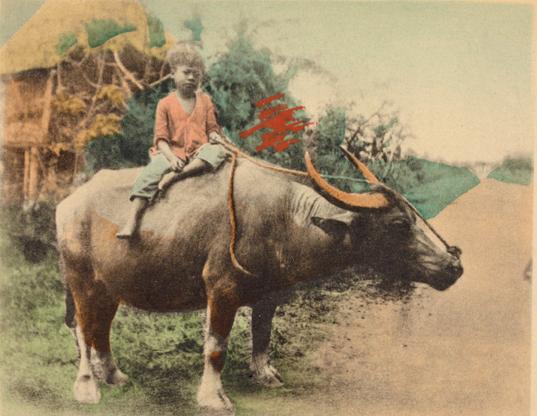
Here comes a herd of buffaloes returning from the swamp a mile away. What huge, shaggy, fierce-looking creatures they are, with their wild eyes, tossing manes, and great, spreading, sharp-pointed horns! Yet the watcher of the buffaloes is not a man, nor even a youth; he is a tiny, dark-skinned, naked little boy, barely seven years old. But he sits on the leading buffalo as proudly as a king on his throne, and screams orders in his small shrill voice, and thwacks his huge charges with a stick, and is obeyed as promptly as possible. Upon gaining the village street the herd breaks up, and every buffalo seeks the shed of its master. To-morrow morning they will reassemble, and the child will take them to the swamp again to feed.
It is his father's buffalo on which the boy is riding, and as he reaches his own door, his mother comes out to welcome him. The child at once begins to relate the happenings of the day. There was a big tiger in the swamp; the boy saw him two or three times, and saw his footmarks many times, as the great savage beast circled about the herd, hoping to cut off a straggler and kill it, and drag it off for food.
The mother listens with interest, but without fear for the child's safety. The tiger might be the biggest and fiercest of his kind, but the boy, amid his buffaloes, was as safe as in his own home. On such an occasion as this the intelligence of the big shaggy beasts is wonderful. No sooner do they scent a tiger than they draw together and face him, with the tiny herdsman in their midst. The tiger will never charge them. He knows better. Those long sharp horns, those stamping hoofs, would soon make short work of him. A single buffalo will make a splendid stand against a tiger, and a number would kill him easily. The tiger's chance is to catch one unawares, and spring upon it, and deal a fatal blow before it can face round and get its terrible horns to work.
Next come the cows and goats from the pastures near at hand, and the women are soon busy milking and fastening them up in the sheds for the night. The men arrive at all times, some early and some late, for the latter have perhaps walked three or four miles home from distant fields. After supper comes the leisure hour of the day. The villagers meet to chat, and smoke, and chew betel-nuts, and a favourite place is near the well in the shade of a great tamarind-tree.
Here the gossip of the village passes, and the crops and the weather are discussed as countrymen discuss them everywhere. Perhaps among the company may be the village poet, or a wandering poet who passes from hamlet to hamlet, singing songs and begging. As a rule, the poet is a very poor man, and earns a great portion of his living by writing a poem in praise of a wealthy neighbour, who is then expected to make him a present. When the villagers are at leisure he amuses them with songs and stories, or, if they are in a serious mood, he recites and explains to them portions of the great Indian classics, such as the Mahabharata. The villagers sit down to listen to him after supper, and often half the night will pass while he recites and expounds portions of a great poem, and his audience listens with the greatest attention.
At seasons of the year when work does not press, this nightly session may be continued for several months, and at the end of the period each listener pays a small sum to the poet, or gives him a present of food or grain, or new clothes or an ornament.
The poet has a wonderful memory, which is stored with songs, stories, poems, anecdotes, and proverbs, so that he can meet every occasion of life with some fitting verses or tale, and can suit every audience with a poem or a story adapted to their understanding. On this evening the village poet is with the company under the tamarind-tree, and he is amusing them with this story:
Once upon a time there was a jackal, who lived in a hole under a rock at the foot of a great mountain, where many great and powerful wild animals were to be found. Of all these animals the jackal was the poorest and meanest, and he had such great difficulty in finding food that his bones stood out through his hide. Yet, as we shall see, he found means to feed upon the grandest and most majestic of his neighbours. One day he saw a splendid elephant browsing on the shrubs of the valley, and he thought how fine it would be to feed upon the flesh of such a magnificent animal. So he ran to the elephant and bent low before him, and humbly begged him to listen for one moment.
"What have you to say?" asked the elephant.
"I wish to tell my lord the elephant," replied the jackal, "that I believe him to be the chief in all this country for beauty, and strength, and valour. Yet in the jungle at the foot of the valley there is an elephant who dares to speak in the most disrespectful manner of you and of your noble family."
"I will seek him out," said the elephant, "and teach him a lesson that he will not speedily forget." So he set off with slow and stately step towards the jungle.
But the jackal ran on ahead, slipping unseen through the bushes, and made his way to the elephant of the jungle. To him he told a similar story, and when the two elephants met they engaged at once in a terrible battle, and in the end the first elephant was killed. The jackal had watched the fight from the jungle, and as soon as the winner went away he rushed to the place and began with great delight to feed upon the fallen elephant. He ate and ate until he had made his way into the elephant's stomach, where he still went on eating.
Now, it was the hottest time of the year, and the elephant's body shrank in the great heat, and the opening into the stomach shrank also. Thus, when the jackal had eaten his fill, he could not get out, for the opening was smaller, and he had swollen himself with food. So he began to cry for help.
It happened that the great god Siva and his wife were passing that way, and they were very greatly astonished to hear a voice coming from the body of a dead elephant.
"There is some wonderful spirit shut up there," said Siva, and he approached the body, and called upon the spirit to reveal itself to him.
"I cannot," replied the voice, "unless you first send for the god Indra, the god of rain." In order to please the strange being, Siva sent for the god Indra, and with Indra came pouring rain and driving wind. Many other gods and goddesses came as well upon hearing of this remarkable being shut up in the body of a dead elephant. The rain soaked the dead body and swelled it, until the opening was as wide as it had been before. But when, instead of a wonderful spirit, only a mean jackal crept from the body of the elephant, then Siva and his friends laughed till they made the skies ring, and went to their own world greatly delighted with the joke.
The villagers, too, laugh with equal delight at the story of the cunning jackal, and then the meeting breaks up, and the men go home to bed. As they pass down the street they hear the cry of several jackals prowling round the village in search of food—a long, whining cry, which is answered by the yelps of the pariah dogs. These are miserable curs which belong to no man in particular, but slink about the village, mangy, half-starved and miserable, devouring every morsel of rubbish which is eatable, and so aiding the scavenger in his labours. Soon the last door is shut, the last dim light put out, and the pariah dogs have the village streets to themselves, and they scour hither and thither in search of garbage, and fight and snarl over any scrap of offal which falls in their way.
Finnemore, John. Home Life in India. A. & C. Black, 1917.
About TOTA
TOTA.world provides cultural information and sharing across the world to help you explore your Family’s Cultural History and create deep connections with the lives and cultures of your ancestors.