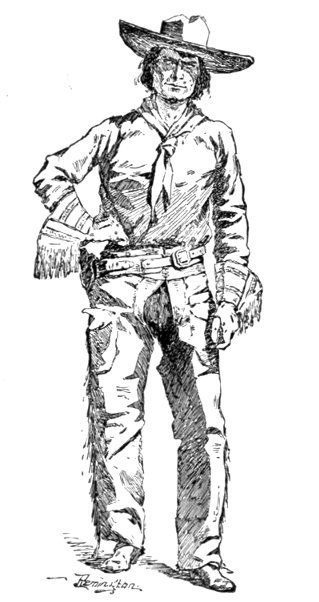

The Cowboy
The cowboys, who have supplanted the old hunters and trappers as the typical men of the plains, themselves lead lives that are almost as full of hardship and adventure.

Note: This article has been excerpted from a larger work in the public domain and shared here due to its historical value. It may contain outdated ideas and language that do not reflect TOTA’s opinions and beliefs.
“A Texan Cowboy.” Frederic Remington, 1899, images from text.
Frontier Types: The Cowboy, from Ranch Life and the Hunting-trail by Theodore Roosevelt, 1899.
The cowboys, who have supplanted the old hunters and trappers as the typical men of the plains, themselves lead lives that are almost as full of hardship and adventure. The unbearable cold of winter sometimes makes the small outlying camps fairly uninhabitable if fuel runs short; and if the line riders are caught in a blizzard while making their way to the home ranch, they are lucky if they get off with nothing worse than frozen feet and faces.
They are, in the main, hard-working, faithful fellows, but of course are frequently obliged to get into scrapes through no fault of their own. Once, while out on a wagon trip, I got caught while camped by a spring on the prairie, through my horses all straying. A few miles off was the camp of two cowboys, who were riding the line for a great Southern cow-outfit. I did not even know their names, but happening to pass by them I told of my loss, and the day after they turned up with the missing horses, which they had been hunting for twenty-four hours.
All I could do in return was to give them some reading matter—something for which the men in these lonely camps are always grateful. Afterwards I spent a day or two with my new friends, and we became quite intimate. They were Texans. Both were quiet, clean-cut, pleasant-spoken young fellows, who did not even swear, except under great provocation,—and there can be no greater provocation than is given by a "mean" horse or a refractory steer. Yet, to my surprise, I found that they were, in a certain sense, fugitives from justice.
They were complaining of the extreme severity of the winter weather, and mentioned their longing to go back to the South. The reason they could not was that the summer before they had taken part in a small civil war in one of the wilder counties of New Mexico. It had originated in a quarrel between two great ranches over their respective water rights and range rights,—a quarrel of a kind rife among pastoral peoples since the days when the herdsmen of Lot and Abraham strove together for the grazing lands round the mouth of the Jordan. There were collisions between bands of armed cowboys, the cattle were harried from the springs, outlying camps were burned down, and the sons of the rival owners fought each other to the death with bowie-knife and revolver when they met at the drinking-booths of the squalid towns.
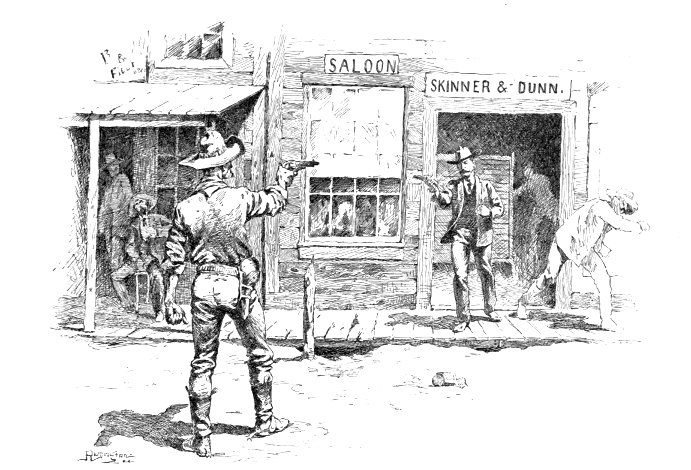
“A Fight in the Street.” Frederic Remington, 1899.
Soon the smoldering jealousy which is ever existent between the Americans and Mexicans of the frontier was aroused, and when the original cause of quarrel was adjusted, a fierce race struggle took its place. It was soon quelled by the arrival of a strong sheriff's posse and the threat of interference by the regular troops, but not until after a couple of affrays, each attended with bloodshed. In one of these the American cowboys of a certain range, after a brisk fight, drove out the Mexican vaqueros from among them. In the other, to avenge the murder of one of their number, the cowboys gathered from the country round about and fairly stormed the ''Greaser" (that is, Mexican) village where the murder had been committed, killing four of the inhabitants.
My two friends had borne a part in this last affair. They were careful to give a rather cloudy account of the details, but I gathered that one of them was "wanted" as a participant, and the other as a witness.
However, they were both good fellows, and probably their conduct was justifiable, at least according to the rather fitful lights of the border. Sitting up late with them, around the sputtering fire, they became quite confidential. At first our conversation touched only the usual monotonous round of subjects worn threadbare in every cow-camp. A bunch of steers had been seen traveling over the scoria buttes to the head of Elk Creek; they were mostly Texan doughgies (a name I have never seen written; it applies to young immigrant cattle), but there were some of the Hash-Knife four-year-olds among them.
A stray horse with a blurred brand on the left hip had just joined the bunch of saddle-ponies. The red F. V. cow, one of whose legs had been badly bitten by a wolf, had got mired down in an alkali spring, and when hauled out had charged upon her rescuer so viciously that he barely escaped. The old mule, Sawback, was getting over the effects of the rattlesnake bite. The river was going down, but the fords were still bad, and the quicksand at the Custer Trail crossing had worked along so that wagons had to be taken over opposite the blasted cottonwood. One of the men had seen a Three-Seven-B rider who had just left the Green River round-up, and who brought news that they had found some cattle on the reservation, and were now holding about twelve hundred head on the big brushy bottom below Rainy Butte.
Bronco Jim, our local flash rider, had tried to ride the big, bald-faced sorrel belonging to the Oregon horse-outfit, and had been bucked off and his face smashed in. This piece of information of course drew forth much condemnation of the unfortunate Jim's equestrian skill. It was at once agreed that he "wasn't the sure-enough bronco-buster he thought himself" and he was compared very unfavorably to various heroes of the quirt and spurs who lived in Texas and Colorado; for the best rider, like the best hunter, is invariably either dead or else a resident of some other district.
These topics having been exhausted, we discussed the rumor that the vigilantes had given notice to quit to two men who had just built a shack at the head of the Little Dry, and whose horses included a suspiciously large number of different brands, most of them blurred. Then our conversation became more personal, and they asked if I would take some letters to post for them. Of course I said yes, and two letters—evidently the product of severe manual labor—were produced. Each was directed to a girl; and my companions, now very friendly, told me that they both had sweethearts, and for the next hour I listened to a full account of their charms and virtues.
But it is not often that plainsmen talk so freely. They are rather reserved, especially to strangers; and are certain to look with dislike on any man who, when they first meet him, talks a great deal. It is always a good plan, if visiting a strange camp or ranch, to be as silent as possible.
Another time, at a ranch not far from my own, I found among the cowboys gathered for the round-up two Bible-reading Methodists. They were as strait-laced as any of their kind, but did not obtrude their opinions on any one else, and were first-class workers, so that they had no trouble with the other men. Associated with them were two or three blear-eyed, slit-mouthed ruffians, who were as loose of tongue as of life.
Generally some form of stable government is provided for the counties as soon as their population has become at all fixed, the frontiersmen showing their national aptitude for organization. Then lawlessness is put down pretty effectively. For example, as soon as we organized the government of Medora—an excessively unattractive little hamlet, the county seat of our huge, scantily settled county—we elected some good officers, built a log jail, prohibited all shooting in the streets, and enforced the prohibition, etc., etc.
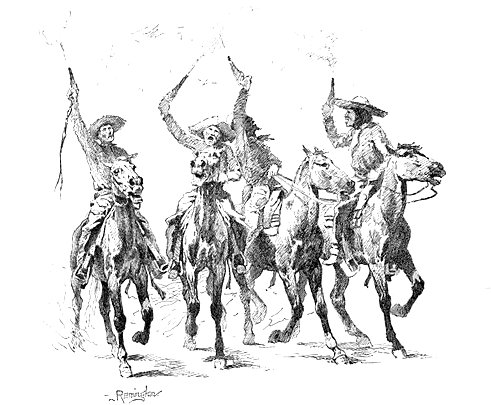
“Painting the Town Red.” Frederic Remington, 1899.
Up to that time there had been a good deal of lawlessness of one kind or another, only checked by an occasional piece of individual retribution or by a sporadic outburst of vigilance committee work. In such a society the desperadoes of every grade flourish. Many are merely ordinary rogues and swindlers, who rob and cheat on occasion, but are dangerous only when led by some villain of real intellectual power.
The gambler, with hawk eyes and lissome fingers, is scarcely classed as a criminal; indeed, he may be a very public-spirited citizen. But as his trade is so often plied in saloons, and as even if, as sometimes happens, he does not cheat, many of his opponents are certain to attempt to do so, he is of necessity obliged to be skillful and ready with his weapon, and gambling rows are very common. Cowboys lose much of their money to gamblers; it is with them hard come and light go, for they exchange the wages of six months' grinding toil and lonely peril for three days' whooping carousal, spending their money on poisonous whisky or losing it over greasy cards in the vile dance-houses.
As already explained, they are in the main good men; and the disturbance they cause in a town is done from sheer rough light-heartedness. They shoot off boot-heels or tall hats occasionally, or make some obnoxious butt "dance" by shooting round his feet; but they rarely meddle in this way with men who have not themselves played the fool. A fight in the streets is almost always a duel between two men who bear each other malice; it is only in a general melee in a saloon that outsiders often get hurt, and then it is their own fault, for they have no business to be there.
One evening at Medora a cowboy spurred his horse up the steps of a rickety "hotel " piazza into the bar-room, where he began firing at the clock, the decanters, etc., the bartender meanwhile taking one shot at him, which missed. When he had emptied his revolver he threw down a roll of bank-notes on the counter, to pay for the damage he had done, and galloped his horse out through the door, disappearing in the darkness with loud yells to a rattling accompaniment of pistol shots interchanged between himself and some passer-by who apparently began firing out of pure desire to enter into the spirit of the occasion,—for it was the night of the Fourth of July, and all the country round about had come into town for a spree.
All this is mere horse-play; it is the cowboy's method of "painting the town red," as an interlude in his harsh, monotonous life. Of course there are plenty of hard characters among cowboys, but no more than among lumbermen and the like; only the cowboys are so ready with their weapons that a bully in one of their camps is apt to be a murderer instead of merely a bruiser. Often, moreover, on a long trail, or in a far-off camp, where the men are for many months alone, feuds spring up that are in the end sure to be slaked in blood.
As a rule, however, cowboys who become desperadoes soon perforce drop their original business, and are no longer employed on ranches, unless in counties or territories where there is very little heed paid to the law, and where, in consequence, a cattle-owner needs a certain number of hired bravos. Until within two or three years this was the case in parts of Arizona and New Mexico, where land claims were "jumped" and cattle stolen all the while, one effect being to insure high wages to every individual who combined murderous proclivities with skill in the use of the six-shooter.
Roosevelt, Theodore. Ranch Life and the Hunting-Trail. The Century Co., 1899.
About TOTA
TOTA.world provides cultural information and sharing across the world to help you explore your Family’s Cultural History and create deep connections with the lives and cultures of your ancestors.