
Immigrating from London to Canada, Pt. 1: Quebec
A letter from a young immigrant traveling west through Canada from the United Kingdom, 1911.

Note: This article has been excerpted from a larger work in the public domain and shared here due to its historical value. It may contain outdated ideas and language that do not reflect TOTA’s opinions and beliefs.
Letter No. 1
Quebec,
April 13, 1911,
My Dear Mother,
We reached here safely at 8 o'clock this morning, and I have an hour left, it is now 2 o'clock in the afternoon, in which to write you a letter about our voyage, and what I have seen of Quebec. I hope you got the postcard I posted at Moville. I am afraid it was not very cheerful, but all the emigrants saying “good-bye" to their friends at Liverpool just when we started made me feel rather queer, and I never knew how much I loved home and England and mother till I stood on deck seeing the old land grow dimmer and dimmer in the distance.
Neither were many of us very cheerful for a day or two on the open sea. The sailors said we were having a good time, but I thought it was quite stormy; and we left a good deal behind besides the old country. On the third morning, however, I felt quite well, but very thin and hungry; and after that I really enjoyed the voyage very much. I was very glad that I came second cabin instead of steerage, for if it did cost eight pounds instead of five, it was more than worth the difference between the two. There were several hundred foreign steerage passengers, Galicians, I think they called them, some kind of Austrians or Poles anyway; and though these were kept mostly separate from the English, still they were pretty close neighbours, and rather wild and strange-looking, and smelling.
We second cabin had more freedom on deck, besides having good big rooms for smoking and music the smoking room was always full; the music room was very comfortable, and lots of singing, and some very good singers and players amongst us. We had really first-class concerts on two nights, at which collections were taken up for some homes for sailors' widows and orphans. I sang “Under the old Apple-tree," and everybody joined in the chorus all very free-and-easy and jolly. After we left Ireland the sailors opened the hatches into the hold, and four “stowaways" crawled out just like a B.O.P.'s story.
They were Liverpool street boys, who had hidden away to steal a passage to Canada. They got a good "going over" from the captain, but they were not unkindly treated; but they had to do what work they could, to make up for their passage, and they were set to keep the decks clear of all rubbish and litter. If any one dropped orange peel or bits of paper on deck, it was their job to pick them up and keep everywhere tidy.
On the Sunday we were at sea we had church in the first-class saloon first and second-class passengers together. There was no clergyman on board, so the captain read the service and a short sermon in a straightforward sailor sort of way, and the singing was splendid old hymns, old tunes and everybody sang. One of the steerage fellows told me that a Salvation Army chap took a service with them he said it was rather "rummy" after the parish church at his village at home, but very earnest and hearty, and a great deal better than no Sunday service at all.
The food on board was very good, and plenty of it. The three regular meals and some bread and cheese for supper, if you wanted it. I always did after those three blank days at first.
For breakfast we had porridge, fish, bacon, and marmalade or jam; for dinner, soup, fish, meat, pudding and bread and cheese, and a good English tea, so we did not do at all badly. There was great excitement this morning when we woke up to find we were in the St. Lawrence, and everybody was on deck to catch the first sight of Quebec. The old city looked very beautiful in the morning sun as we slowly steamed up the river, and one of the stewards showed me "Wolfe's Cove," where General Wolfe landed before the battle, and the Heights of Abraham. There is a large house with beautiful trees and lawns near Wolfe's Cove, where the Lieutenant-Governor of the province of Quebec lives.
I have been very busy since we landed, going about with one of the other fellows to see as much as we could before we started again for Montreal.
We got on an electric street car, quite close to the landing-place down in this part of the city the streets were very narrow and old-fashioned sometimes only just wide enough for the carts and carriages to let the cars go by. After going some distance, however, the street widened, and we went up quite a steep hill that brought us to the Upper Town, where there were plenty of very good shops and fine buildings. We got off the car here and walked about to see the sights.
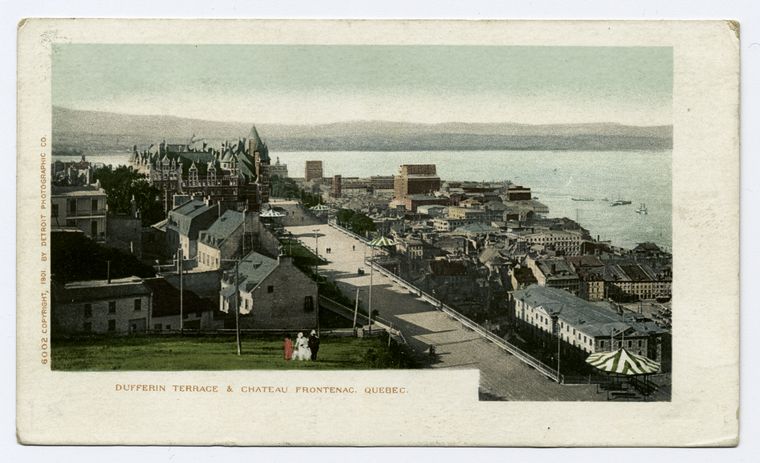
The finest sight of all was the Chateau Frontenac, it looks like a beautiful castle standing high on the cliff overlooking the river, but really it is a huge hotel belonging to the Canadian Pacific Railway. There is a terrace walk all along the front of the chateau, and from this you can see a long way down the river, while if you look straight down over the railings you see the roofs of the houses in the Lower Town.
From the "Chateau" we went to the Church of England Cathedral. It is not a bit like what we call a cathedral at home just an ordinary, old-fashioned church, but it made me think of home. There were a good many marble tablets on the walls, and some of them were in memory of English officers who died out here, fighting in the old wars. After leaving the cathedral we asked the way to Wolfe's monument, and were told to take the electric street car that went close by the cathedral gates. The car took us down a very fine street, with handsome houses and some big buildings just as good as we have in a large town at home; but I was rather disappointed when we came to the Heights of Abraham. It was only a biggish, flat-looking field, with some trees in it. The monument was all right not very big, very plain, and a very simple, inscription, just "Here fell Wolfe victorious" and the date. That single word "victorious" is fine, it tells the whole story.
From the "Heights" we took the car back to the Lower Town, where we have just had a very decent dinner for a shilling, and in a few minutes we shall be on board again and on our way to Montreal. You must not expect another long letter till we get to Winnipeg, just a picture post-card, perhaps, posted on the train. I am sending you one or two photos of Quebec. After I get settled in Manitoba I shall be able to send you lots of my own taking, with the camera Uncle Jack gave me.
The chap that is with me does not like Quebec, he says it is not his idea of a British colony, it looks foreign, the houses are French, the people are French, and they talk French; but I tell him he need not mind, it is the old flag that waves on the citadel, and that is enough for me. Now good-bye, mother, dear.
Your loving son,
Tom Lester.
Gill, Edward, editor. A Manitoba Chore Boy; The Experiences of a Young Emigrant Told From His Letters. Religious Tract Society, 1912.
About TOTA
TOTA.world provides cultural information and sharing across the world to help you explore your Family’s Cultural History and create deep connections with the lives and cultures of your ancestors.