Log of the "Nautilus" part 1
Two brothers sail across the Atlantic Ocean aboard a 19 foot sailboat in 1878.
From: 1878 C.E. To: 1878 C.E.

Note: This article has been excerpted from a larger work in the public domain and shared here due to its historical value. It may contain outdated ideas and language that do not reflect TOTA’s opinions and beliefs.
“Log of the ‘Nautilus.’" from A Daring Voyage Across the Atlantic Ocean, by William Andrews and James Maculay, 1880
Friday, June 7th, 1878. — Left Captain Coyne's Wharf, City Point, South Boston, Massachusetts, for Havre, France, at three o'clock this p.m., amid an enthusiastic send-off. When off Long Island wind shifted to east. Was advised to go to Beverly, and take the next fair wind from there; so we parted company of friends. But the wind soon came round to S.W., and we bore away on our course. Yacht " Violet" spoke us off Boston Light, bidding us "God speed."
Soon after tug-boat "Camilla" overhauled and spoke us. Soon left Minots Light out of sight, and shortly after sighted Highland Light, Cape Cod. The wind blowing a gale, the top of our binnacle came off, and went overboard. Shortly our white light lantern, our only light except the binnacle, went out by the pitching of the boat. Shortly after, the globe cracked and the side fell out. Soon our small binnacle light burnt out dry, leaving us in total darkness. Walter had to turn out and fill it in the dark as best he could, our little craft pitching heavily. Shortly after something very serious happened, and then we concluded to return and repair damages, to make our berth a little more convenient, and get more substantial lights. When we put about, Highland Light bore S.W., distant about twelve miles, and was visible at daylight; also the Highlands. We saw a shoal of whales this morning off Cape Cod, spouting and playing around us, also some porpoises.
Saturday, June 8th. — Wind S.W. Sighted Minots Lighthouse, and bore away for Beverly. Took observation as best I could with cloudy sky and bad horizon; four miles E. of Boston Lighthouse, and made my latitude 42.20 N. I did not try to get longitude. Arrived in Beverly at 4 p.m. After fixing toilet and eating a few baked beans, left there at 5.48 for Boston. Arrived home at 8.30 p.m., creating considerable excitement, my wife asking where was Walter, &c. I felt terribly mortified at losing such a good chance to get off the coast, and wondered how folks would talk about our returning, &c. But let them wonder; we know ourselves what we are doing. Every small boat has put in somewhere before leaving the land for good.
I felt terribly stiff and sore all over, and went right to bed to get rested; did not want to see anybody. But I did allow my old friend Abbott an interview. Of course the remark was made that the old saying of sailing on Friday worked true enough, in our case any way. It commenced to rain at 4 p.m., and drizzled all night. Made up my mind that it was all for the best.
Sunday, June 9th. — The arrival of the "Nautilus" at Beverly was announced in the Beverly "Herald." There was a wrong statement in regard to our compass, it saying the needle broke, which was not the case. Wind N.; rainy at intervals.
Monday, June 10th. — Wind N.E. Rainy at intervals.
Tuesday, June 11th. — Wind N.E. Crowds flock from far and near to see the "Nautilus," the little beauty, as she lies moored in the dock.
Wednesday, June 12th. — WindS.W. Took our departure from Beverly. Wind changed to S.E. Course E. by S. Had a good escort of Beverly friends as far as Baker's Island.
Got poor observation, latitude 42.33 N. wind E., then N.E., then S.E.; the wind very light; course various. Spoke "Lapstreak" boat, Captain Warren Jaquith. He told us not to carry sail too long on the "Nautilus." Thunder and lightning with some rain at 8 p.m. Calm from 9 p.m. till daylight. Lost sight of Thatcher's Island Light at 2 a.m. Run about thirty miles.
Thursday, June 13th.—Light westerly winds. Several sails in sight. Coffee for breakfast. Saw one whale and few porpoises. Got observation, latitude 42.14 N. Plenty of mackerel and mackerel sharks. Becalmed almost all day and all night. We have drifted nearly twenty miles off our course to the southward and eastward, making a run of about thirty miles.
Friday, June 14th.—Foggy and calm. Fog lifted at 11 a.m. Saw three sails in sight. Got out our oars and started a fine white ash breeze, and spoke one of them, the British schooner " Jennie T. Hibbard," Captain W. H. Dean, latitude 42.22 N., longitude 69.37 W. Being no wind the captain prevailed on us to come on board and get some dinner and recreation. It seems as though we had been out a week on the voyage. At 5 p.m., a light wind springing up, we left him, wishing us good luck, &c. Wind increased, and blew good breeze all night. The "Nautilus" behaved splendidly; course E. by S. half S.; wind S.E.; changed to S.W. Run fifty-five miles. Fog came on at 10 p.m., and remained all night.
Saturday, June 15th. — Morning foggy and cold; wind S.W. During a gleam of the fog saw a schooner. She saw us and ran down and spoke us. Proved to be the "Commonwealth," of Gloucester, a mackerel-catcher, 117 miles from Thatcher's Island. Got observation, latitude 42.17 N. Soon set in foggy. Passed many logs, planks, &c. Blew fog-horn occasionally; sometimes with response. Night very foggy. This keeping your eyes on the compass and watching for lights, blowing fog-horn, wet and cold without relief, watching the seas as they follow you, thinking now and again that you may hear a log come crashing through your half-inch cedar, is a novelty not to be desired long. We passed to the northwards, of "George's Stormy Banks" in the night. Course E. by S. half S. Run 100 miles.
Sunday, June 16th. — Walter made some royal coffee for breakfast. Wind S.W. by S. Had a good wash. Saw a ship and schooner to the southward. Sun out and fog disappearing. Feel better. Got observation, lat. 42.21 N. While getting observation was surrounded by shoal of porpoises, some striking the "Nautilus" with their tails. Two sails ahead. Passed Cunard steamer, distance one mile; at same time spoke fishing schooner "Triumph," of North Haven, Maine. Got a pair of mittens from her; gave them a corned shoulder " that we got from schooner, ‘J. T. Hibbard' to grease our foretack with." Passed Brown's Bank. Big tide rips. Saw some very small birds resting on the water ; saw one that could not fly; tried to catch him, but he dived under the "Nautilus." Moon rose awfully red. Passed a barque bound to the westward. Course E.S.E. Run sixty-five miles.
Monday, June 17th. — Sun rose very red; wind S.W., light. Latitude by observation 42.13 N. Course E. by S. half S. Saw no sails to-day. Saw one shark ahead and tried to run over him. Wind shifted to N.E. this evening; signs of a storm. " Beware of Sable Island." Thick fog set in. This is one of the luxuries in this part of "the Big Drink." Run about sixty-five miles.
Tuesday, June 18th. — Rainy and foggy. Wind S.E. No coffee to-day; no sails either. We are "monarchs of all we survey." "What are the wild waves saying, dear sister?" One wave broke clean over our little "Nautilus," but did not wet our bed, as Walter was in there, and the lid shut down. The sun came out for a few moments at about noon; tried to get observation, but it was imperfect. Latitude 42.14 N.; run fifty-five miles; wind shifted in the evening to S., then S.W. Cleared off and came on thick again. And it was so dark—oh! how dark!—you could not distinguish the water from the mist.
Wednesday, June 19th.—Wind S.W.; bids fair to-day. "Coffee and sardines for two." Had a wash for a change. I saw a big smoke, and made for it; they saw us, and changed their course accordingly. She proved to be the White Star steamer "Adriatic," lat. 42.35 N., long. 59.20 W. Some one wanted to know if there were any more Yankees left over there. The purser wished to know if we wanted any fresh cooked stuff. Answered in the negative. She was from Liverpool, England, to New York. Could not hear anything scarcely for noise of steam blowing off. They gave us three rousing cheers, which we heartily reciprocated; and as we bore away for Havre they cautioned us to beware of the propeller.
They had read of us in the English papers, the departure from Boston having been telegraphed. This made us feel " better than turkey and plum-pudding." More than 440 miles from home, saw another sail ahead; did not want to speak her. One was enough for to-day. She passed to windward of us. Got observation, lat. 42.30. Passed another ship, bound N.W. Wind S. and S.W. At 7.30 p.m. sighted another steamer. Run sixty miles.
Thursday, June 20th.—Wind S. and S.W., variable. A very heavy sea commenced running at 3 a.m.; had to reef, and shortly after to heave to. About 12 noon resumed our trip. Passed one of our namesakes, a nautilus, a fine specimen nine inches long. Passed two ships to leeward. About 2 a.m. heard horns blowing; saw green light, and spoke fine ship "Henrietta," from Newport to St. John's, New Brunswick. Blowing strong, and seas heavy. Could not say or talk much, it was so rough; I do not think they saw anything but our light, for the captain wanted to know what schooner this was. We ex- plained a little, and I know he was relieved, when he said he would report us. Wind N.E., course E. by S. Tried our square sail to-day; did not amount to much, for it would not give us steerage-way. Run fifty miles.
We are in the gulf stream, and it must be a good degree to the northward of where it is laid down on the chart.
Saturday, June 21st. — Wind E. and N.E. Strong heavy sea running. Had to heave to and put out the drogue. Soon took in the drogue and tried to run double-reefed. Could not. Tried our square sail, gave it up, and tried the drogue again. It looked like a storm in winter. The water was very bad from 3 p.m. till 2 a.m., 22nd. I don't want to see anything any worse while in the "Nautilus." Rain, fog, wind, and cold. No warm grub. I don't think I ever saw such seas before, nearly all of them breaking. We had to put all of our cable on to the drogue, unship the rudder, make everything snug. The waves were "mountains," truly. Run and course very doubtful.
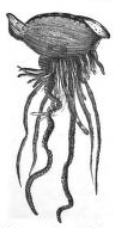
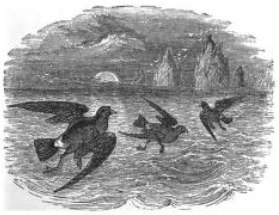
Saturday, June 22nd.—Lat. 42.53 N., long. 56.55 W. Just passed a "Portuguese man- of-war." Wind N.E. Came on foggy shortly after sunrise; cleared up about 11 a.m. Very pleasant now. Picked up a bottle half-full of some sort of poor rum. Sunset very yellow, betokening plenty of wind to-morrow. The sea is bad enough now. Saw some skipjacks and stormy petrel. The plot thickens. Course S.E. Fog came on, but cleared soon after. Wind E. and E. by N. More nautili; water rough and head beat sea.
At 4 a.m , 23rd, Walter sighted green light ahead; gave one blast of fog-horn to let them know that we were on the starboard tack; proved to be a ship; showed our light, then put it out of sight and ran down to speak them; but the moment we doused the "glim" (our light) they turned and ran before it, and we after them, for a mile or so, but finding a stern chase a long one, we gave it up and let them go; so I blew my fog-horn and whistle alternately for a minute, and resumed our course as best we could on an E.S.E. wind.
Shortly after they hove to till daylight. Whether they knew what we were or not I can't tell, but it is my impression that they must have taken us for the Flying Dutchman, and they did not want any of our correspondence. We are getting to be a terror in these waters; five days now banging around, hove to, and otherwise of no advantage to ourselves or any one else. Run and course under the circumstances very doubtful.
Sunday, June 23rd. — Wind N.E. and E. and S.E., all easterly. Lat. 42.50. No longitude for me; foggy and discouraging enough. Got a rap on the head with the club of the sail, which nearly stunned me.
Coffee for breakfeast; tomatoes and ham for dinner. At 5 p.m. sighted a ship, and as the wind was E. by S., and we could not lie our course, we waited for him to come up. Proved to be the ship "Tyro," of Yarmouth, N.S., Captain Raymond, long. 55.20 W. Wanted to know if we wanted him to take us off. Told him we guessed not. There were some lady passengers on board; they cheered us heartily. Said his barometer indicated easterly winds; said he would report us. Shortly after concluded that it would not pay for wear and tear, so we hove to at drogue, and remained all night. We are on the edge of the gulf stream. Run and course of ho consequence.
Monday, June 24th. — Wind S.E. and very high. Rough sea. Still at the drogue. Saw steamship bound to the eastward and two ships to westward. A terrible high combing sea running. Threw some oil to see what it was good for; found that the smell of the cod-liver oil was about as disagreeable as the clean water breaking over us. The smell summoned all the Mother Carey's chickens, hagdens, marble-headers, and other sea-birds, from far and near to us. What scent they have, and such a hurrah as they set up ! Also a grampus came puffing along, and they were all disgusted, for they found only a "big cry and little wool." We are drifting to the N.W. Somehow or other, I can't keep Sable Island out of my mind, and I often stand up and look to leeward for it while at the drogue; also for sails.
Tuesday, June 25th. — Wind S.S.W. Bad sea running. Threw more oil. Don't mind the smell so much now, as the situation is becoming a little more interesting. Ah! can it be possible? Yes, it is true—the wind is moderating. We hauled the drogue in at 2 p.m., and started from this miserable place.
Course S.E. by E. This is wild sailing. Oh, how I wish some of my chums could see old Bill now! Oh, that this scene could only be photographed on paper as it ever will be in my mind!
Came on foggy later in day. At dusk heard steam whistle. Blew our horn, showed our light, and saw a steamship coming head on. I gave the "Nautilus" a little starboard helm, and we passed within a few yards of her. I waved my hat; they cheered as they passed.
I heard some one ask if they could do anything for us. I asked what steamer that was, and heard some one say "New York," and they were lost to view in the fog and dusk. I saw New York in letters on the starboard side of her round stern. She was travelling like the wind, and if she struck a vessel she would strike them hard. Well, I guess they knew their business. A Mother Carey's chicken flew into our sail, and was stunned and fell nearly dead into my lap. Oh, how I pitied the poor, quivering, fluttering visitor! I took it as a good omen, though, and, as it recovered (for all sea-birds cannot rise from any hard substance) I placed it out on the raging water again, and had the satisfaction of seeing it fly away in the darkness. Rain ! Oh, how it rained! and how we flew! Sailed 200 miles these twenty-four hours.
Wednesday, June 26th. — Wind S. W. Passed near to a large barque, painted green, bound to the W. Have since learnt from a lady passenger who saw us that it was a Russian barque, and was lost soon after, all hands taking to a raft. They were bothered by whales, and wondered if the whales bothered us. Oh, how it rained this p.m. I think we drove the "Nautilus" twenty miles in two hours. Cleared off this evening. No observation to-day, or lately; it has been so rough and foggy. Passed a ship bound W. in the night ; also a shoal of whales that were puffing, blustering, and "playing engine." Course S.E. by E. An old hagden sea-bird saw us, and thought he had made a discovery. He came up and whirled round us several times, but as we did not pan out well for him he left.
Position doubtful.
Thursday, June 27th. — A heavy swell on this morning, but the first fine day for quite a spell. All that we have in the shape of clothes and bedding and everything else that is not; air-tight are completely wet through. Stewed beans for breakfast. Course S.E. by E.; wind S.W. At night a shoal of whales kind of made us feel uncomfortable. You could touch some of them with your hand. Their blowing was terrific.
I was turned in, and Walter called me. I got all ready to jump out of bed pretty quick. Feeling tired and sick, I lay down again, telling Walter if he saw any coming head on with their mouths open to call me. It was so dark you could not see twenty feet on the water. Some rubbed the boat with their sides. I think our light attracted them. There was but little wind, so we kept quiet, and believed in the old adage, that if you let them alone they will let you alone. I told Walter to put the light out of sight, which he did, but it made no difference. Shortly after I took the helm, and a breeze springing up, they departed, to our extreme pleasure. Early this morning a large steamer passed quite handy to us, but as they could not see us, kept right along. We wished that we had been a little farther that way. Feel better this morning, 28th. Calm, with little puffs from all quarters. Heavy swell running.
Friday, June 28th.—A royal breakfast —coffee with condensed milk, corned beef with "hard tack." Plenty of Mother Carey's chickens, hagdens, and marble-headers. Thick overhead. Had a good wash, and we are waiting for something to turn up. Walter has turned in for a short rest. Now he turns out we wedge our mast, make sail, and he turns in again. Got observation, though it was a hard job, 42.29 N., longitude, dead reckoning, 53.10 W. Passed between two ships, one going E. and the other W. This is the first one we have seen going E. Some whales. We did not show any light last night, just for fun.
Saturday, June 29th. — This morning at daybreak I felt terribly sleepy, and with the greatest difficulty I kept my post at the helm. In spite of my exertions, however, I could not refrain from a momentary drowse; yet my previous experience as a soldier on guard often reminded me to be a man, and be as vigilant to my own cause as I was to that of my country. But in spite of my exertions I must have lost consciousness, for I was suddenly startled by hearing some voice halloaing to me, and looking up I expected to see some hardy Cape Ann fisherman attending to his trawls; but I was disappointed, for all I saw was fog and a deep heavy swell on the water, but I knew by the scene before me that I was on the southern edge of the Grand Banks of Newfoundland as well as if. it had been a book with large letters, by a kind of inward instinct.
I was then reminded of my half-inch cedar boat, and about 1000 fathoms of water between me and the most magnificent garden in the world. The bottom here was well portrayed by lines by Southey in his “Kehama," xvi. 5, which strangely came to my mind by way of contrast, I suppose:—
"It was a garden still beyond all price —
Even yet it was a place of Paradise.
And here were coral-bowers,
And grots of madrepores,
And banks of sponge as soft and fair to eye
As e'er was mossy bed
Whereon the wood-nymphs lie,
With languid limbs, in summer's sultry hours.
Here too were living flowers,
Which like a bud compacted,
Their purple cups contracted,
And now in open blossom spread,
Stretch'd, like green anthers, many a seeking head,
And arborets of jointed stone were there,
And plants of fibres fine as silkworm's thread,
Yea, beautiful as mermaid's golden hair
Upon the waves dispread.
Others that like the broad banana growing,
Raised their long wrinkled leaves of purple hue,
Like streamers wide outflowing."
But I am departing from my course, and such a contrast from the bottom of the sea to the top and our real condition! Occasionally I hear the well-known quack of what the sailors call hagdens, a sea-bird familiar hereabouts. I will to my dreary log again.
Wind N.W. for the first time since we started, course E.S.E., very light winds these last twenty-four hours. Did not sail over seventy-five miles. Rain, fog. Some whales.
Two ships so far away could not speak them. Running by dead reckoning now. Feel better than I expected, but not very well anyway. These last two weeks have been very hard on an old cripple like me. We hope for a better show now that we are up to the Grand Banks. When we see a ship the fog will shut her out, so we cannot get correct longitude, as we have no chronometer, and if we did it would be hard on the chronometer.
Part 2
Andrews, William A. and James Macaulay, A Daring Voyage Across the Atlantic Ocean, E. P. Dutton and Co.,1880.
About TOTA
TOTA.world provides cultural information and sharing across the world to help you explore your Family’s Cultural History and create deep connections with the lives and cultures of your ancestors.