
Our Journey, Part 1
The first part of Christina Holmes Tillson's account of travelling out to Illinois in 1822.
From: 1821 C.E. To: 1822 C.E.

Note: This article has been excerpted from a larger work in the public domain and shared here due to its historical value. It may contain outdated ideas and language that do not reflect TOTA’s opinions and beliefs.
From A Woman’s Story of Pioneer Illinois by Christina Holmes Tillson, 1919.
In 1822 it was still a great event to undertake a journey to Illinois, and many were the direful remarks and conclusions about my going. Your grandmother dreaded my starting without any lady companion, and was much relieved to find that a Mrs. Cushman, a widow lady, whose husband had been a lawyer in Halifax, and who had but one child—a son, settled near Cincinnati—was waiting an opportunity to go and end her days with her beloved Joshua, and that your father had offered her a seat in our carriage, which offer had been accepted. Your uncle Robert was also to go. The carriage had been built at Bedford, Massachusetts, under your father's directions, expressly for the journey. Your Great-grandmother Briggs had seen the carriage pass her house, and in telling how she felt at parting with her eldest granddaughter, and the sadness it had given her to see the carriage that was to take me away, was not aware that she said "hearse" instead of carriage. It amused those who heard it, but they had too much reverence for her feelings to tell her of the mistake.
How hard it is to shake off the sadness of our young days. Partings, the breaking up of families and home attachments, have always been to me particularly painful, and the sad forebodings I was constantly hearing at that time of the fearful journey, and the dismal backwoods life which awaited me were not calculated to dispel the clouds that would sometimes come over me. I did not know then, as I realize now, that I was more ready to be influenced by fears than by hopes. My timidity through life has been my infirmity, want of self-confidence and a shrinking from notoriety marked my early life; and it is only from a sense of duty to myself and children that I have, in a measure, overcome the folly that has kept me back from many good performances.
I did not intend to enter into an investigation of my own particular temper and disposition, but found myself—before I was aware of it—doling out my shortcomings. It has been my misfortune to dwell on my own weakness.
We left my father's house at Kingston, October 6, 1822. Our carriage being somewhat such a vehicle as we would now call a two seated buggy, at that time the name buggy was not known. The seats were so made that a trunk could be fitted under each one of them, and there was room in front for a bonnet trunk that held my leghorn bonnet, and a portmanteau containing the gentlemen's change of clothing. Mrs. Cushman's trunk rode behind, and with a little bamboo basket containing my night clothes, brushes, &c., and a lunch basket, we found ourselves pretty closely packed.
We were to travel at about the rate of one hundred miles in three days, and St. Paul-like, commenced our journey coast-wise. We passed through Providence, stopping to dine with Seth Allen, who had formerly been a neighbor of your Grandfather Tillson's. I speak of this because theirs were the last faces I saw of those I had known before, and not until four years after, when your Uncle Charles arrived in Illinois, did I see any face that I had before looked upon after leaving the Allens' on my second day from home. Our course carried us along the southern, the shore line of Connecticut, passing through New Haven.
We arrived at New York in eight days. It being my first visit, I was much disappointed to find the city almost depopulated by the yellow fever. We knew before starting that the fever was prevailing to some extent; but as intelligence did not then, as now, go with lightning speed, and we had been so long on the way, the extent of the sickness was not known to us. We rode into New York in the morning, but it had a very desolate appearance. The inhabitants had closed their places of business, and the merchants had removed their goods out of what was then termed the city. The place where Union Square now is, was country, and those who were willing to risk the chances of yellow fever so near them had erected shanties and were displaying their goods. There was a large brick building where an Irishman kept a decent tavern. They were holding a political caucus the night we stopped there.
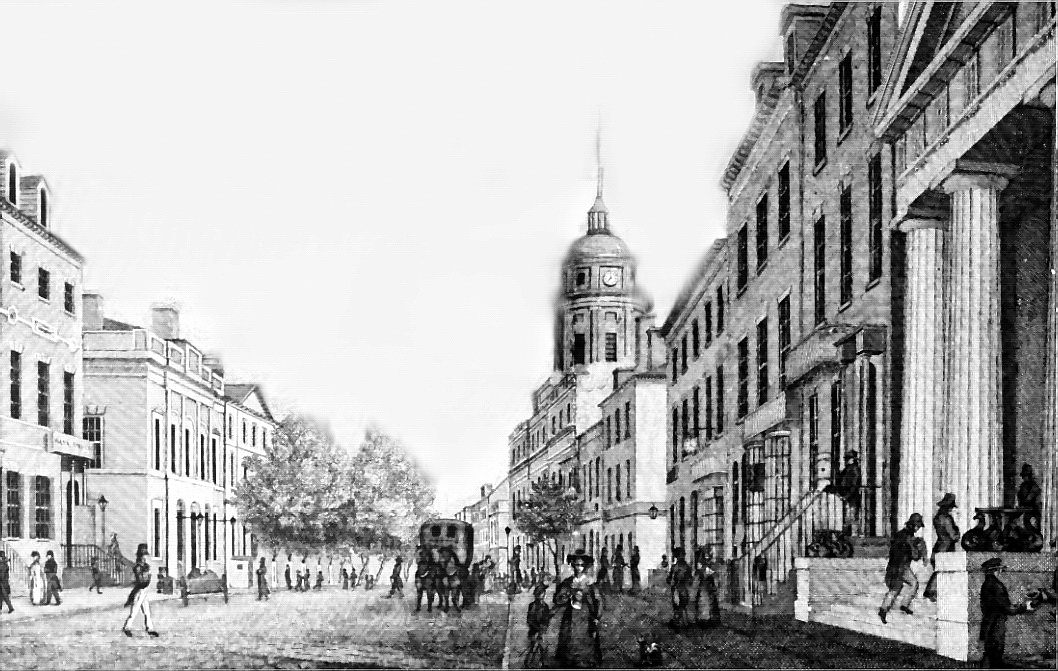
At Philadelphia we stayed a day, putting up at a Quaker boarding house. We went out and bought a white merino shawl and some winter trimmings for my large leghorn bonnet. We did not then change as often as now, having a winter, spring, summer, and fall bonnet. Those who had a nice leghorn, as was mine, changed the trimmings with the season. Those who could afford it wore ostrich feathers in the winter, while in the summer flowers were substituted. Feathers at that time were thought to be in bad taste for summer wear. I enjoyed my day in Philadelphia; also my whole journey through New Jersey and Pennsylvania. The country was very different from anything I had seen. Having been brought up on the sandy soil of the old Colony, among the pine woods, where every farmer is a poor man, and those who have farms and are rich have made themselves so by manufacture or commerce, it seemed strange to see the big Dutch barns, which in the distance we continually mistook for churches. The inhabitants also interested me. We stopped every night, and between Philadelphia and Lancaster found ourselves in houses where they could not speak a word of English, and our pantomime performances were sometimes very amusing. I can now recall some things which occurred while your father and I were trying to come to some understanding with the host and hostess. I can now see your Uncle Robert in his mulberry suit, both arms hanging straight from his shoulders, not speaking or moving himself, but good-naturedly watching the movements of the rest.
Arrived at Wheeling we stopped for breakfast, and then in a ferry boat crossed the Ohio, where I was somewhat disappointed. The river was very low at that time, and its narrow stream between two sandy shores I looked on with other eyes and other emotions than I had in store for the “beautiful Ohio.” From Wheeling we went across the country to Williamsburgh, a town twenty miles from Cincinnati, where we were to leave Mrs. Cushman with her son. I should like to describe Mrs. Cushman, but now feel like plodding my way through Ohio. After crossing the Ohio River, a new scene opened to me, and my initiation to a new country began.
From Cumberland, Pennsylvania, to Wheeling, we had traveled on the National Road, but it extended no farther, and after that we were left to make our way as best we could over such roads as Ohio at that time could offer. When we were wading through swampy, boggy bottom lands we hailed a corduroy with joy, not that corduroys were our particular fancy, but anything for a variety; and when the jostling, jolting, up and down process became unbearable, a change to a mud hole was quite soothing. We were not all the time, however, in so sad an extremity. We sometimes for hours would ride through high and dry woodlands where there had been roads surveyed and the under-growth cleared out the width of a carriage road, and every few rods we would find what they termed a blaze, which was a tree with the bark hacked off, and these served as guide boards.
At Zanesville we found the first comfortable stopping place after leaving Wheeling. We went from there to Chillicothe, where we found a good house. This place always recalls Mrs. Cushman. She found in the morning that in passing to her bedroom the night before she had come in contact with fresh paint, and had marred the appearance of her nice blue cloth traveling suit. She went to the painter, showed him her garment, and asked for some spirits of turpentine. The painter looked indifferent, and told her he had no turpentine, whereupon she grew earnest, and asked him what kind of a painter he could be, not to have spirits of turpentine, to which he gave her some rather waggish answer. She then drew his attention to the intrinsic worth of the garment, by telling him she paid so many dollars per yard in Boston, where she had had it made just before starting on her journey.
Nothing moved by her sorrows, he kept at his work, being very respectful, though looking wonderfully amused. Mrs. Cushman, finding she could accomplish nothing with the painter, resorted to mine host, who, with his wife, two or three greasy girls from the kitchen, and all the younglings of the family, were open-mouthed, listening to her sad story. A happy thought at last moved some brain of the group to go to the druggist's and obtain the desired remedy, which, after much ado and hard rubbing, finally produced the erasive effect desired, so that our friend went on her journey as well satisfied as if nothing had happened.
Mrs. Cushman was not a fault-finding woman, and with a few outbreaks like the one named excepted, made a pleasant companion, and accommodated herself to the inconveniences of such a journey better than most people would have done. She was a fine looking woman, always neat and well dressed, and had in her young days been called a beauty; was a sister of Thomas Hubbard of Hanson, the rich man of the town; had married Jotham Cushman of Halifax, an educated and handsome man, brother to Joshua Cushman of Maine. After her husband's death her house was given up and she left minus house, home, and every means of support, and entirely dependent on her brother's bounty. Her only son, Joshua, had gone to Ohio to seek his fortune; had married, and his wife had died, leaving one child. Her desire to be with her son and to take charge of his little daughter made her prefer the uncertainty of a new western home to the comfortable provision her brother had extended to her in his own family.
On inquiring for Williamsburgh, after leaving Chillicothe, we could find no one who knew of such a place. At last a shrewd backwoodsman where we spent the night told us it was only a "stake town." It had been staked out but they had not made any “improvements" yet; he reckoned they might get up some cabins in the spring. Did not know any man by the name of Cushman. There were a few families settled in the timber, near where the town was staked off; shouldn't wonder if the man might be there; seems like he had heard the name. Poor Mrs. Cushman! I hardly dared look at her. How could she bear the change? I felt sad, sad indeed. Not so with Mrs. Cushman; the thought of being so near her only child seemed to exclude every other feeling. The weariness from her long journey, the racking from the corduroy roads; and even the few remaining spots of white lead that had clung to her blue skirt, were all forgotten in the thought that in a few hours she might meet her Joshua. Such is a mother's love. A father may love his children dearly, tenderly, a husband a wife, a wife a husband, a brother a sister, a sister a brother, but none of those can comprehend a mother's love.
It was Saturday, about noon, when we arrived at the house of Mr. Jernegan; the Buckeyes called him "Johnnygins. " The family were from Nantucket. A sea-faring man had been Mr. Jernegan. He had moved to Ohio, and a pretty daughter of his had married Mr. Joshua Cushman, a handsome young Yankee. We found Mr. Cushman and child — a sweet little girl, about three years old—at Mr. Jernegan's. The family were living in a small brick building that had been put up with the intention of putting a large front to what they designed for a kitchen, but at the time of our visit it served for kitchen, dining-room, and parlor, and two little bedrooms partitioned from the kitchen completed the mansion.
Mrs. Jernegan, a plain, sensible, modest woman, who, with her daughter, did the work of the family, received Mrs. Cushman politely, but seeing her looking at the stately appearance of Mrs. Cushman, and then at her own accomodations—her little bedrooms and plain kitchen arrangements—I could see and understand the “Oh, dear! what I am to do?" although unuttered. We were, however, relieved when Joshua pointed out a small brick building which he said he could make ready and go to housekeeping in a short time. We made the best possible time after leaving Mrs. Cushman on Saturday, for Cincinnati, where we arrived Sunday morning in time for church, but in no plight for church-going. We stopped at a house kept by a Mr. Fox.
I forgot to mention a night we spent between Wheeling and Cincinnati with a Bostonian. We were told through the day, when, as was our custom, we inquired for a stopping-place for the next night, that there was no tavern on the road, but that by turning a little off the "big road," we would find "a Yankee man that had settled in, and had made a clearing, and sometimes kept public." We reached the cabin about sunset and found a little man who, with his big wife, decided that we could stay. The little man seemed to be a Massachusetts Yankee, out-and-out, but his bigger half I could not understand her. She did not seem to work, or to know how; did not look too good to work, or to know enough to be a lady. Another woman seemed to be housekeeper and cook. The little man had a neighbor with him helping him to kill sheep. We made no protest against the slaughter, for one of the most urgent demands of our nature was in full force, we having eaten nothing since breakfast, and the savory odors made us almost rebellious at the tardiness of the cook, but the whiskey bottle with which our host and his neighbor were exhilarating themselves did not suit me. They prepared a mug of whiskey toddy for Mrs. Cushman and myself, but both said "No; thank you;" hostess didn't thank, but said “Yes.”

After supper, on a bureau which stood in the room, I found a number of Massachusetts papers and a file of the Boston Recorder. While I was trying to reconcile the paper with the whiskey, the little man handed me a late number of the Recorder , saying that his son was the editor, and sent him the paper every week. I said, "Nathaniel Willis edits the Recorder.'' He said, "Yes, Nat.; I gave Nat. my trade; I was a printer. Nat. has got along pretty well; Nat. is the editor now." "Then you are the father of Nathaniel Willis.?" "Yes; I worked at printing until I got tired, and thought I would give it up to Nat. and come west and try farming: pretty rough yet; but I got tired of the printing office.”
Some twelve or fifteen years afterward I met N. P. Willis at the American Hotel in New York. He had just returned from Europe with his English wife, and they were showing off, to the amusement of other guests of the house. I thought then how much easier his grand-dad might have dropped on his knee and laced the shoes of his big half than could N. P. with his tight unmentionables all strapped down; to accomplish which gallant act gracefully under the circumstances, required some skill. In after years I became acquainted with Richard Willis, who told me that the wife I saw was not his grandmother, but that she was a Virginian, and I then comprehended her—evidently ''poor white folks." When the fastidious N. P. Willis went through the West, and was shocked at the rudeness of Quincy and the Quincy House, I again thought of the old grand-dad. Fanny Fern, had she known of it, might have written a book about "The days of my grand-dad; the jolliest man that ever broke bread."
Tillson, Christina Holmes, A Woman’s Story of Pioneer Illinois, R. R. Donnelly and Co, 1919.
About TOTA
TOTA.world provides cultural information and sharing across the world to help you explore your Family’s Cultural History and create deep connections with the lives and cultures of your ancestors.