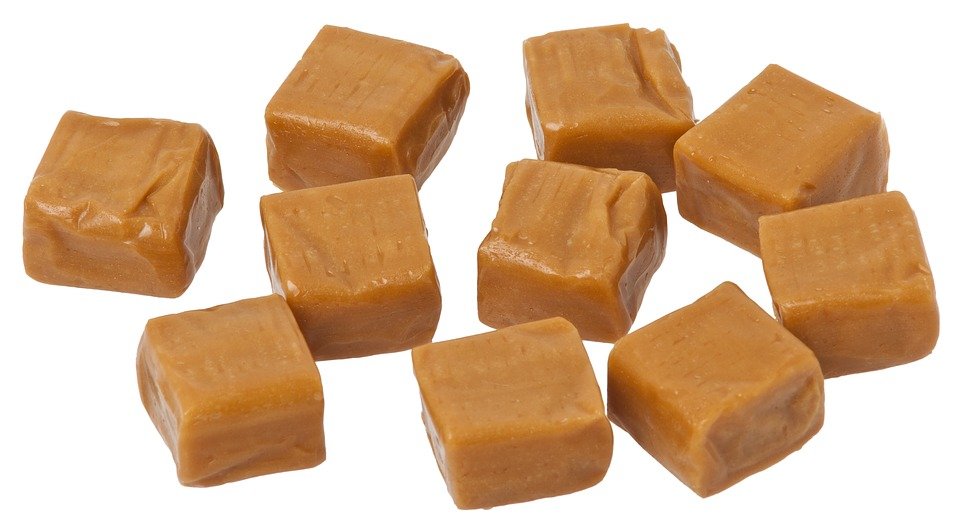

Caramels
From Our Candy Recipes by May B. Van Arsdale, Day Monroe, and Mary I. Barber, 1929.
From: 1929 C.E. To: 1929 C.E.

From Our Candy Recipes by May B. Van Arsdale, Day Monroe, and Mary I. Barber, 1929.
Caramels
General Suggestions. — Caramels burn very easily so care must be taken in their making. Select a heavy aluminum, copper, block tin, or unchipped agate sauce-pan. It is better to cook over a low flame and it is necessary to stir constantly to prevent curdling and scorching.
The pans into which caramels are turned when done should be very slightly greased. Excess butter in the pans will make caramels greasy to handle. Use a square or rectangular pan, rather than a round one or a platter, so that all caramels may be of good shape.
Turn the caramels out of the pan so that they can be cut evenly. Use a large knife and cut the whole length of the block of candy with one stroke. If you find it difficult to cut "by eye," mark the candy, and follow the mark. It is quite important to have caramels well cut and neatly wrapped.
Wrapping should be done as soon after the caramels are cold as possible. Cut the paper into pieces of the right shape for wrapping. Do not have the paper so wide that folded ends must be brought over the top of the caramel.
Vanilla Caramels
Large Recipe
Sugar, 2 cups
Light corn syrup, 1 cup
Condensed milk, 1 cup
Cream, ½ cup
Milk, 1 cup
Butter, ¼ cup
Vanilla, 2 teaspoons
Mix together all the ingredients except the vanilla, and cook over a low flame, stirring constantly, until the mixture reaches 246° F.
Remove from fire, add vanilla, and turn at once into a very slightly greased pan. When cold, turn the block of candy out of the pan in order to cut it more evenly. Cut into squares with a large, sharp knife.
Wrap each caramel in waxed paper.
Cold water test of caramels at 246° F. : a ball of the firmness of the caramel when cold.
Yield (large recipe): seventy- two caramels; weight— two and one-fourth pounds.
Everyday Vanilla Caramels
Large Recipe
Granulated sugar, 2 cups
Brown sugar, 1 cup
Light corn syrup, 1 cup
Cream, 1 cup
Milk, 2 cups
Butter, ⅓ cup
Vanilla, 4 teaspoons
Put all the ingredients, except the vanilla, into a saucepan and cook, stirring constantly, over a low flame until the candy reaches the temperature 248° F.
Remove from the fire, add vanilla, and turn at once into slightly greased pans. When cold remove from the pan; cut into squares and wrap.
Cold water test when the candy reaches 248° F.: a ball of the firmness desired in the finished caramel.
Yield (large recipe): seventy-two caramels; weight—two and one-half pounds.
Honey Caramels
Large Recipe
Sugar, 2 cups
Light corn syrup, 1 cup
Condensed milk, 1 cup
Cream, ½ cup
Milk, ½ cup
Strained honey, ½ cup
Butter, ¼ cup
Vanilla, 2 teaspoons
Stir together all the ingredients, except the vanilla, and cook over a low flame, stirring constantly, until the mixture reaches 248° F.
Remove from fire, add vanilla, and turn at once into a very slightly greased pan. When cold, turn the block of candy out of the pan in order to cut it more evenly. Cut into squares with a large, sharp knife.
Wrap each caramel in waxed paper.
Cold water test of caramels at 248° F. : a ball of the firmness of the caramel when cold.
Yield (large recipe) : seventy-two caramels; weight—two pounds five ounces.
Maple Caramels
Large Recipe
Sugar, 2 cups
Light corn syrup, 1 cup
Condensed milk, 1 cup
Cream, ½ cup
Milk, ½ cup
Maple syrup, 1 cup
Butter, ¼ cup
Vanilla, 2 teaspoons
Mix together all of the ingredients except the vanilla. Cook over a low flame, stirring constantly, until the mixture reaches 248° F.
Remove from fire, add vanilla, and turn at once into a very slightly greased pan.
When cold, turn the block of candy out of the pan in order to cut it more evenly. Cut into squares with a large, sharp knife.
Wrap each caramel in waxed paper.
Cold water test of caramels at 248° F.: a ball of the firmness of the caramel when cold.
Yield (large recipe): seventy-two caramels; weight — two and one-fourth pounds.
Chocolate Caramels
Large Recipe
Sugar, 2 cups
Light corn syrup, 1 cup
Condensed milk, 1 cup
Cream, ½ cup
Milk, 1 cup
Chocolate, 6 squares(6 ounces)
Vanilla, 2 teaspoons
Chocolate should be broken into small pieces, but it need not be grated.
Stir together all of the ingredients except the vanilla and cook over a low flame, stirring constantly, until the mixture reaches 246° F.
Remove from fire, add vanilla, and turn at once into a very slightly greased pan.
When cold, turn the block of candy out of the pan in order to cut it more evenly. Cut into squares with a large, sharp knife.
Wrap each caramel in waxed paper.
Cold water test of caramels at 246° F.: a ball of the firmness of the caramel when cold.
Yield (large recipe) : seventy-two caramels; weight—two and one-half pounds.
Brown Sugar Caramels
Large Recipe
Brown sugar, 2 cups
Granulated sugar, 1 cup
Light corn syrup, ½ cup
Cream, 1 cup
Milk, 2 cups
Butter, ½ cup
Vanilla, 4 teaspoons
Nut meats, 1 cup
Mix together all of the ingredients, except the vanilla and nut meats, and cook over a low flame, stirring constantly, until the mixture reaches 248° F.i
Remove from fire, add vanilla and nut meats, and turn at once into a slightly greased pan. When cold, turn the block of candy out of the pan in order to cut it evenly. Cut into squares with a large, sharp knife.
Wrap each caramel in waxed paper.
Cold water test of caramels at 248° F. : a ball of the firmness of the caramel when finished.
Yield (large recipe): seventy-two caramels; weight—two and one-half pounds.
Creamy Caramels
Large Recipe
Sugar, 2 cups
Light corn syrup, 1¼ cups
Milk, 2 cups
Cream, 1 cup
Butter, 2 tablespoons
Fondant, 1½ cups
Vanilla, 2 teaspoons
Put the sugar, corn syrup, milk, and cream into a saucepan and cook until the temperature 242° F. is reached. During the cooking the mixture must be stirred quite constantly because it curdles and scorches easily. Remove from fire, add butter, set aside to cool for about five minutes to 180° F.
Add fondant and vanilla and stir until thoroughly blended. Pour into slightly greased pans.
When cold turn the block of candy out of the pan in order to cut evenly. Cut into pieces a little less than one inch square.
The texture of this candy is a cross between that of a caramel and an opera cream. It has excellent keeping qualities.
Cold water test when the candy reaches 242° F. firm ball.
Yield (large recipe): seventy-two caramels; weight—two pounds.
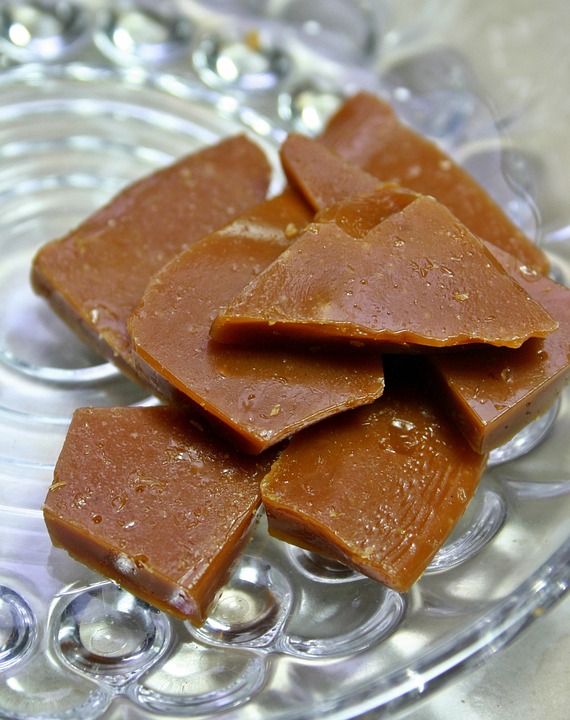
Caramel Variations
Caramel Nut Roll.—Make caramels, using small recipe, for any kind of caramel desired—vanilla, honey, chocolate, etc.
When the caramels are cooked set the saucepan into a pan of hot water, to prevent the caramel from hardening.
Make a roll of fondant about three inches long and three-fourths of an inch in diameter. Lay on a fork and dip quickly into the hot caramel mixture. Allow to stay in the caramel only long enough to be coated, or the fondant will melt.
Remove the roll from the saucepan and drop it into nut meats on waxed paper. Turn with a fork until all parts of the roll are covered. Press with the hands so that the nuts will be firmly imbedded in the roll. It is necessary to have plenty of nuts in which to drop the roll, or the caramel will stick to the waxed paper and be pulled away from the fondant.
Better results are obtained if about half the nut meats are whole, and half broken in two or three pieces.
The smaller pieces fill spaces between the whole nuts.
The caramel which is left after dipping can be poured into a slightly greased pan and cut into squares. It will become sugary because of the bits of fondant which have been washed off in the dipping, hence it should not be mixed with freshly cooked caramels.
Variety may be obtained by adding nuts, cocoanut, or nuts and cherries to the fondant center of the roll.
Cocoanut which has been browned in the oven can be used instead of nuts for the coating of the roll.
The center roll can be made from any kind of fondant which is firm enough to mold. Butter fondant is especially good. Opera creams, divinity, nougat, fudge, or penuchi may be used for the center roll. Or it may be made from one kind of caramel and dipped into another—as a chocolate caramel dipped into vanilla caramel.
Nut Caramels.—Nut caramels can be made by the addition of nuts to any of the recipes given for caramels. Add one and one-half cups of nuts to the large recipe.
The nuts should be cut or broken into fairly large pieces. If chopped there will be a fine powder which will cloud the candy.
If pecans or English walnuts are to be used, they should be freshened in the oven. Black walnuts or Brazil nuts are especially good in caramels.
Cocoanut Caramels. — Either fresh or desiccated cocoanut may be used. Spread it in a thin sheet on a pan and heat in the oven until delicately browned. This develops flavor and removes excess moisture from the fresh cocoanut. Add about three-fourths of a cup of cocoanut to the large recipe for any kind of caramels.
Fruit Caramels.—Raisins, figs, or dates may be cut up and used separately or mixed, to give variety to caramels. Add three-fourths of a cup of fruit to the large recipe for caramels. Vanilla caramels are especially good with dates added.
Layer Caramels. — Layer caramels add a great deal to the appearance of a box of candy. These may be made in two or three layers, of different kinds of caramels, or of caramels combined with nougat or divinity.
A layer of light colored caramel, capped by a layer of dark chocolate caramel, makes a candy both good-looking and delicious.
Layer caramels are made by pouring a thin layer into a pan, allowing it to cool, and then pouring in a second layer of contrasting color and flavor.
The three-layer caramels may be made with caramel top and bottom and nougat or divinity between.
If to be used at once, butter fondant can be combined with caramels to form layer candies. However, it should not be used if to be kept, because the fondant dries out more quickly than the caramels and the layers will separate.
Van Arsdale, May B., Day Monroe, and Mary I. Barber. Our Candy Recipes. The MacMillan Company, 1929.
About TOTA
TOTA.world provides cultural information and sharing across the world to help you explore your Family’s Cultural History and create deep connections with the lives and cultures of your ancestors.