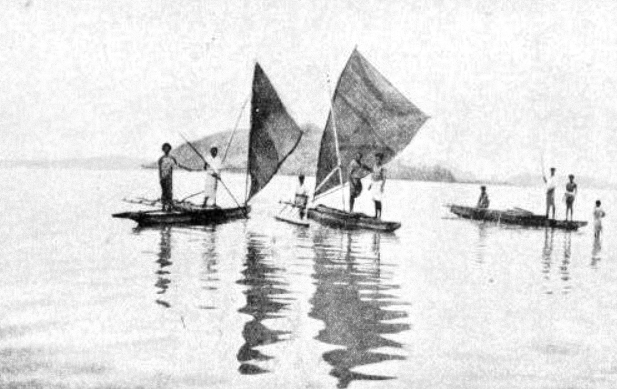

Glimpses of Pacific History
From “Glimpses of History (continued) in The Islanders of the Pacific, or, The Children of the Sun, by T. R. St. Johnston, 1921.

From “Glimpses of History (continued) in The Islanders of the Pacific, or, The Children of the Sun, by T. R. St. Johnston, 1921.
Another early wave was that which ultimately colonized New Zealand; because there it is, more than anywhere else, that one finds such close kinship with ancient Indian mythology, art, and customs, so ancient that they could not have been picked up by mixing with the more modern Indians who came down on Java in the first century a.d., but must have been derived from an earlier association with "pre-Indians" if one may use the expression—in Burma and India itself. (This would be the "overland" migration that I mentioned at page 46.) The "log" of this journey gives the following order of calling places:
Hono-i-wairua
Tawhiti-pa-mamao
Tawhiti-roa
Tawhiti-nui
(to New Zealand)
Then there was another distinctly later migration into Hawaii direct from Tahiti, of which much evidence may be gathered from tradition, custom, and stone remains. The people of this Tahitian invasion brought with them many new ideas, including the system of Moi or Suzerain chiefs, replacing the ancient "Hau" or priest-kings (called "Sau" in the Fiji-Tonga-Samoa Group); the separation of the temporal and spiritual kingship; the "committee of nobility," which bolstered up and set apart by dress, observance, and in every possible way the "nobles"; the laced, skin-covered drums, replacing the hollow wooden "tree-gongs" (which are still used in the Fiji-Tonga-Samoa Group); the elevation to supreme rank of the god Tangaroa; the institution of human sacrifices; and the walled-in "heiau" temples, replacing the old open pyramids.
And a rather puzzling "log" is that given by old people of Raratonga (Cook Islands) as the journey of their ancestors before reaching Samoa. It is as follows—
Atia-te-varinga-nui, which S. P. Smith thinks is India
Avaiki-te-varinga ,, „ Java
Iti-nui „ „ another part of Java
Papua „ „ some island north of Fiji
Enua-kura „ „ Papua
Avaiki „ „ Savaii, Samoa
Kuporu „ „ Upolu, Samoa
Manuka „ „ Manu'a, Samoa
I myself am inclined to think that between "Avaiki-te-varinga" and "Iti-nui" there should be a gap, i.e., that some portion of the "log" has been lost, and that Iti-nui is Fiji (Viti Levu). "Papua" may be Bua, an ancient district on Vanua Levu Island; Enua Kura, is Taveuni Island; and Avaiki, Kuporu and Manuka are the Samoan Islands as given above.
In a Paumotu tradition one of the calling-places is "Iti-nui, with its king, Tangaroa-menehune." He is shown on the Tahitian genealogies to be forty-two generations ago, or about a.d. 950—the beginning of the second period of migration starting from Fiji. But between the fifth and tenth centuries we have records of other great chiefs who flourished in the Fiji-Tonga-Samoa Group, the earliest being Tu-tarangi, who must have been one of the first arrivals, and whom the genealogies date about a.d. 450. Then, during Tu-tarangi's time, we find that another chief, Ari, built a wonderful stone house at Samoa, which had stone pillars, stone beams, and stone rafters, and "there was a stream running through it." One glimpses here an Eastern courtyard with a cooling stream, possibly a fountain, diverted for the chief's pleasure.
About this time there appear to have been quarrels and warfare between the various Polynesian chiefs who had begun to colonize these rich and fertile lands; and very possibly the aborigines (from whom there had probably been wrested only a very precarious foothold along the coasts) would seize the opportunity to come down in force from the hills and add to the general discomfort.
The consequence was that there followed a period of dispersal and migration from Fiji, though a few important chiefs still held their own for many generations to come, the old stock, however, gradually getting more and more "Melanesianized" until the blend of "Fijian"—as we know him to-day—was formed. (I think the recent "back-wash" from Tonga of the few Tongan rovers who visited Fiji in search of good canoes during the period of about 1750 to 1850 had but little real effect on the race. The more refined, more "Polynesian," physical appearances of the Bau people, who came down from the hills to settle on the coast towards the end of the eighteenth century, is, I consider, due to the fact that they are hybrid descendants of some branch of the ancient Polynesians who, at the time of the Melanesian overflow, did not put to sea like the others, but escaped to the hills and settled there, too strong to be exterminated, and who—blood will tell—eventually came into their own once more. I state this with all diffidence—I believe it is the first time such a theory has been put forward—but it seems to me not altogether improbable.)
One of the well-known chiefs in Fiji in those early days was Tu-tonga-kai-a-iti, who was driven to Tonga about A.D. 600, and it was about the same time or a little later that the famous Ui-te-rangiora, the explorer, commenced his wonderful voyages in search of new lands; one of his journeys towards the far south I have already mentioned on page 44.
Another famous chief, Tawake, whose name is constantly appearing in the traditions, and who was a great navigator, appears to have lived in Fiji about A.D. 750. He ascended the mountain of " Whitihana," and Matuku and Benga Islands (Peka in Polynesian) are mentioned in connection with his name.
There is a long story that about A.D. 850 a chieftainess named Akapura lived with her ten brothers (probably some were cousins, called "brothers" in the Polynesian way) at Hapa'i Island, Tonga. They became very jealous of her son, who had grown to manhood skilled in all arts of warfare, and whose influence they apparently had begun to fear; and one day they killed him. She at once gathered together what forces she could, especially the help of a powerful relative from Samoa, and at the first battle they were able to kill three of the "brothers."
The tradition says that her Samoan ally—typical warrior of the day—called out: "But now let us swallow their eyeballs, as a token to Orokeva of how the rest will be crushed in my mouth," and proceeded to do so! But the point of the story is that the remainder, with their followers, fled in an easterly direction and became the first Polynesian colonizers of the Cook Islands. And the Cook Islanders say that their forefathers were a peaceable folk and knew not warfare till these Tongans came among them with their iron-wood clubs and introduced real fighting.
Now we come to an important time in the history of Samoa. There appear to have been two big migrations from Samoa to Tonga, probably neither of them voluntary, as "... a migration induced by an attraction is rare as compared with that produced by an expulsion " (A. C. Haddon, Wanderings of Peoples).
One of these migrations is thought to have taken place in the time of the second Tui Tonga, which is stated to have been thirty-four generations before the death of King George Tupou in 1893. This would bring it to about a.d, 1050, and the same account would have it that the Haamonga, the great trilithon of Tonga, was built by these people.
Of the other migration we have a more definite account. It would appear that the pure Polynesians (whom we will call here the "Tonga-Fiti" people) were settled in strength in a part of Savaii, and had overcome the neighbouring peoples (whom we may suppose were a mixture of another drift of Polynesians with the earlier Melanesian element and whose chief was Savea, the first Malietoa) sufficiently to exact tribute from them. Malietoa's people had probably been gathering in strength for some time, and one day his two sons, on taking the tribute in to their oppressors, deliberately pulled up the Le-ale-a, or iron-wood mooring-stick, of the Tongan chief's canoe, which act was considered a deadly insult. It was a declaration of rebellion, and in the battles that followed Malietoa's party gained the upper hand and drove the "Tonga-Fiti" out of Samoa to Tonga, eventually enforcing a treaty by which the expelled people undertook "never to return to Samoa except in peace," which treaty, probably through necessity, has always been kept.
Now the time of the first Malietoa is said to be about A.D. 1250, and the last high-priest of Raratonga stated that according to the Raratongan "histories" the trilithon was built in the time of Makea Karika, of both Samoa and Raratonga, whose date by the genealogies works out at about a.d. 1250. Mateialonga, late Governor of Hapai, informed Sir Basil Thomson that it was built in the time of Tui-Ta-tui, which is about A.D. 1350; but if the one set of genealogies has been worked out on the thirty-year, and the other on the twenty-five-year, scale we get the same result, viz., twenty-two to twenty-three generations ago. I think one would not be far out if one sets the Haamonga trilithon down as late thirteenth century. Moreover, there is more than one trilithon in Tonga, and there may be confusion for that reason also; though it is evident that they were all built by the same people, even if a century or two divided the building of the first one from that of the last.
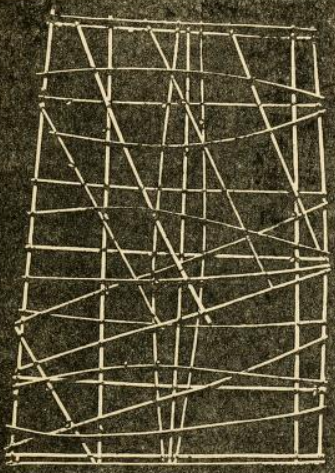
It was the Karika mentioned above who appears as an actor in the story of Tangiia and his relentless pursuer Tutapu—one of the most picturesque dramas of the Pacific. Tangiia was a famous voyager, second only in renown to Ui-te-rangiora, but a traveller more from necessity than choice! For he had wronged Tutapu, a powerful chief, and to escape his vengeance fled from island to island all over the Pacific. His wanderings extended for over twenty years, and a vast number of voyages; it is recorded that on his ninth voyage he visited Rapa-iti, otherwise Oparo, in the Austral Group, and eventually settled and died at Raratonga, Cook Islands, which was the last calling-place (except perhaps the Kermadec Islands) of the Polynesians, who formed the chief migrations to New Zealand. It is said that at Rapa-iti, and only at Rapa-iti, are found the typical New Zealand fortifications of "Pa"—can they have been constructed by Tangiia?
A remarkable dovetailing of data which, I believe, has not been hitherto pointed out is that on the one hand we have Tangiia, an ancestor of Raratongars, and therefore most probably of New Zealand Maoris, of about twenty-two generations ago, visiting Rapa-iti (with no doubt the inevitable fighting that all such "visits" resulted in), and we have traces of the Raratongan-New Zealand "Pa's"; on the other hand we have the legend that "about twenty-two generations ago a King of Rapa-iti was driven out and fled to Rapa-nui (Easter Island), where he and his men killed off the 'long-eared' people, except the women, and settled." And to-day we find at Easter
Island a race of semi-Polynesians who have kept up parts of their Melanesian cult, but speak Polynesian and strive their utmost to keep alive the traditions and genealogies of their Polynesian ancestry by means of a system of carved marks and symbols as memory aids, amounting to a rude script, which—as Mrs. Routledge told me—probably was evolved by themselves; the Melanesian carving instinct and the Polynesian history instinct for once coming aptly together on a fertile soil.
To return to Tangiia. Another vivid glimpse of the old Polynesian days is given us in the "histories," where we find that on one occasion, when the never-ending chase by the vengeance-hungry Tutapu seemed at last on the verge of satisfaction, Tangiia was in danger of being cut off by a canoe that was cruising off Samoa with Karika, a possible ally of Tutapu, on board. Tangiia, at his wits' end, decided to try conciliatory measures and win Karika over to his own side, so he drew alongside and proffered his "Au," or token of supremacy, as a gift. I am not quite clear what this may have been, but whatever it was it was so highly venerated by his followers and relatives that one of them, shamed that such an emblem should pass from the tribe, snatched at it, and in the scuffle that ensued it fell into the sea and was lost. This implies that it was of some heavy material, and was probably of metal, jade, or ivory, very likely some sort of sceptre. Tangiia, not to be baulked, then proffered his Pare-kura, the sacred red feather headdress, which Karika accepted, and—not to be outdone in generosity—offered his own daughter to Tangiia as a wife. Thus was cemented an alliance which one has reason to believe lasted till death.
Another voyaging of Tangiia's was that on which he sailed to Tahiti, and remained there for a long time, fighting and subduing the inhabitants. It is recorded that he conquered "the pygmies" of Tahiti, and the names of four tribes are given, namely Neke, Kai lila, A-vakevake, and Menehune. I imagine that these "pygmies" must have been the short dark aborigines, but I am inclined to think that the word Menehune or Manaune especially implies a distinct people. It is a term constantly occurring in ancient traditions of the Pacific.
Fornander states that a Hawaiian legend mentions the capturing and bringing over from Tahiti "dwarfs," and in another tradition it is said that the great stone works at Hawaii, such as the "fish-ponds," were built by the Menehune people. But if the dwarfs were the same as the Mene-hune, why was it necessary in the legends to distinguish them? S. P. Smith considers, and I at first thought the same, that these were the short aboriginals employed in great numbers by the Polynesians to construct the big stone buildings, of which so many traces yet remain, but on further consideration I think they were not the short aboriginals, although they no doubt were the slave builders of the big stone works. The same people apparently were to be found in Fiji (see the reference a few pages back to " Iti-nui, with its king, Tangaroa-manaune ").
One of the last accounts we have of Tangiia is that as an old man, weary of the incessant wandering and fighting, he journeyed back to Avaiki-te-varinga, the land of his fathers, to consult the ancient deity, Tonga-Fiti. The god, or his priest, told him to make his way to Tumu-te-varovaro (Raratonga Island), and that he should there end his days. This he did, but it is mentioned that on his way back he mislaid, at Uea Island (? in the Loyalty Group), a sacred "trumpet" that he had brought back from Avaiki-te-varinga, and so important was it that he had to go back a considerable part of his journey to get it.
St. Johnston, T. R. The Islanders of the Pacific, or, The Children of the Sun, T. Fisher Unwin, 1921.
About TOTA
TOTA.world provides cultural information and sharing across the world to help you explore your Family’s Cultural History and create deep connections with the lives and cultures of your ancestors.