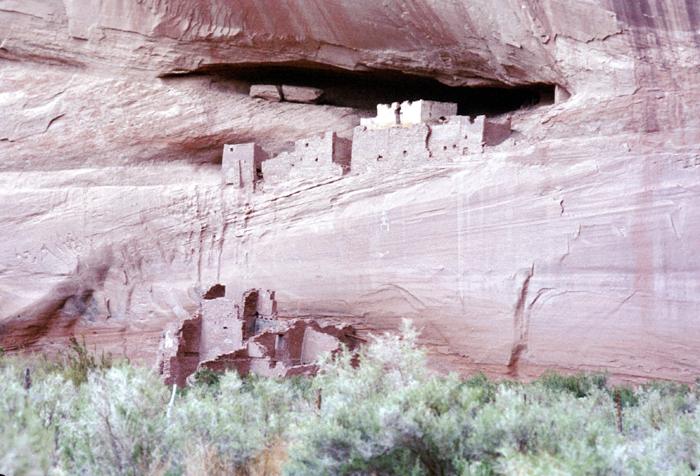

Dawn Boy Goes to White House
In the ancient days, there were four songs which you had to sing if you would enter the White House. The first was sung when you were ascending the cliff;…

Note: This article has been excerpted from a larger work in the public domain and shared here due to its historical value. It may contain outdated ideas and language that do not reflect TOTA’s opinions and beliefs.
“The Legend” from Navaho Myths, Prayers and Songs by Washington Matthews, 1907.
In the ancient days, there were four songs which you had to sing if you would enter the White House. The first was sung when you were ascending the cliff; the second, when you entered the first doorway; the third, when you walked around inside the house; and the fourth, when you were prepared to leave. You climbed up from the ground to the house on a rainbow. All this was in the old days. You cannot climb that way now. In those days, Hayolkal Aski, Dawn Boy, went there on a rainbow.
In the ancient days, there lived in this house a chief of the house. There were four rooms and four doors, and there were sentinels at each door. At the first door there were two big lightnings, one on each side; at the second door there were two bears; at the third door there were two red-headed snakes, which could charm you from afar, before you got near them; and at the fourth door there were two rattlesnakes.
Of course few people ever visited the place, for if the visitor were not a holy one some of these sentinels would surely kill him. They were vigilant. The chief of the house and his subordinates had these songs, by the power of which they could enter and quiet the sentinels, who always showed signs of anger when any one approached them.
Dawn Boy got leave from Hastseyalti to go to White House. Hastseyalti instructed him how to get there, taught him the prayers and songs he must know, and told him what sacrifices he must make. These must include fragments of turquoise, white shell, haliotis, and cannel-coal, besides destsi corn-pollen and larkspur pollen, and were to be tied up in different bags before he started. "When you get into the plain, as far off as the people of White House can see you, begin to sing one of these songs and a rainbow will form on which you may walk," said Hastseyalti.
Dawn Boy then set forth on his journey. When he got to Dzildanistini, or Reclining Mountain, he got his first view of the White House, and there he began to sing. Reclining Mountain is, today, far from White House; you cannot see one place from the other; but in the ancient days the world was smaller than it is now, and the people of whom I speak were holy ones. When he had finished the song a rainbow appeared, as Hastseyalti had promised, spanning the land from Reclining Mountain to White House. As he walked on the rainbow, a great wind began to blow, raising a dust that blinded the sentinels at White House and prevented them from seeing Dawn Boy when he entered.
There was a black kethawn at each side of the door and a curtain hung in the doorway. When he entered the house, he walked on a trail of daylight and he sprinkled pollen on the trail. The people within became aware of the presence of a stranger and looked up. Hastseyalti and Hastsehogan, the Talking God and the House God, who were the chief gods there, looked angrily at him, and one said: "Who is this stranger that enters our house unbidden? Is he one of the People on the Earth? Such have never dared to enter this place before.” Dawn Boy replied:
"It is not for nothing that I come here. See! I have brought gifts for you. I hope to find friends here.” Then he showed the precious things he had brought and sang this song:
Song A. (Free translation.)
1. Where my kindred dwell, there I wander.
2. Child of the White Corn am I, there I wander.
3. The Red Rock House, there I wander.
4. Where dark kethawns are at the doorway, there I wander.
5. With the pollen of dawn upon my trail. There I wander.
6. At the yuni, the striped cotton hangs with pollen. There I wander.
7. Going around with it. There I wander.
8. Taking another, I depart with it. With it I wander.
9. In the house of long life, there I wander.
10. In the house of happiness, there I wander.
11. Beauty before me, with it I wander.
12. Beauty behind me, with it I wander.
13. Beauty below me, with it I wander.
14. Beauty above me, with it I wander.
15. Beauty all around me, with it I wander.
16. In old age traveling, with it I wander.
17. On the beautiful trail I am, with it I wander.
Then he gave them the sacred things he had brought with him, and Hastseyalti said it was well, that he was welcome to remain, and they asked him what he wanted. "I want many things," he replied. "I have brought you pieces of precious stones and shells; these I wish wrought into beads and strung into ornaments, like those I see hanging abundantly on your walls. I wish domestic animals of all kinds, corn of all kinds, and plants of all kinds. I wish good and beautiful black clouds, good and beautiful thunder storms, good and beautiful gentle showers, and good and beautiful black fogs.”
The chiefs thanked him for his gifts, and asked him whose song it was that enabled him to come to "White House, who it was that taught it to him. But he had been warned by his informant not to reveal this, so he answered: "No one told me; I composed my songs myself. They are my own songs." "What is your name?” they asked. “I am Hayolkal Aski, Dawn Boy,” he replied.
"It is well,” said the holy ones. “Since you know our songs you are welcome to come here; but rarely does any one visit us, for there are but two outside of our dwelling who know
our songs. One is Hastseyalti of Tse'intyel, 8 in this cañon, and the other is Hastseyalti of Tse'yahodilyil in Tse'gihe.
Then Hastsehogan sent for a sacred buckskin, and one son and one daughter of each of the two gods, Hastseyalti and Hastsehogan spread the skin for Dawn Boy to stand on. Thus do we now, as the gods did then. As he stood, Hastsehogan taught Dawn Boy the White House prayer, as follows:
Prayer No. 1. (Free translation.)
I.
1. In Kininaekai.
2. In the house made of dawn.
3. In the story made of dawn.
4. On the trail of dawn.
5. O, Talking God!
6. His feet, my feet, restore (or heal).
7. His limbs, my limbs, restore.
8. His body, my body, restore.
9. His mind, my mind, restore.
10. His voice, my voice,, restore.
11. His plumes, my plumes, restore.
12. With beauty before him, with beauty before me.
13. With beauty behind him, with beauty behind me.
14. With beauty above him, with beauty above me.
15. With beauty below him, with beauty below me.
16. With beauty around him, with beauty around me.
17. With pollen beautiful in his voice, with pollen beautiful in my voice.
18. It is finished in beauty.
19. It is finished in beauty.
II.
2. In the house of evening light.
3. From the story made of evening light.
4. On the trail of evening light.
5. O, House God !
(The rest as in I, except that lines 12 and 13 are transposed.)
III.
5. O, White Corn Boy !
(The rest as in I.)
IV.
5. O, Yellow Corn Girl !
(The rest as in II.)
V.
5. O, Pollen Boy !
(The rest as in I.)
VI.
5. O, Grasshopper Girl !
(The rest as in II, with "It is finished in beauty" four times.)
When they had done, Hastsehogan said: “You have learned the prayer well; you have said it properly and you have done right in all things. Now you shall have what you want.” They gave him good and beautiful soft goods of all kinds, all kinds of good and beautiful domestic animals, wild animals, corn of all colors, black clouds, black mists, male rains, female rains, lightning, plants, and pollen.
After he had said the six prayers (or six parts of a prayer) as he had been taught, he prayed in his mind that on his homeward journey he might have good pollen above him, below him, before him, behind him, and all around him; that he might have good pollen in his voice. The holy ones said: “We promise you all this. Now you may go."
As he started he began to sing this song :
Song B. (Free translation.)
1. To the house of my kindred, there I return.
2. Child of the yellow corn am I.
3. To the Bed Rock House, there I return.
4. Where the blue kethawns are by the doorway, there I return.
5. The pollen of evening light on my trail, there I return.
6. At the yuni the haliotis shell hangs with the pollen, there I return.
7. Going around, with it I return.
8. Taking another, I walk out with it. With it I return.
9. To the house of old age, up there I return.
10. To the house of happiness, up there I return.
11. Beauty behind me, with it I return.
12. Beauty before me, with it I return.
13. Beauty above me, with it I return.
14. Beauty below me, with it I return.
15. Beauty all around me, with it I return.
16. Now in old age wandering, I return.
17. Now on the trail of beauty, I am. There I return.
He continued to sing this until he got about 400 paces from White House, when he crossed a hill and began to sing the following song:
Song C. (Free translation.)
I.
Held in my hand. (Four times. Prelude.)
1. Now with it Dawn Boy am I. Held in my hand.
2. Of Red Rock House. Held in my hand.
3. From the doorway with dark kethawns. Held in my hand.
4. With pollen of dawn for a trail thence. Held in my hand.
5. At the yuni, the striped cotton hangs with the pollen. Held in my hand.
8. Going around with it. Held in my hand.
9. Taking another, I walk out with it. Held in my hand.
10. I walk home with it. Held in my hand.
11. I arrive home with it. Held in my hand.
12. I sit down with it. Held in my hand.
13. With beauty before me. Held in my hand.
14. With beauty behind me. Held in my hand.
15. With beauty above me. Held in my hand.
16. With beauty below me. Held in my hand.
17. With beauty all around me. Held in my hand.
18. Now in old age wandering. Held in my hand.
19. Now on the trail of beauty. Held in my hand.
II.
3. From the doorway with the blue kethawns. Held in my hand.
4. With pollen of evening for a trail thence. Held in my hand.
5. At the yuni, the haliotis shell hangs with pollen. Held in my hand.
(The rest as in I, except that 14 and 15 and also 16 and 17 change places.)
By the time he had finished this song he was back at Dzildanistini, whence he started on his quest and from which he could see Depentsa and the hills around Tse'gihi. Then he began to think about his home, and he sang another song.
Song D. (Free translation.)
There it looms up, it looms up, it looms up, it looms up. (Pre- lude.)
1. The mountain of emergence looms up.
2. The mountain of dawn looms up.
3. The mountain of white corn looms up.
4. The mountain of all soft goods looms up.
5. The mountain of rain looms up.
6. The mountain of pollen looms up.
7. The mountain of grasshoppers looms up.
8. The field of my kindred looms up.
He thought it was yet a long way to his home, so he sat down to eat some food he had brought with him. Then he sang another song, one of the Beziwyasin or Food Songs, as follows:
Song E. (Free translation.)
Ina hwie! my child, I am about to eat. (Three times. Prelude.)
1. Now Hastseyalti. His food I am about to eat.
2. The pollen of dawn. His food I am about to eat.
3. Much soft goods. His food I am about to eat.
4. Abundant hard goods. His food I am about to eat.
5. Beauty lying before him. His food I am about to eat.
6. Beauty lying behind him. His food I am about to eat.
7. Beauty lying above him. His food I am about to eat.
8. Beauty lying below him. His food I am about to eat.
9. Beauty all around him. His food I am about to eat.
10. In old age wandering. I am about to eat.
11. On the trail of beauty. I am about to eat.
ina hwie! my child. I am about to eat. Kolagane. (Finale.)
When he had finished his meal, he sang another of the Bezinyasin, a song sung in these days when pollen was administered in the rites.
SONG F. (Free translation.)
Ina hwie! my grandchild, I have eaten. (Three times. Prelude.)
1. Hastsehogan. His food I have eaten.
2. The pollen of evening. His food I have eaten.
3. Much soft goods. His food I have eaten.
4. Abundant hard goods. His food I have eaten.
5. Beauty lying behind him. His food I have eaten.
6. Beauty lying before him. His food I have eaten.
7. Beauty lying above him. His food I have eaten.
8. Beauty tying below him. His food I have eaten.
9. Beauty lying all around him. His food I have eaten.
10. In old age wandering. I have eaten.
11. On the trail of beauty. I have eaten.
ina hwie! my grandchild. I have eaten. Kolagane. (Finale.)
Dawn Boy now crossed a valley to Tse'gihi, and as he crossed it he sang another song the burden of which was "Hozogo nasa, in a beautiful manner I walk.”
When he got to the edge of the canon he looked across it, and there he saw his mother, his father, his sisters, his brothers, and all his relations. They espied him from afar at the same time, and they said: "Hither comes our elder brother. Hither comes our younger brother," etc., and Hastseyalti, who first taught him the songs and sent him forth on his journey, said: "Sitsowe nada', my grandson has returned home." Then his father, who had gone inside to spread a sacred buckskin for him, came out again.
Dawn Boy sang a song when he was at the door of the house, the burden of which was, "Sagan si niya, I approach my home," and after he entered he sang " Sagan si nida, in my house I sit down."
Hastseyalti entered the house after him, and then all the neighbors crowded in and sat down. The old man and the old woman said: "My son, tell us your story;" and Hastseyalti said: “Tell us the story of the holy place you visited, where no stranger ever dared to venture before." Dawn Boy bade them sing a song and promised when they were done singing he would tell his story. The father then sang a song the burden of which was ”Diia t i silnaholue se, this person will tell me a story.”
When the song was finished, Dawn Boy said: "My grandfather, my mother, my father (etc.), what you said was true. It was in truth a holy place that I visited. I did not at first believe that it was such; but now I know that it is.” Then he related all his adventures as they have been already told.
After he had related his story, they made preparations to have a ceremony for him. They made him stand on a sacred buckskin, even as the people of White House had done. As he stood on the footprints, drawn in pollen, he said this prayer:
Prayer No. 2. (Free translation.)
1. Dawn Boy am I, I say.
2. Soft goods of all kinds, my moccasins, I say.
3. Soft goods of all kinds, my leggins, I say.
4. Soft goods of all kinds, my shirt, I say.
5. Soft goods of all kinds, my mind, I say.
6. Soft goods of all kinds, my voice, I say.
7. Soft goods of all kinds, my plumes, I say.
8. Soft goods of all kinds, hanging above me, I say.
9. Hard goods of all kinds, hanging above me, I say.
10. Horses of all kinds, hanging above me, I say.
11. Sheep of all kinds, hanging above me, I say.
12. White corn, hanging above me, I say.
13. Yellow corn, hanging above me, I say.
14. Corn of all kinds, hanging above me, I say.
15. Plants of all kinds, hanging above me, I say.
16. Dark clouds, good and beautiful, hanging above me, I say.
17. Male rain, good and beautiful, hanging above me, I say.
18. Dark mist, good and beautiful, hanging above me, I say.
19. Female rain, good and beautiful, hanging above me, I say.
20. Lightning, good and beautiful, hanging above me, I say.
21. Rainbows, good and beautiful, hanging above me, I say.
22. Pollen, good and beautiful, hanging above me, I say.
23. Grasshoppers, good and beautiful, hanging above me, I say.
24. Before me beautiful, I go home, I say.
25. Behind me beautiful, I go home, I say.
26. Above me beautiful, I go home, I say.
27. Below me beautiful, I go home, I say.
28. All around me beautiful, I go home, I say.
29. In old age wandering, I am, I go home, I say.
30. On the trail of beauty, I am.
31. In a beautiful manner, I am.
32. It is finished in beauty.
33. It is finished in beauty.
34. It is finished in beauty.
35. It is finished in beauty.
The ceremonies performed were some of those which now occur in the rites of the Night Chant, on the last morning when the great nocturnal dance is finished.
Matthews, Washington, Navaho Myths, Prayers and Songs, P. E. Goddard, editor, The University Press, Berkeley, 1907.
About TOTA
TOTA.world provides cultural information and sharing across the world to help you explore your Family’s Cultural History and create deep connections with the lives and cultures of your ancestors.