
Traditions of the New Year
A look at the history of New Year's celebrations and their most popular customs.

New Year’s Eve and Day are two of the most widely celebrated holidays in the world. Each December 31st, people across the globe stay up until midnight to welcome in the New Year and reflect on the last. It’s a time to set new goals and appreciate our friends, family, and memories.
Not every culture celebrates its new year on January 1st—notable examples include the Lunar New Year of China, several dates on the Hindu Calendar, the Islamic New Year, and Nowruz in Iran. Still, the Gregorian Calendar’s New Year has become the standard for most countries in the world, celebrated across a globe-spanning 24 hours. How did this holiday spread so far? Why do nations as diverse as Brazil, Australia, and Japan all ring in the year with fireworks? And what is an auld lang syne? Read on to find out more.
The Roman Origins of the New Year
Let’s start with some fundamental questions: Why do we celebrate the New Year on January 1st? And why does January 1st occur in the middle of each winter? The historical answer traces back to the Romans, but the reasons behind it may also reflect a common human experience. In the Northern Hemisphere, January 1st occurs just eleven days after the Winter Solstice, the shortest day of the year. As cold winter nights grow shorter and shorter, it’s natural for families to look forward to spring and long summer afternoons.
This hopeful attitude may be reflected through Janus, the Roman god of transitions and the namesake of January. Janus was a god with two faces, one facing forward and one facing back. Who better to shed the previous year and look ahead to the future? Originally, the Ancient Romans held a feast for Janus and pledged their goals to the god, the beginnings of modern New Year’s resolutions.
The Ancient Romans also developed the Julian Calendar, named after Gaius Julius Caesar himself. This calendar, 365.25 days long, brought a new degree of accuracy to time-keeping through the use of leap years. But even this carefully crafted system wasn’t perfect. After about 1600 years in use, people noticed that the days were beginning to drift. To solve the problem, Pope Gregory XIII modified it slightly into the Gregorian Calendar in 1582, which we still use today. The Gregorian Calendar has since spread to most nations in the world, uniting billions of us along the same measure of days, months, and years.
The Start of Fireworks on New Year’s Eve
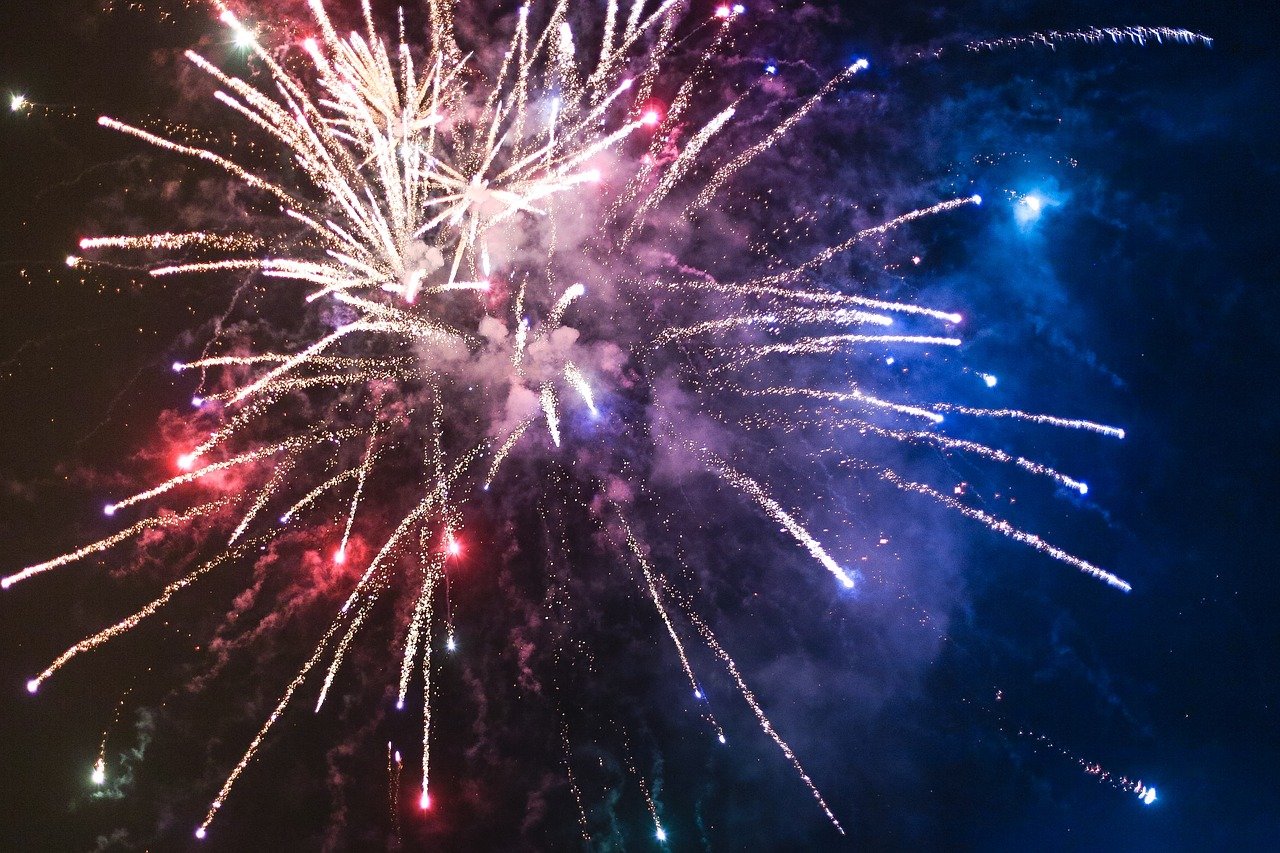
People have been celebrating the New Year for thousands of years, but fireworks are a relatively new invention. Why do we associate colorful explosions with a changing calendar? The simplest answer is that human beings like to light up the night. In earlier times, bonfires were often lit on New Year’s Eve to help families stay warm and ward away evil spirits. More recently, these New Year’s bonfires are sometimes stoked with old Christmas trees. Before firecrackers, families made noise by drumming or beating on pots and pans.
In Ancient China, where fireworks were invented, their use on the Lunar New Year is a centuries-old tradition. Fireworks traveled along the Silk Road to the Middle East, where they were carried home by traders and crusaders. In Renaissance Italy, fireworks as we know them were further refined and popularized, until they became a common sight and sound at festivals. As New Year’s celebrations spread and television flourished, large cities began hosting their own fireworks displays for global audiences.
The Auld Lang Syne
Another popular custom for the new year is the singing of “Auld Lang Syne.” The song was penned by famous Scottish poet Robert Burns, who adapted it from an existing folk song. The phrase “auld lang syne” translates roughly to “times long past,” a nostalgic look backward to share with friends and family. The song was likely introduced to the United States in New York in 1929, and it’s been a New Year’s staple ever since.

Foods to Bring You Luck
Of course, it wouldn’t be New Year’s Eve without a few superstitions as well. For many cultures, this is a time to stack up good luck for the next year and avoid any bad omens. Even the foods you eat, supposedly, can influence the outcome of your next 12 months. A champagne toast is perhaps the classic beverage of the new year holiday, but many other foods are served with it. In the Southern United States, for example, a meal of cornbread, collard greens, and black-eyed peas symbolize gold, green cash, and general wealth. In areas influenced by Spanish culture, 12 fruits may be eaten to symbolize 12 months of prosperity. Sauerkraut in Germany and noodles in nations such as Japan symbolize longevity. And, in many nations, special cakes are baked containing a lucky coin or other valuable item—whoever finds the trinket is guaranteed a lucky year.
These are just a few of the most common celebrations for the new year, but thousands more are still practiced among individual families, cities, countries, and cultures. What makes your New Year special? Don’t hesitate to share with us on TOTA!
Reference
Crump, William D. Encyclopedia of New Year's Holidays Worldwide. McFarland, 2016.
About TOTA
TOTA.world provides cultural information and sharing across the world to help you explore your Family’s Cultural History and create deep connections with the lives and cultures of your ancestors.