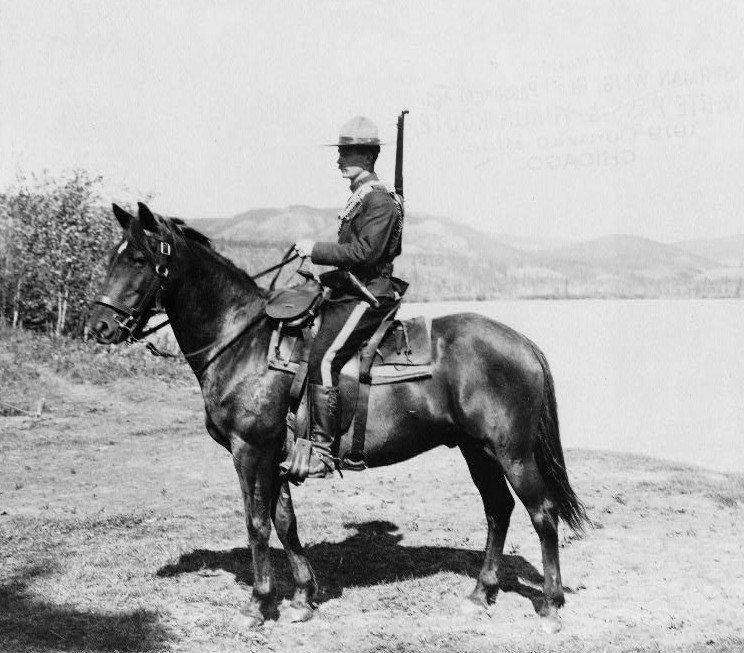

Learning to be a Mountie
An early recruit of the North-West mounted police describes his training.

From Life in the North-West Mounted Police, and Other Sketches by Charles P. Dwight, 1892.
Note: This article has been excerpted from a larger work in the public domain and shared here due to its historical value. It may contain outdated ideas and language that do not reflect TOTA’s opinions and beliefs.
We were up the following morning at the sound of reveille, when with the others I marched to the stables with brush and comb, where, after helping in the general clean-out, I was assigned a horse to water, feed and groom. I knew little or nothing of horses in general at this time, my knowledge of the noble animal having been principally gained by observation on the front platform of a bob-tailed street car. I had, of course, occasionally driven a horse, but beyond that, I had had little or nothing to do with them whatever. But now, however, I was to undergo the interesting operation of learning by experience and close contact something of their management, both in the stall and out.
I was curiously eyed by an officer as I began grooming my horse in the way I considered most proper from my scant knowledge, blowing and puffing the while after the fashion of the proverbial groom, in order to dispel any doubts that might exist as to my extensive experience in this business, but in a few moments I was thoroughly convinced by that gentleman that what I didn't know about properly grooming a horse was sufficient to class me amongst the most verdant of individuals in this respect. I worried through the stable hour, peculiarly conscious of my ignorance as to the proper care of horseflesh after the few hints I had now received, and felt not a little relieved when the business was over, and my first attendance at stables in the police was a thing of the past.
Stables were attended at Regina three times daily, when the same process was gone through each time, so that I became after a while capable of grooming a horse in the regulation fashion, and with more satisfactory results than had at first rewarded my efforts in this direction.
Being a recruit in a very proper sense of the term as regards drilling, I was of course assigned to a squad composed of men whose knowledge in this direction was about on a par with my own. There were about twelve or fifteen of us all told, and we were each day drilled for an hour on foot and another hour on horseback, and, as might be expected, were a source of considerable amusement not only to the older hands who happened at times to watch our crude endeavors, but to ourselves as well, in noting the ludicrous figure often cut by one of our number. More especially was this the case in mounted drill, when various peculiarities were exposed in our attempts at uniformity of movement which were highly amusing at times.
In mounted drill we were first paraded in the riding school, to where each man led his horse after first bridling and saddling him in the stables. This school was a large and spacious building, on the floor of which was strewn hay to the depth of about six inches, as a safeguard against accidents, in the shape of tumbles and tosses. Our saddles were of the universal pattern, without stirrups, and the horses with which we were provided were of the broncho-breed, — a combination which inspired no great degree of confidence in those of us whose equestrian propensities had heretofore lain dormant, only to be aroused now in the rude manner which is here adopted in imparting a knowledge of this peculiar accomplishment.
Our Drill Sergeant was a magnificent rider himself, but individually we received but little attention at his hands, as he stood in the centre of the riding school with a long-reaching circus whip, which he would energetically snap at the heels of any horse inclined to lag in our trots about the school. After all had mounted in the fashion he would first illustrate by springing upon the back of his own horse in two precise movements, we were for sometime walked quietly about the school prior to receiving an order to trot, and in the meantime were instructed as to the manner of properly holding ourselves in the saddle, and various other matters respecting horsemanship generally were explained at length for our enlightenment. I felt myself tolerably secure at first, as we walked our horses quietly about, but as all things must have their beginning, our turn came at length, and our Sergeant in a stentorian voice, gave out the command to "Trot," at which each horse, apparently quite familiar with its significance, broke into a brisk trot.
Without stirrups, and never having ridden before, the ignorant confidence I had commenced to feel in my ability to retain my seat was now most severely shaken, as I was tossed first to one side and then to the other. As is invariably the case, I instinctively twined my legs about the horse's belly with all the energy I could command, in my frantic efforts to keep my seat, but this only tended to increase the briskness of his gait, and make my position every moment more insecure. The riding-master generally took the lead in these trots, and set the pace, which he would unfeelingly continue in its briskness until the strain under which we were all laboring would finally result in first one and then another rolling off on our backs with a dull thud upon the soft floor.
I was one of the first to go down in this way, and even poor Dashwood, despite his vaunted experience as a horseman, found the "stripped saddles" little to his liking, being obliged to abandon his jockey style and adhere strictly to instructions for riding as a policeman, allowing the horse to pitch him fairly, and finding his balance as best he could. For a novice this method is no easy task, and there were but one or two who did not find in the soft floor of the riding school infinitely preferable to the continual pounding which this style of riding involves, and it required a number of lessons before I began to feel the slightest confidence in myself to keep fairly astride my horse.
Our rides were each day more severe and exacting as to our general bearing in the saddle, and the carrying out in detail of all instructions given us. For nearly four weeks we were daily put through this mounted drill on "stripped saddles," and at the end of this time it was considered that most of us had succeeded in acquiring something of a "seat."
We all had our tumbles and tosses on ground that was soft and otherwise, but none of us had so far received any injury of a serious nature. Many of us had become so sore and chafed, however, from the continual pounding, that it often required the greatest effort, intermixed with most delightful spasms of acute sensibility in the regions round about the affected parts, to drag one leg after another, and a sitting posture, needless to say, was for a time scrupulously avoided as far as possible. In fact, so bad did some of us become in this respect that we felt obliged on more than one occasion to seek the sympathy and advice of the surgeon, but under penalty of arrest we were finally told to go near him no more on such a pretext, but to ride until we had worn our soreness off.
This I found a trifle galling, to say the least, when, in compliance with this advice I discovered that my saddle on a number of occasions was dyed a deep vermilion with my own blood. I was assured, however, that this was the only way in which to become properly toughened, and so worried through our rides on many occasions when the agony was almost unbearable, But this complaint, I was snappishly informed, was but “trifling," and altogether unworthy of notice. Oh! how I longed at times to have that surgeon and riding master seated astride a saddle perforated with sharply pointed tacks, or other instruments of equally nice torture, and make them pound it for the space of an hour or so, just to show them how "trifling" I considered my complaint, no one but myself knew.
Dwight, Charles P. Life in the North-West Mounted Police, and Other Sketches. The National Publishing Company, 1892.
About TOTA
TOTA.world provides cultural information and sharing across the world to help you explore your Family’s Cultural History and create deep connections with the lives and cultures of your ancestors.