
Standardized Tagging Guidelines For the HEMA Community
The point of these tags is to provide standardized spelling, punctuation, and classification guidelines so that all HEMA content on TOTA is searchable using the same standards. Articles that all…

Background
The point of these tags is to provide standardized spelling, punctuation, and classification guidelines so that all HEMA content on TOTA is searchable using the same standards. Articles that all use the same keywords will automatically be placed in a collection within a group, making it easy to filter a group’s content.
Discussions are also searchable and should use the same system with the added tag of “Discussion”.
How to Tag Articles
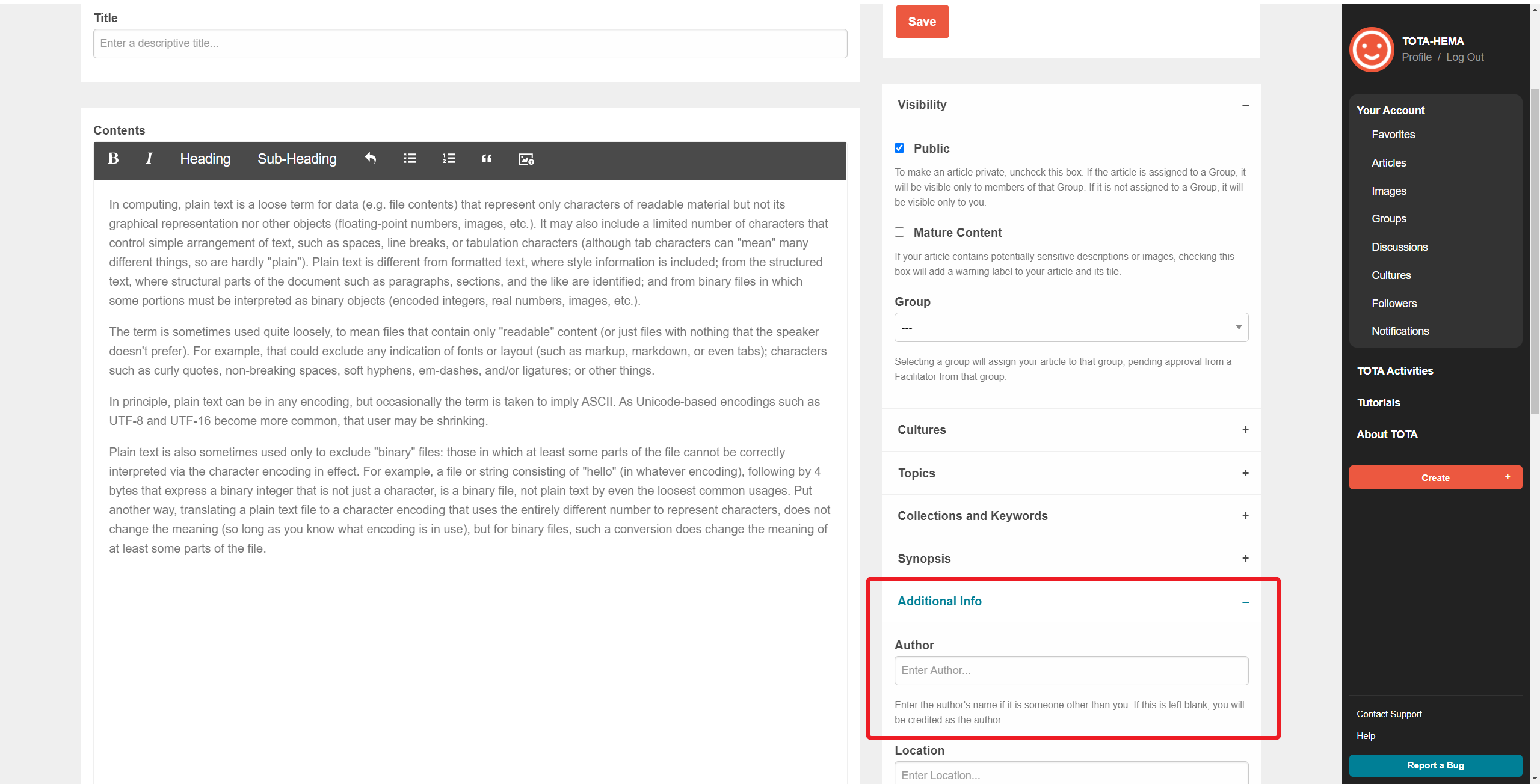
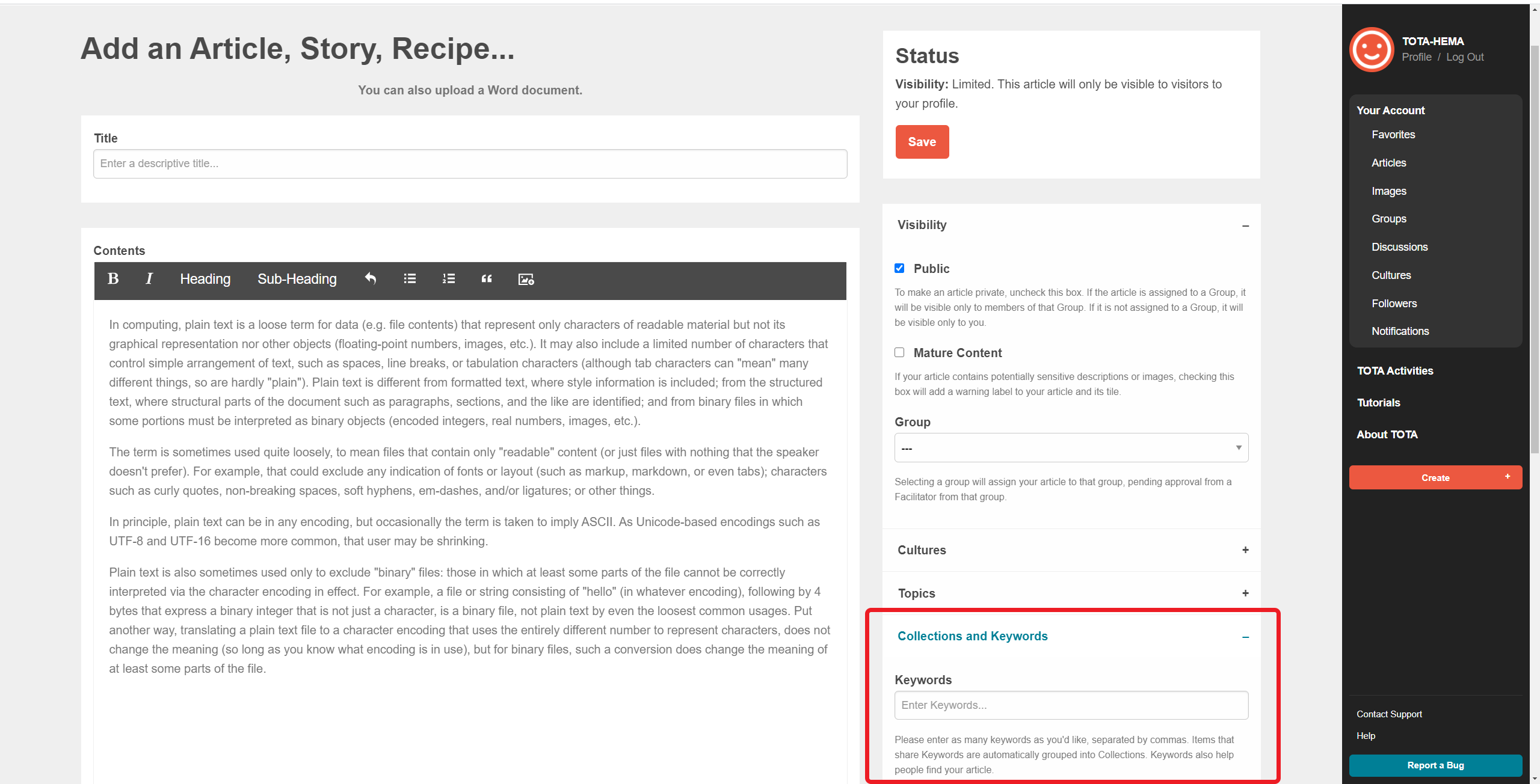
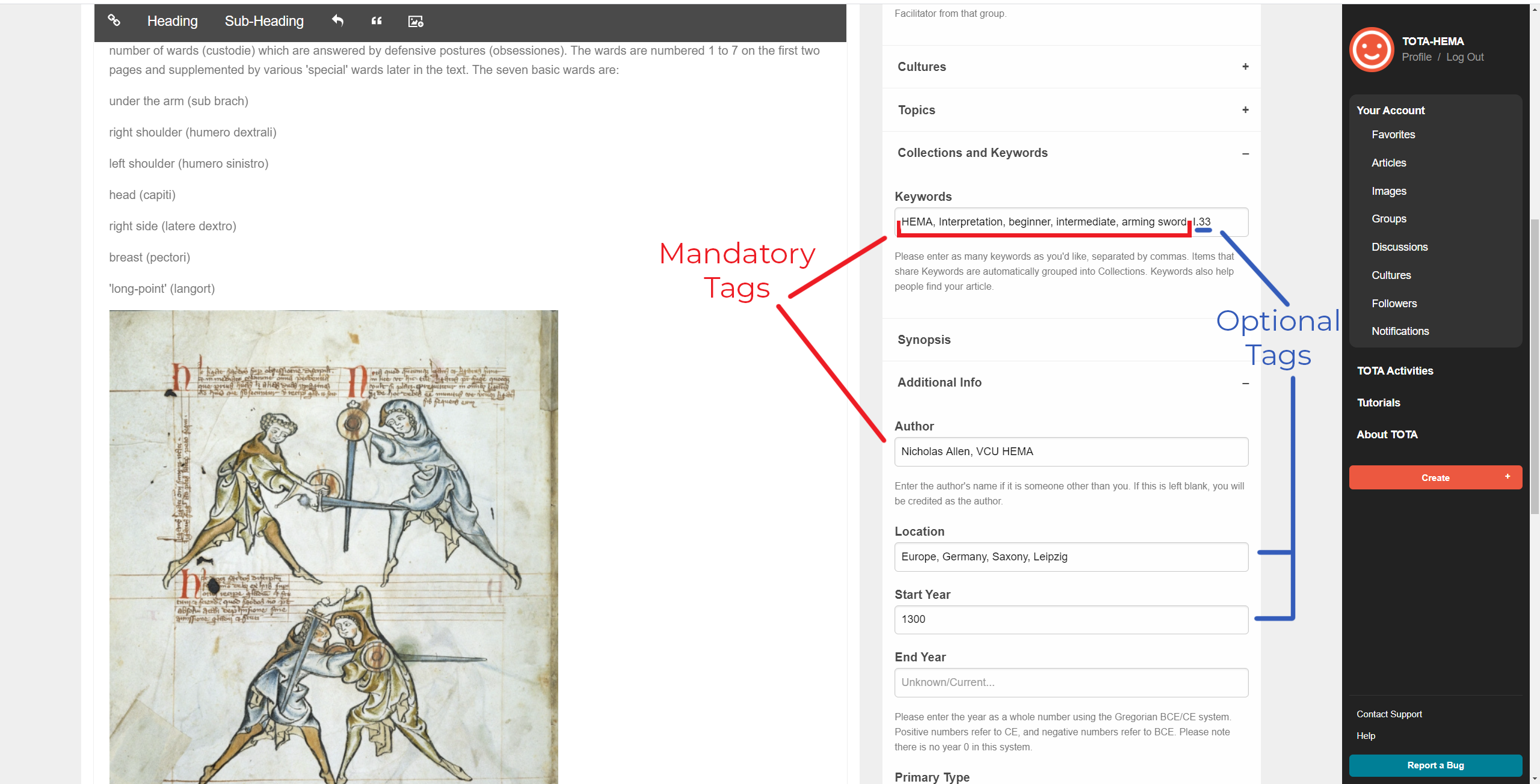
Mandatory tags are tags that must be applied to each article to give it a context and framework amongst other HEMA articles. Tags are located in two places: the “Collections and Keywords” metadata tab and the “Additional Info” tab. Any article can have any combination of tags; for example, a lesson could be tagged as beginner, intermediate, and advanced if it is applicable to a wide range of skill levels. In general, look at the collections that already exist in a group and include those in your tags if applicable. The more tags that content has and the more specific they are, the more refined searches can be. Once the mandatory metadata has been attached, feel free to add as many additional tags as you like.
Mandatory Tags
Author (in the “Additional Info” section)
Author tags allow the article to be properly attributed and should be formatted as the author’s first and last name followed by their club or study group affiliation.
For example: Nicholas Allen, VCU HEMA
If an author is unaffiliated, then the tag should read [Name], Independent
HEMA Tag, Type of Content, Skill Level, and Weapon System (in the “Collections and Keywords” section)
Including the keyword “HEMA” in an article’s tags ensures that that article will be returned in HEMA-related searches.
Including the type of content, skill level, and what weapon system the content features can help users narrow down their results.
Optional Tags
Optional tags serve to refine searches and make it possible for users to be more specific with their queries.
Source/Master (in the “Collections and Keywords” tab)
Time Period, Location (both in the “Additional information” section)
Tag Guidelines
Type of Content
Historical context
Interpretation
Translation
Research
Opinion
Reflection
Theory
Lesson plan
Lecture
...etc.
Skill Level
Beginner/Introductory: Content designed for someone who has never done HEMA or for a student who is just starting out. This content primarily encompasses basic techniques, gear recommendations, and community orientations (e.g. what are the major tournaments in the United States and Europe, who are the biggest suppliers of gear, what are the major sources and weapon systems, etcetera).
Intermediate: This content is for people who have had more experience with the community and includes things like technique discussions and interpretations.
Advanced: This is for scholars discussing theory or picking apart the nuanced differences between similar masters. It’s also for original research and other more technical content that new community members don’t have the foundation or likely the interest to engage with.
Weapon System
These have been pulled directly from Wiktenauer to allow for reciprocity and continuity between seeing content on TOTA about a specific weapon and being able to find out more about its sources on Wiktenauer.
Arming Sword
Armored Fencing
Dagger
Dussack
Flail
Grappling
Longshield
Longsword
Marriage Counseling
Messer
Mounted Fencing
Peasant Weapons
Pole Weapons
Rapier
German
Italian
Spanish
Side Sword
Staff Weapons
Polearms
Glaive
Halberd
Quarterstaff
Spear
Etc
Source/Master
Reference Wiktenauer for spelling, classification numbers, and format. This way, anything found on TOTA is searchable on Wiktenauer, and anything on Wiktenauer can be found in the same format on TOTA. Also, this ensures that community members all speak the same language around authors and sources.
Time Period
Time period tags should be formatted in both standard Arabic numerals and the corresponding century
Enter Arabic numerals in the start/end year section of the additional info tab. e.g. 1300-1330
Enter the century in the Keywords tab. e.g. 14th century
Region
This should be general to specific and as specific as possible
For example, if dealing with a source in Leipzig, the tag would be: Europe, Germany, Saxony, Leipzig
Example Tags
Below is an example of the mandatory and optional tags as they appear in the metadata section of the article.
Types of Content for the Lesson Repository
Because the lesson repository deals specifically with lectures and lesson plans, the group has developed specialized content types to facilitate easy searching.
Lecture: Content with this tag is usually a video of a single presenter giving a lecture to a static audience about a theory or idea. If the audience has weapons, it's a lesson; if they are sitting down it’s probably a lecture.
Interactive Lecture: This is a lecture with an interactive component such as a Q&A or discussion section at the end or which includes demonstrations.
Lesson: This may be either a written or recorded lesson wherein a teacher is instructing a class about a technique or system.
Drill: Content of this type can be either a written or recorded drill that is designed to be practiced during or outside of class with the purpose of enhancing the student’s proficiency in a skill.
Lesson Plan: This category includes any partial or complete lesson plan that can be used to teach (a) technique(s). For example, a set of conditioning exercises or drills designed around a particular principle or theme (as opposed to a single, standalone drill) would fall under the “Lesson Plan” category, even if it is not a complete class. The syllabus of a full workshop indicating how to conduct the class from start to finish would also be categorized as a “Lesson Plan”.
About TOTA
TOTA.world provides cultural information and sharing across the world to help you explore your Family’s Cultural History and create deep connections with the lives and cultures of your ancestors.