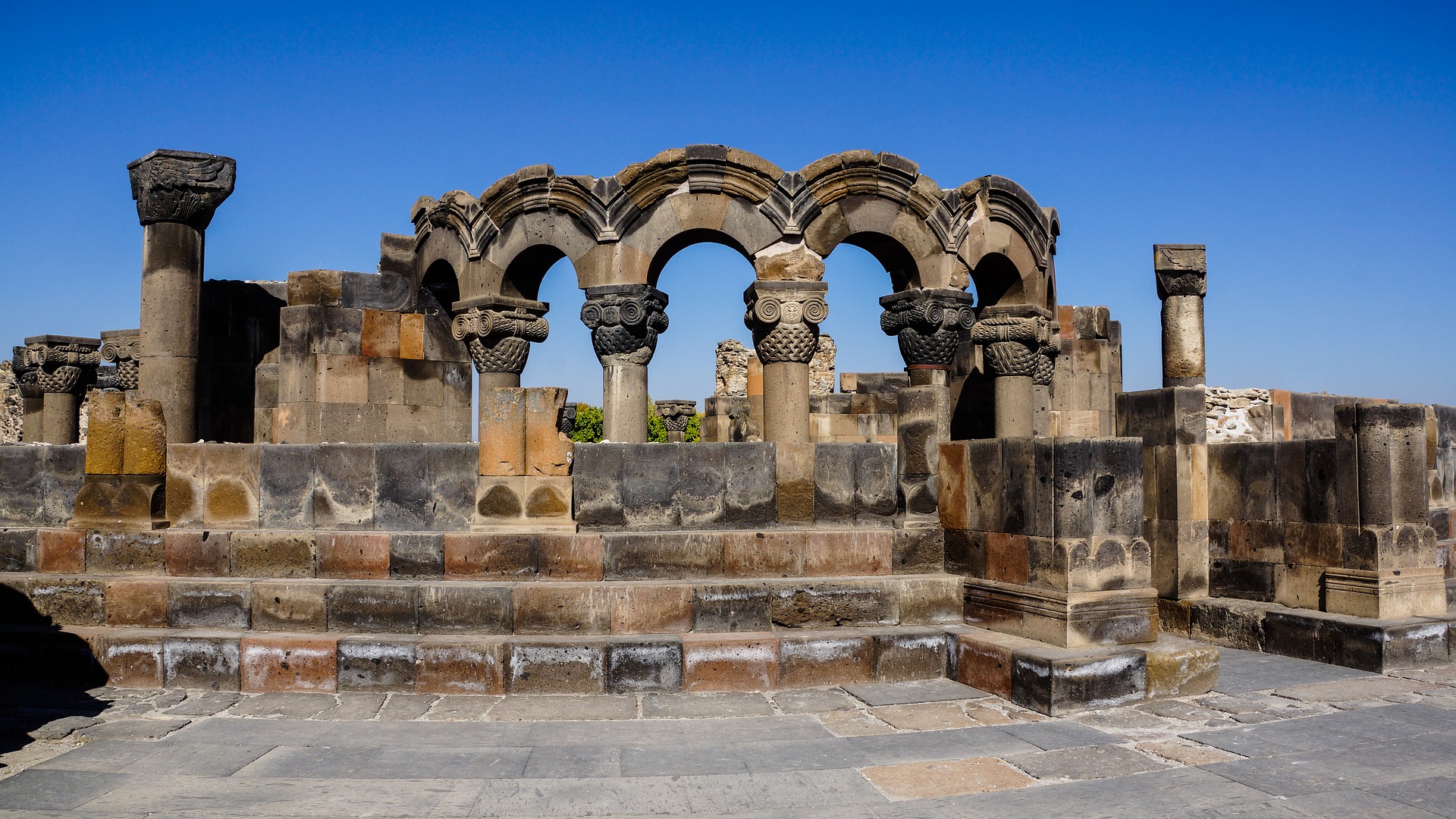

Video: A World Monument: Zvart'nots', Armenia, & the Wars of the Seventh Century
A lecture highlighting the legacy of Zvartnots, a magnificent Armenian cathedral built during the early Muslim conquests.

In the 7th century, Armenia was a region divided and imperiled. It sat at the heart of both old and new conflicts, its territories split between the larger Greek Byzantine and Persian Sasanian Empires. To the south, the young religion Islam was on the move. The faith’s devout followers would soon sweep through Persia and, much later, topple the Byzantines as well. For Armenia, long a Christian kingdom, the rapidly changing political landscape must have felt like a serious existential threat.
Perhaps in response to these developments, Armenian builders began construction on a monumental cathedral, Zvartnots. Although the cathedral only stood for about 300 years, its ruins are a popular visitor site today, and the structure is still studied as a feat of 7th-century architecture. It stands in Armenian memory as a symbol of achievement even in the face of overwhelming adversity.
In this lecture from the Library of Congress, Christina Maranci discusses the historical context of Zvartnots, the many efforts to reconstruct it, and its relationship to other notable works of the time, such as the Dome of the Rock. If you have any interest in historical architecture, her lecture is a must watch!
About TOTA
TOTA.world provides cultural information and sharing across the world to help you explore your Family’s Cultural History and create deep connections with the lives and cultures of your ancestors.