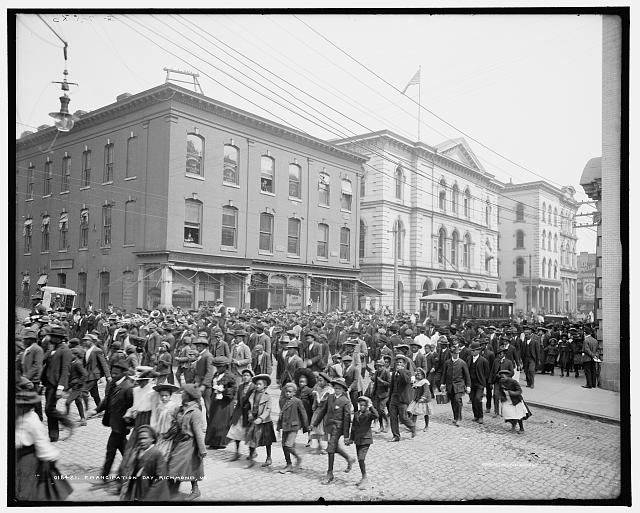

The Story of Juneteenth
A short history of the holiday Juneteenth, or Freedom Day, which commemorates the end of slavery in the United States.

Every June 19th, families come together across the United States to celebrate Juneteenth. Though not a federal holiday, 47 states and Washington D.C. recognize it today. Also known as Freedom Day, the holiday remembers not only the end of slavery in the United States, but also the civil rights activism of black Americans ever since. But why do we celebrate Juneteenth on June 19th, when the Emancipation Proclamation was passed on January 1st? And how has Juneteenth changed over the years? Read on to find out more.
Why is Juneteenth Celebrated on June 19th?
The Emancipation Proclamation was issued on January 1, 1863. Theoretically, it abolished slavery in all of the seceded Confederate states, freeing around 3.5 million enslaved people. In practice, of course, those states would not respect that order unless defeated. As the Union advanced into seceded states, representatives delivered the news of freedom to thousands of enslaved people. And, once Confederate forces began surrendering in April, 1865, the Emancipation Proclamation could finally be enforced in full.
The last state to hear the Emancipation Proclamation read aloud was Texas, the most western Confederate state. Union General Gordon Granger delivered the notice in Galveston on June 19, 1865. His announcement sparked widespread festivities, which formed the foundation of the modern holiday.
It’s important to remember that the Emancipation Proclamation did not actually free several hundred thousand enslaved people in Union states. Slavery would be formally abolished across the United States with the ratification of the 13th Amendment on December 6, 1865.
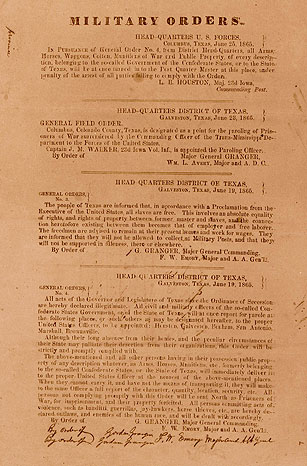
Juneteenth’s Growth Through the Decades
Juneteeth began as a mainly Texan celebration, but it quickly spread throughout the United States. It was sometimes known as Freedom Day, Jubilee Day, and Emancipation Day as well. Every year, black communities and their neighbors came together to remember the anniversary of slavery’s end in the United States. That usually meant picnics, church services, live music, political rallies, and large family gatherings.
The 20th century saw Juneteenth take on new meanings and traditions, especially during the Civil Rights movement of the 1940s to 1960s. It remained especially popular in Texas, which first recognized it as a formal holiday in 1980. Today, Juneteenth is not only a time to celebrate freedom, but also to recognize black artists and discuss current civil rights issues.
Although the holiday is all about celebrating black Americans and their history, public Juneteenth parties generally welcome anyone. If you see an event scheduled for your community, don’t hesitate to stop by, enjoy the festivities, and perhaps learn more about the history of the United States.
References
“History of Juneteenth.” Juneteenth.com, www.juneteenth.com/history.htm. Accessed 15 June 2020.
Abernathy, Francis Edward, ed. Juneteenth Texas: Essays in African-American Folkore. University of North Texas Press, 1996.
About TOTA
TOTA.world provides cultural information and sharing across the world to help you explore your Family’s Cultural History and create deep connections with the lives and cultures of your ancestors.