
Epitome of German Mythology (excerpt 4)
...from "Northern Mythology: compromising the principal popular traditions and superstitions of Scandinavia, North Germany, and the Netherlands" (1851)

“We will now give a slight outline of the externals of divine worship among the heathen Germans.
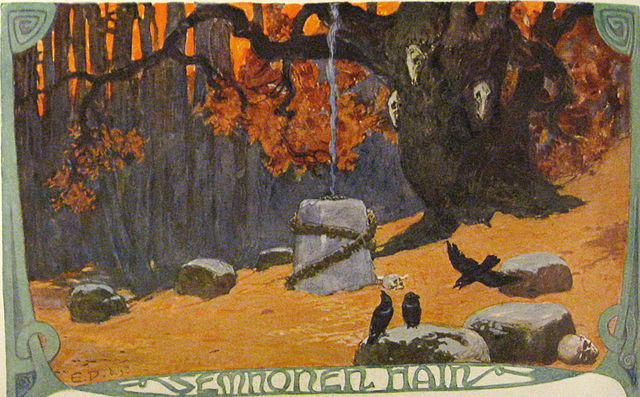
The principal places of worship were, consistently with the general character of the Germans, in the free, open nature. The expression of Tacitus was still applicable- "lucos ac nemora consecrant.” Groves consecrated to the gods are therefore repeatedly mentioned, and heathen practices in them forbidden In Lower Saxony, even in the eleventh century, they had to be rooted up, by Bishop Unwan of Bremen, in order totally to extirpate the idolatrous worship. But still more frequently, as places of heathen worship, trees and springs are mentioned, either so that it is forbidden to perform any idolatrous rites at them, or that they are directly stigmatized as objects of heathen veneration. At the same time we are not justified in assuming that a sort of fetish adoration of trees and springs existed among them and that their religious rites were unconnected with the idea of divine or semi-divine beings to whom they offered adoration; for the entire character of the testimonies cited in the note sufficiently proves that through them the externals only of the pagan worship have been transmitted to us the motives of which the transmitters either did not or would not know.
As sacred spots at which offerings to the gods were made those places were particularly used where there were trees and springs. The trees were sacred to the gods whose festivals were solemnized near or under them; an instance of which is the oak sacred to Jupiter which Boniface caused to be felled. These trees as we shall presently see, were, at the sacrificial feasts, used for the purpose of hanging on them either the animals sacrificed or their hides, whence the Langobardish Blood-Tree derives its name. Similar was the case with regard to the springs at which offerings were made ; they were also sacred to the god whose worship was there celebrated, as is confirmed by the circumstance, that certain springs in Germany were named after gods and were situated near their sanctuaries. How far these were needful in sacrificial ceremonies, and in what manner they were used, we know not.
But the worship of trees and springs may in reality have consisted in a veneration offered to the spirits who, according to the popular faith, had their dwelling in them; tradition having preserved many tales of beings that inhabited the woods and waters, and many traces of such veneration being still extant, of which we shall speak here-after. It seems, however, probable that the worship of such spirits, who stood in a subordinate relation to the gods, was not so prominent and glaring that it was deemed necessary to issue such repeated prohibitions against it. This double explanation applies equally to the third locality at which heathen rites were celebrated -stones and rocks In stones according to the popular belief the dwarfs had their abode ; but principally ragged stone altars are thereby understood such as still exist in many parts of Germany.
We are unable to say with certainty whether the before-mentioned offering-places served at the same time as burying-grounds of the dead, a supposition rendered probable by the number of urns containing ashes which are often found on spots supposed to have been formerly consecrated to heathen worship. But the graves of the dead at all events seem designated as offering-places. That such offerings at graves were sometimes made to the souls of the departed who after death were venerated as higher and beneficent beings may be assumed from the numerous prohibitions, by the Christian church, against offering to saints and regarding the dead indiscriminately as holy; although not all the sacrificia mortuorum and the heathen observances, which at a later period took place at burials, may have had reference to the dead, but may also have had the gods for object. Hence we may safely conclude that all the heathen rites, which were performed at springs stones and other places, had a threefold reference: their object being either the gods, the subordinate elementary spirits, or the dead ; but in no wise were lifeless objects of nature held in veneration by our forefathers for their own sake’s alone.
It now remains for consideration whether the gods were worshiped only in such places in the open air, or whether temples were erected to them. In answer to this question we shall limit ourselves to a few general observations.
In general it appears that temples, even at the period of the conversion, were, as in the time of Tacitus, but few. In the interior of Germany it is probable that none existed; for, had the case been otherwise, we should hardly have been without some notice of a temple among the Saxons. There is, however, little doubt that the Frisians had temples; for the words of the Lex Frisionum: “Qui templum effregerit immoletur diis, quorum templa violavit," precludes all doubt on the subject. But with respect to the temples of which mention is made, either on the Rhine or in Gaul (where the greater number occur), it is doubtful whether they are not rather to be considered as Keltic, which the invading Franks and Burgundians appropriated to themselves; as heathenism is inclined to dedicate to its own worship places regarded by others as holy. With respect to other places, the accounts supplied by the authorities are so vague, that it cannot be pronounced with certainty whether the question is of a temple or a grove, as the "fanum arboribus consitum,” which is mentioned among the Langobardi , can certainly have been only a grove. The fourth chapter of the Indiculus De Casulis, i.e. fanis, may refer to small buildings, in which probably sacrificial utensils or sacred symbols were kept.
The paucity of temples among the Germans implies also a paucity of idols among them; for the heathen temple did not, like a Christian church, serve for the reception of a holy-day congregation, but was originally a mere shelter or house for the image of the god. Certainly we are not justified in totally denying the presence of images; as it is expressly stated that the Gothic king Athanric (ob. 382) caused a carved image to be carried about, which, like Nerthus, was everywhere received with prayers and offerings. Nor are we, at the same time, justified in assuming the fact of their existence among all the German nations; and although in the authorities iiiola and simulacra are repeatedly mentioned, and great zeal is manifested against the folly of the heathen, in expecting aid from images of gold, silver, stone and wood; yet are these only general forms of speech directed against idolatry, and applying rather to Roman than German heathenism. We have in fact no genuine or trustworthy testimony that clearly describes to us an idol in Germany Proper. In no Life of a saint is it related that a converter destroyed such an idol. On the contrary, all the passages, which here enter into consideration, point either to a blending of foreign worship, or, on closer examination, there is no question in them of an idol, or they are of doubtful character.
The three brazen and gilt images, which St. Gall found and destroyed at Bregenz on the Lake of Constance, built into the wall of a church dedicated to St. Aurelia, and venerated by the people as gods, were no doubt of Roman origin, like those stone images which St. Columban (ob. 615) met with at Luxeuil in Franche Comte. The statue of Diana at Treves, and the images of Mars and Mercury in the south of Gaul, of which Gregory of Tours makes mention, are likewise rather Roman or Keltic than German. Not even the noted and in other respects remarkable passage of Widukind (i.12), according to which the Saxons, after their victory over the Thuringians on the Unstrut, raised an altar and worshiped a god "nomine Martem, effigie columnarum imitantes Herculem, loco Solem,quern Graeci appellant Apollinem” appears to us unquestionably to indicate a true idol. We can infer from the words of Widukind nothing more than the erection of a column similar to the Irmenseule at Eresburg which Charles the Great destroyed. In the passages which relate to this latter it is called sometimes idolum, sometimes fanum, sometimes lucus; but the word itself shows that Rudolf of Fulda was right in defining it ‘truncum ligni non parvse magnitudinis in altum erectum' nor is his expression for it of ‘universalus columna’ an unfitting one.
The history of the development of Greek and Roman image worship may aid us to a clearer insight into our native heathenism. The Greek representation of a god had not from the commencement the pretension of being a likeness of the god, but was only a symbol of his presence, for a sense of which the piety of ancient times required the less of externals the more deeply it was impressed with the belief of that presence. An external sign of the divinity was, nevertheless, necessary for the sake of having an object on which pious veneration of the gods might manifest itself. As, therefore, both in Hellas and Italy, the antique representations of the gods, as lances, etc, were mere symbols, in like manner we may regard the swords of the Quadi and the golden snakes of the Langobardi only as consecrated signs announcing the presence of the god. The representations of the gods next developed themselves, among the Greeks, under the form of rough stones, stone pillars and wooden poles, which were set up and regarded as images of the gods. Raised-up poles or beams were, no doubt, also among the Germans the prevailing and still symbolic species of images. The Irmenseule was such a pole: to such an image, if so it can be called, to a simple up-raised pillar, does the before-quoted passage of Widukind allude.
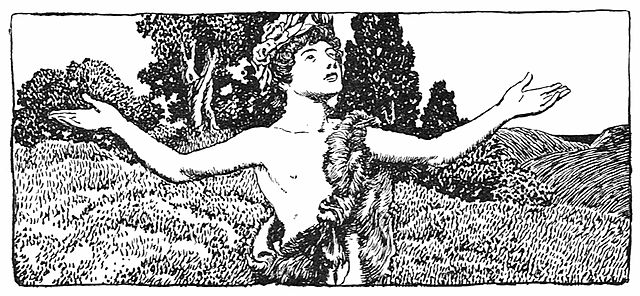
That prayers to the gods were frequently composed in a metrical form, that religious songs and poems existed, is evident from the circumstance that the Langobardi offered to one of their gods the head of a goat, with certain ceremonies and accompanied by a song'. The passage which gives this account affords ground for the supposition that certain saltations took place at the sacrifices. And why should there not be religious songs at this period, when, at a still earlier, songs in honour of Hercules were sung before a battle, when Tacitus makes mention of old mytho-epic songs in which the traditions of the German people were recorded? The oldest poetry of a nation generally attaches itself closely to religion, and the numerous forms of adjurations and spells, which through tradition we have inherited from heathenism, are for the most part composed in a rhythmical garb. It may, therefore, be reasonably supposed that the popular songs were, in the first Christian centuries, so bitterly decried by the clergy because they contained many remains of heathenism, and, consequently, seemed perilous to Christianity. The stigmatizing of the popular songs as carmina diabolica, the predicates turpia, inepta, obscaena applied to them give to this supposition additional strength; and the Capitularies explicitly forbid dances and songs as relics of heathenism. At funerals also, heathen religious songs were sung.
With prayer, sacrifice, which formed the chief part of heathen worship, was inseparably connected. In general here was prayer only at the sacrifices. The principal sacrifice was a human one, the offering of which by all the Germanic races is fully proved. Human beings appear chiefly to have served for sacrifices of atonement, and were either offered to the malign deities, or, as propitiatory, to the dead in the nether world. The custom of burning the servants and horses with the corpse, must, therefore be understood as a propitiatory sacrifice to the shade of the departed.
The testimonies just cited on the subject of human sacrifices inform us at the same time that prisoners of war -as in the time of Tacitus- purchased slaves or criminals were especially chosen for sacrifice. When a criminal was sacrificed his death was at the same time the penalty of his misdeeds. He was offered to the god whom, it was believed he had particularly offended, and his execution, decreed by the law, was reserved for the festival of that divinity. This usage, which gives an insight into the intimate connection between law and religion, and shows the punishment of death among the Germans in a peculiar light, is particularly conspicuous among the Frisians. This people put criminals chosen for sacrifice to death in various ways; they were either decapitated with a sword, or hanged on a gallows, or strangled, or drowned. A more cruel punishment awaited those who had broken into and robbed the temple of a god.
Of animals used for sacrifice, horses, oxen and goats are especially mentioned. The horse-sacrifice was the most considerable, and is particularly characteristic of the Germanic races. The heads were by preference offered to the gods, and were fixed or hung on trees. The hides also of the sacrificed animals were suspended on sacred trees. In the North the flesh of the sacrifices was boiled, and the door-posts of the temple were smeared with their blood. The Indiculus (chap. 26) leads to the supposition of a particular kind of offering. The Simulacrum de consparsa farina there mentioned appears to be the baked image of a sacrificial animal which was offered to the gods in the stead of a real one. Similar usages are known to us among the Greeks and Romans and in Sweden even in recent times it was a custom on Christmas eve to bake cakes in the form of a hog…”
Sources:
"Northern Mythology: compromising the principal popular traditions and superstitions of Scandinavia, North Germany, and the Netherlands" Thorpe Benjamin, London, E. Lumley (1851)
About TOTA
TOTA.world provides cultural information and sharing across the world to help you explore your Family’s Cultural History and create deep connections with the lives and cultures of your ancestors.