
Municipal Kite Contests and Fall Sports
“Municipal Kite Contests and Fall Sports” from When I Was a Boy in Korea by Ilhan New, 1928.

Note: This article has been excerpted from a larger work in the public domain and shared here due to its historical value. It may contain outdated ideas and language that do not reflect TOTA’s opinions and beliefs.
“Municipal Kite Contests and Fall Sports” from When I Was a Boy in Korea by Ilhan New, 1928.
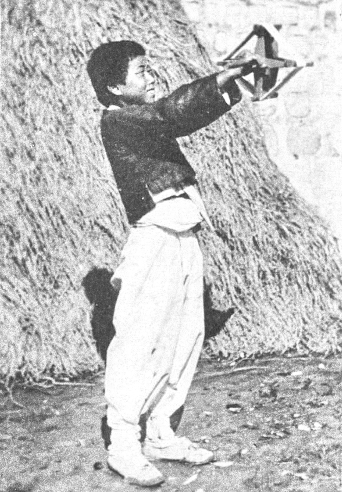
The day following the holiday marks the opening of the municipal kite contest. Every boy who has been at all able has been busy for weeks making his kite and reel, for these annual contests are the great sport event of the year and every Korean boy at some time in his life has hoped for the championship of his village.
The reel is made first. Five carefully rounded sticks are prepared, the fifth one being at least four inches longer than the others. The four of the same length are set together with crosspieces so that a rectangular framework eight inches square is formed. Across the ends, placed just inside the framework, are diagonal cross-pieces through which the fifth stick is passed and fixed firmly, hub fashion. This forms the handle of the reel and the length of the string is regulated by rotating this handle very quickly.
The kite is made of a rectangular framework of bamboo which is seldom larger than a foot in width and about fifteen inches in length; more often the dimensions are smaller. Two diagonal crosspieces complete the framework. A certain peculiarly tough native paper is then stretched over the whole and carefully glued so that none of the bamboo shows. At the intersection of the diagonals a round piece the size of a dollar is cut out, and at this point the line is attached. Two short pieces of string are fastened a few inches along this mainline at a common point and the free ends are fastened to opposite upper corners. Colored paper is expensive, and, since each boy must furnish all his materials without cost to the family, the kites are usually unadorned.
The line that has been spoken of is a very fine silken one. For many weeks previous, bits of broken bowls, crocks, and the like have been gathered and put away carefully. When the reel and kite are finished, these bits are pulverized. A small pot of glue is heated and the line is passed quickly through the hot glue, then through the pulverized mixture. The line must, of course, be dried thoroughly before it can be wound on the reel.
In every village and city these contests take place at the same time of year, and everywhere the kites resemble a vast flock of gulls. This is not merely aimless flying. There is a real purpose of vanquishing rivals by cutting their kites free by friction of line against line, aided by the abrasive with which the string was coated. This is where the art proclaims its true worth. If one whose kite is attacked is mentally alert, he scents danger immediately and, in a flash, has unreeled his line.
This averts cutting, for, to be effective, the sawing motion of the assailant’s line must fall on only one spot. As the kite strings are severed so quickly and amid such confusion, an adult wonders how the boys can distinguish anything. In a few hours, however, the victor of the day is carried off the hill, bearing the first prize, an event that is the great corner-stone of his childhood.
The sport is a fitting close to the summer vacation, for as soon as the intense heat and humidity have decreased school opens. In a few weeks there is a decidedly cool breeze each night, after the suffocating rays of the sun. With the nights grown cool, the streets immediately take on new garb. Dust lessens and the air begins to be filled with the odor of sweet potatoes roasting over charcoal. Everywhere are tiny carts with kettles of hot soup; some selling fresh clams broiled over glowing coals. With October come the chestnuts.
A majority of the venders are very small boys, who are doing their part to increase the family budget. The poorer Korean boy sees very little play; he must make his work his play, and it is touching, as well as inspiring, to see these little fellows sitting on the ground before their tiny fires, splitting the skins of the nuts, stirring the ones that are over the fire, and fanning the coals. Their little throats are often hoarse from singing their wares, but their bright, cheery attitude defies anything but admiration.
September, October, and November are three of the most beautiful months in Korea. The skies are a beautiful blue overhead, humidity has lessened, there is a soft breeze that is just right in temperature, harvesting has been finished, and the larders are bulging at the one time of the year when, for every one, there is a calm, serene peace that fills the heart.
The clear air emphasizes the continual rat-a-tat-tat of the ironing sticks which are in more prominence at this time, for, very soon, the heavy cotton-padded garments must be worn. The same white cotton goods are used for winter clothing, but a thick cotton padding is added for warmth. When these garments are soiled, they must be ripped entirely apart, laundered, and remade.
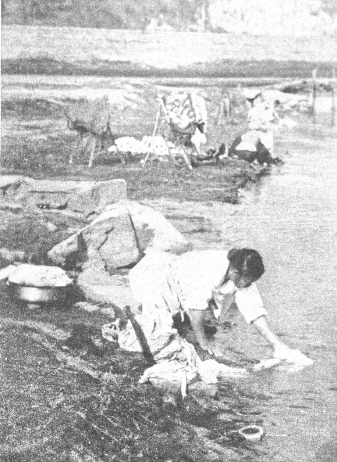
The native woman spends half her life laundering. At any time of the year a group may be seen at the side of any stream washing, even when the surface ice must be broken to reach the water. They have no wash-boards, but place the garment on a flat rock and beat it with a wedge-shaped wooden washing-stick. When once more white, and this is only after long, laborious effort, the clothes are dried and saved until after all other housework is finished at night.
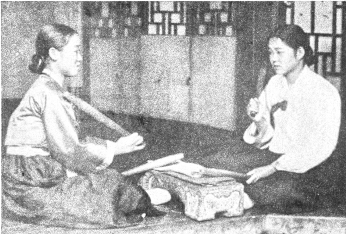
The ironing is done by two women who sit opposite each other with a shining flat oblong stone between. Each woman has a pair of smooth round ironing-sticks. The dried pieces of clothing are then placed side by side on this flat stone and subjected to a thorough pounding. This process gives the fabric a wonderfully glossy finish, making it like new, and is probably the most satisfactory method of finish when laundering entails so much labor. In the summer, when the thin “mo-see” clothes are worn, the ironing is done by another method. A pan that is the duplicate of a frying-pan is used. This is made of iron, however, and bears a very smooth and shining bottom. Red-hot coals are placed in the pan. When the bottom becomes hot, it is ready for use. Two women are needed for this process also, for the garment cannot be placed on a flat surface, but must be stretched between the women mid-air and ironed.
One never sees a lone woman laundering at a stream. Visiting between homes is indulged in very little, and so when one sees these groups chattering together as they work, he realizes that the gathering is really, in a way, a social one. In the same manner, the week’s ironing becomes the occasion for mental relaxation. The children are all fast asleep, there are no other household chores to fill the mind, and one is always wise enough to select a congenial neighbor with whom to do the ironing.
As the days grow colder, the boys are found fashioning tops of ordinary pine fire-wood. Occasionally there is a fond grandfather who labors for days making the next head of the house an especially marvelous top. This poor country, where there are no toy shops, is much different from America, where the grandfather may come home loaded with wonderful things purchased in a glittering store.
The Korean tops are shaped like American tops, but are used more on the ice than on the ground. When the ice is hard enough on the river, large groups are found top-driving. The driver is a round wooden stick with about a foot and a half of heavy cord fastened to one end. The top is thrown on the ice and lashed quickly with the cord until a rotating motion is initiated. The top by this lashing, first from one side, then from the other, is kept spinning and made to travel in whichever direction the driver wishes. Even very small boys become proficient at this amusement and are able to keep the top going from two to three hours at a time. The smooth glistening surface of the ice allows the top to travel rapidly with each stroke, and the boy must take long slides to keep up. We had no such luxury as skates when I was a boy, and what a pity, for what a sport top-driving could have become!
New, Ilhan. When I Was a Boy in Korea. Lothrop, Lee & Shepard Co., 1928.
About TOTA
TOTA.world provides cultural information and sharing across the world to help you explore your Family’s Cultural History and create deep connections with the lives and cultures of your ancestors.