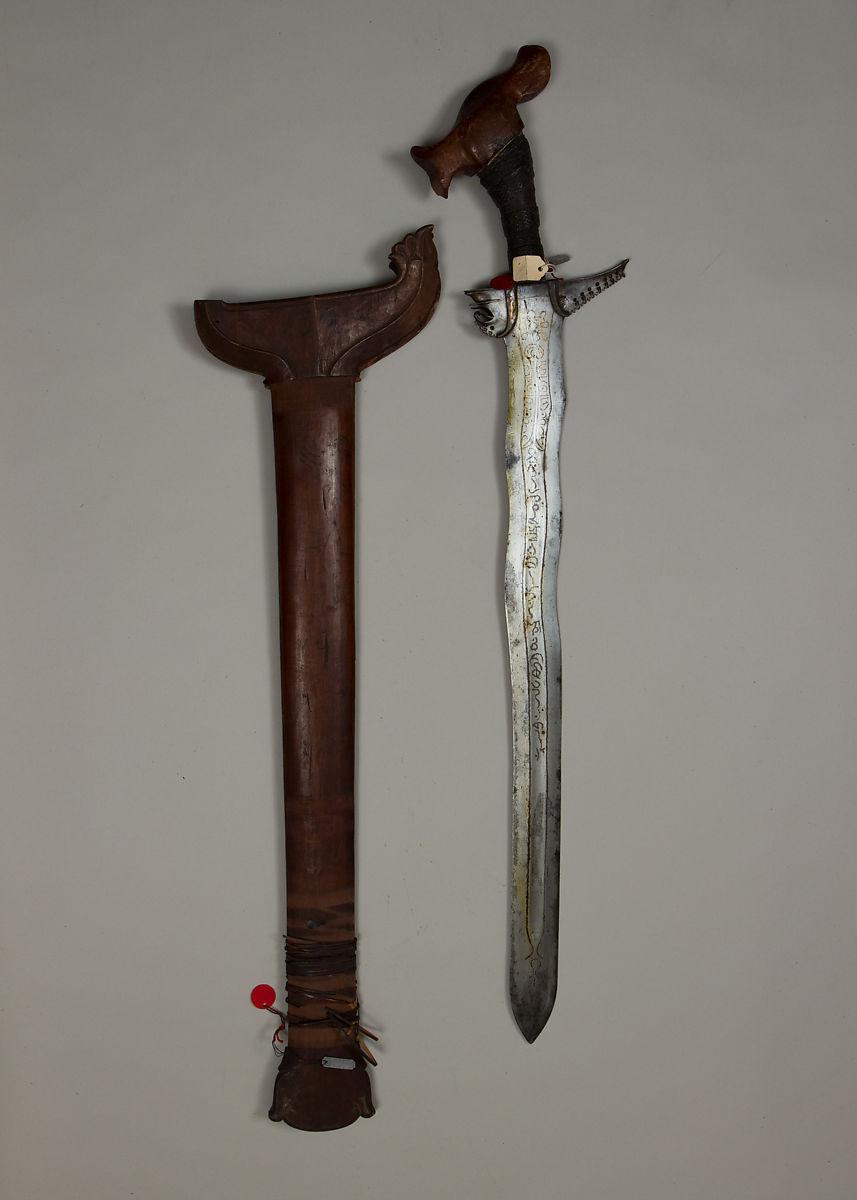

Forging of a Kris in a Moro Village
The Moro blacksmith, with an outfit of exceeding crudeness, will turn out a knife of graceful curving lines and smooth finish.

Note: This article has been excerpted from a larger work in the public domain and shared here due to its historical value. It may contain outdated ideas and language that do not reflect TOTA’s opinions and beliefs.
From Philippines: The War and the People; A Record of Personal Observations and Experiences by Albert Gardner Robinson, 1901
The Moro blacksmith, with an outfit of exceeding crudeness, will turn out a knife of graceful curving lines and smooth finish. The smith is an interesting man to watch as he turns such bits of iron, often only scraps, into one of those wicked-looking krises or the more generally serviceable but less artistic barong. The shops which I have seen have consisted of four corner posts and a roof.
The anvil is a small block of iron set in the ground, its surface some three or four inches above the ground-level. Two or three rude hammers of different weights and two or three pairs of equally rude tongs appear to compose the smith’s working outfit. He sits on the ground as he works, and his forge is a fire built on the ground.
His bellows illustrate one of the myriad of uses to which the bamboo is put. Behind the forge stand two hollow sections of bamboo of eight inches or so in diameter and some five feet in height. Sometimes they show a carved band around top and bottom. These are connected, underground, by a single pipe which reaches into the bottom of the fire. Each tube holds a packed plunger. Upon a properly elevated seat behind the tubes there sits a helper who, with a plunger in each hand, pumps, first right and then left, just as one might work two of those old-fashioned upright churns that may still be seen in remote necks of the American woods. This furnishes a constant current whose force may be easily regulated by the operator at the word of the smith.
The lines of the knife are formed with the crude implements and gaged wholly by the eye. The surface is pounded to as accurate a level as can be obtained by hammering. The knife is then passed on to other workers, who, also sitting on the ground, with endless patience rub and rub the blade upon a large block of some suitable stone which serves the same purpose as our familiar grindstone. It is, of course, a tedious and monotonous process, but it does the work and time is no important matter in Moro life.
Most of the handles of these weapons are made by the Chinese. They are often of elaborate design in ivory, silver or some richly grained and colored wood. I cannot say how long it takes to make an ordinary kris, but the prices at which they have been sold would indicate small wages for the workman. I have been buying some of the knives, six inches or so in length, used by the betel-chewers for cutting the areca-nut chewed with the betel-leaf. They are worth about five cents apiece, and I doubt if more than three or four could be made and finished in a day. Some are a little clumsy, but I have seen none that was not graceful in its lines.
Robinson, Albert Gardner. Philippines: The War and the People; A Record of Personal Observations and Experiences. McClure, Phillips & Co. 1901
About TOTA
TOTA.world provides cultural information and sharing across the world to help you explore your Family’s Cultural History and create deep connections with the lives and cultures of your ancestors.