
Thumbelisa, Part Two
Thumbelisa quite shook with fright, for the bird was very, very big beside her who was only one inch high, but she gathered up her courage

Note: This article has been excerpted from a larger work in the public domain and shared here due to its historical value. It may contain outdated ideas and language that do not reflect TOTA’s opinions and beliefs.
“Thumbelisa” from Faery Tales from Hans Christian Andersen, 1910.
In the autumn all the swallows fly away to warm countries, but if one happens to be belated, feels the cold so much that it falls down like a dead thing, and remains lying where it falls till the snow covers it up. Thumbelisa quite shook with fright, for the bird was very, very big beside her who was only one inch high, but she gathered up her courage, packed the wool closer round the poor bird, and fetched a leaf of mint which she had herself for a coverlet and laid it over the bird's head. The next night she stole down again to it and found it alive, but so feeble that it could only just open its eyes for a moment to look at Thumbelisa who stood with a bit of tinder-wood in her hand, for she had no other lantern.
"Many, many thanks, you sweet child," said the sick swallow to her; "you have warmed me beautifully. I shall soon have strength to fly out into the warm sun again."
"Oh! " said she, "it is so cold outside, it snows and freezes, stay in your warm bed, I will tend you." Then she brought water to the swallow in a leaf, and when it had drunk some, it told her how it had torn its wing on a blackthorn bush, and therefore could not fly as fast as the other swallows which were taking flight then for the distant warm lands. At last it fell down on the ground, but after that it remembered nothing, and did not in the least know how it had got into the tunnel.
It stayed there all the winter, and Thumbelisa was good to it and grew very fond of it. She did not tell either the mole or the field-mouse anything about it, for they did not like the poor unfortunate swallow.
As soon as the spring came and the warmth of the sun penetrated the ground, the swallow said good-bye to Thumbelisa, who opened the hole which the mole had made above. The sun streamed in deliciously upon them, and the swallow asked if she would not go with him, she could sit upon his back and they would fly far away into the green wood. But Thumbelisa knew that it would grieve the old field-mouse if she left her like that.
"No, I can't," said Thumbelisa.
"Good-bye, good-bye, then, you kind pretty girl," said the swallow, and flew out into the sunshine. Thumbelisa looked after him and her eyes filled with tears, for she was very fond of the poor swallow.
"Tweet, tweet," sang the bird, and flew into the green wood.
Thumbelisa was very sad. She was not allowed to go out into the warm sunshine at all; the corn which was sown in the field near the field-mouse's house grew quite long, it was a thick forest for the poor little girl who was only an inch high.
"You must work at your trousseau this summer," said the mouse to her, for their neighbour the tiresome mole in his black velvet coat had asked her to marry him. "You shall have both woollen and linen, you shall have wherewith to clothe and cover yourself when you become the mole's wife."
Thumbelisa had to turn the distaff and the field-mouse hired four spiders to spin and weave day and night. The mole paid a visit every evening, and he was always saying that when the summer came to an end, the sun would not shine nearly so warmly, now it burnt the ground as hard as a stone. Yes, when the summer was over he would celebrate his marriage; but Thumbelisa was not at all pleased, for she did not care a bit for the tiresome mole. Every morning at sunrise and every evening at sunset she used to steal out to the door, and when the wind blew aside the tops of the cornstalks so that she could see the blue sky, she thought how bright and lovely it was out there, and wished so much to see the dear swallow again; but it never came back; no doubt it was a long way off, flying about in the beautiful green woods.
When the autumn came all Thumbelisa's outfit was ready.
"In four weeks you must be married," said the field-mouse to her. But Thumbelisa cried and said that she would not have the tiresome mole for a husband.
"Fiddle-dee-dee," said the field-mouse; "don't be obstinate or I shall bite you with my white tooth. You are going to have a splendid husband; the queen herself hasn't the equal of his black velvet coat; both his kitchen and his cellar are full. You should thank heaven for such a husband!"
So they were to be married; the mole had come to fetch Thumbelisa; she was to live deep down under the ground with him, and never to go out into the warm sunshine, for he could not bear it. The poor child was very sad at the thought of bidding good-bye to the beautiful sun; while she had been with the field-mouse she had at least been allowed to look at it from the door.
"Good-bye, you bright sun," she said as she stretched out her arms towards it and went a little way outside the field-mouse's house, for now the harvest was over and only the stubble remained. "Good-bye, good-bye!" she said, and threw her tiny arms round a little red flower growing there. "Give my love to the dear swallow if you happen to see him."
"Tweet, tweet," she heard at this moment above her head. She looked up; it was the swallow just passing. As soon as it saw Thumbelisa it was delighted; she told it how unwilling she was to have the ugly mole for a husband, and that she was to live deep down underground where the sun never shone. She could not help crying about it.
"The cold winter is coming," said the swallow, "and I am going to fly away to warm countries. Will you go with me? You can sit upon my back! Tie yourself on with your sash, then we will fly away from the ugly mole and his dark cavern, far away over the mountains to those warm countries where the sun shines with greater splendour than here, where it is always summer and there are heaps of flowers. Do fly with me, you sweet little Thumbelisa, who saved my life when I lay frozen in the dark earthy passage."
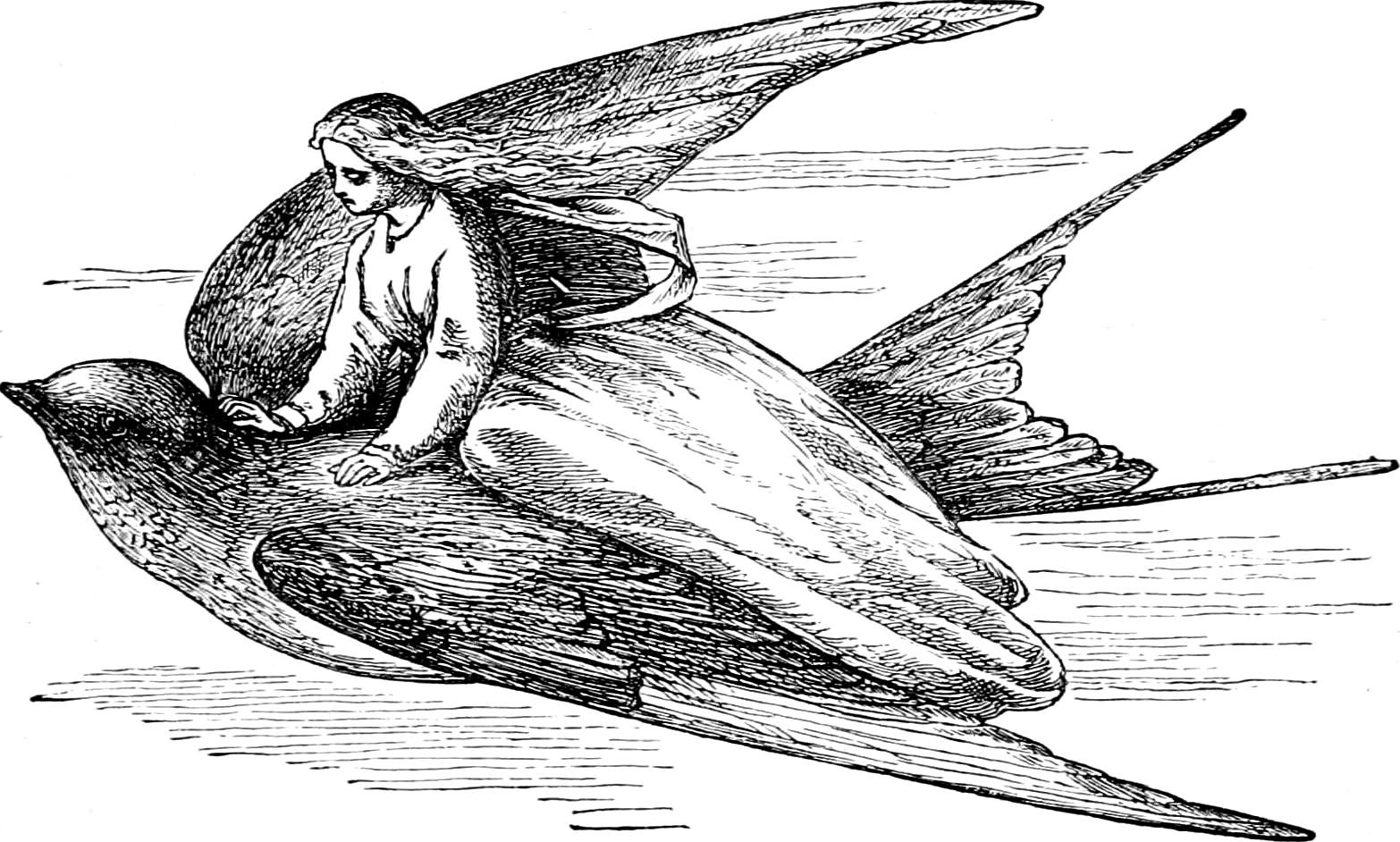
"Yes, I will go with you," said Thumbelisa, seating herself on the bird's back with her feet on its out-spread wing. She tied her band tightly to one of the strongest feathers, and then the swallow flew away, high up in the air above forests and lakes, high up above the biggest mountains where the snow never melts; and Thumbelisa shivered in the cold air, but then she crept under the bird's warm feathers, and only stuck out her little head to look at the beautiful sights beneath her.
Then at last they reached the warm countries. The sun shone with a warmer glow than here; the sky was twice as high, and the most beautiful green and blue grapes grew in clusters on the banks and hedgerows. Oranges and lemons hung in the woods which were fragrant with myrtles and sweet herbs, and beautiful children ran about the roads playing with the large gorgeously-coloured butterflies. But the swallow flew on and on, and the country grew more and more beautiful. Under magnificent green trees on the shores of the blue sea stood a dazzling white marble palace of ancient date; vines wreathed themselves round the stately pillars. At the head of these there were countless nests, and the swallow who carried Thumbelisa lived in one of them.
"Here is my house," said the swallow; "but if you will choose one of the gorgeous flowers growing down there, I will place you in it, and you will live as happily as you can wish."
"That would be delightful," she said, and clapped her little hands.
A great white marble column had fallen to the ground and lay there broken in three pieces, but between these the most lovely white flowers grew. The swallow flew down with Thumbelisa and put her upon one of the broad leaves; what was her astonishment to find a little man in the middle of the flower, as bright and transparent as if he had been made of glass. He had a lovely golden crown upon his head and the most beautiful bright wings upon his shoulders; he was no bigger than Thumbelisa. He was the angel of the flowers. There was a similar little man or woman in every flower, but he was the king of them all.
"Heavens, how beautiful he is," whispered Thumbelisa to the swallow. The little prince was quite frightened by the swallow, for it was a perfect giant of a bird to him, he who was so small and delicate, but when he saw Thumbelisa he was delighted; she was the very prettiest girl he had ever seen. He therefore took the golden crown off his own head and placed it on hers, and asked her name, and if she would be his wife, and then she would be queen of the flowers! Yes, he was certainly a very different kind of husband from the toad's son, or the mole with his black velvet coat.
So she accepted the beautiful prince, and out of every flower stepped a little lady or a gentleman so lovely that it was a pleasure to look at them. Each one brought a gift to Thumbelisa, but the best of all was a pair of pretty wings from a large white fly; they were fastened on to her back, and then she too could fly from flower to flower. All was then delight and happiness, but the swallow sat alone in his nest and sang to them as well as he could, for his heart was heavy, he was so fond of Thumbelisa himself, and would have wished never to part from her.
"You shall not be called Thumbelisa," said the angel of the flower to her; "that is such an ugly name, and you are so pretty. We will call you May."
"Good-bye, good-bye," said the swallow, and flew away again from the warm countries, far away back to Denmark; there he had a little nest above the window where the man lived who wrote this story, and he sang his "tweet, tweet" to the man, and so we have the whole story.
Andersen, Hans Christian. Faery Tales from Hans Christian Andersen. Translated by Mrs. E. Lucas, J.M. Dent & Co., 1910.
About TOTA
TOTA.world provides cultural information and sharing across the world to help you explore your Family’s Cultural History and create deep connections with the lives and cultures of your ancestors.