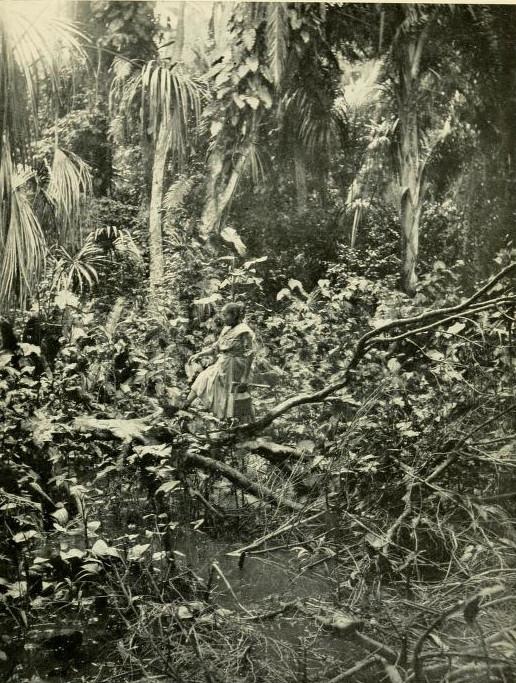

Rubber Workers of Pará, c. 1900
"I must express my deep admiration for the woman who braves these difficulties to support her household and the poor, incapacitated husband..."

Note: This article has been excerpted from a larger work in the public domain and shared here due to its historical value. It may contain outdated ideas and language that do not reflect TOTA’s opinions and beliefs.
From The Lower Amazon by Algot Lange, 1914.
The [rubber-worker’s] hut faces the expanse of water which connects the Guajara River, in front of Para, with the Marajo Bay some five miles farther north-west, leading past several islands. Some ten yards from the hut mangrove- trees begin and extend far out into the water, forming an impassable belt with their interlocking roots. This characteristic ''ocean-tree" is found in immense quantities wherever the littoral is composed of pure alluvial deposit, throughout tropical South America, and it generally grows in front of a belt of ciri-uba trees, which, with their whitish trunks and small leaves, remind one not a little of our North American birch-trees.
The mangrove is named in mangue, and it prefers salt water, but thrives nevertheless a hundred miles from the ocean itself. The main trunk of this tree often rises, with its branches, to a height of forty feet, counting from five or six feet above the roots, which are bent like bows and converge to form the trunk. The roots are studded with protuberances, and are very soft inside. When cutting into a mangrove tree with a polished, or clean, machete, the shiny surface soon turns a bluish-grey, from the tannic acid the sap contains oxidizing the iron. If one bites the bark, or a root, one's mouth is disagreeably affected by the action of the tannin, which is present in a quantity that doubtless would have commercial value. The roots are disclosed only at low tide, when all sorts of crustaceans scurry in and out between the tangled mass, and as the waters fill up the delta the roots again disappear.
Many grasses of a wiry, tough growth, and cyperaceas thrive among the mangroves. Where one sees such clumps as these it is impossible to land; the mud is too soft to support the weight of anything heavier than a bird, and too solid to allow of swimming, or even of paddling a canoe. Only at high water can one reach the island, and then only by navigating between the trees till high land is attained.
The man is now ready with the coffee and serves it to me in a gourd richly carved and painted. He tells me then about his long, eventless existence on this very island. He judges that he may be around fifty-five or sixty years of age, but he is not sure, as he lost count many years ago. Perhaps he does not know how to count very far. He feels himself growing infirm and old, and showing me a withered arm claims that it is due to repeated snake-bites. As I soon discover, there are plenty of poisonous surucucu and jararaca snakes about. Every time he has been bitten, some six or seven, he has been very sick and complained of rheumatism in his arms and legs. For fully thirty-five years, he calculates, he has worked in the rubber estradas; now he is tired, very tired, and would rest.
Fortunately he has a wife younger than he who takes the main load from his shoulders, leaving for him only the household duties and such other light work as he can easily perform. While he is speaking I hear a hollow sound as if somebody were beating a heavy drum. It is his wife, he says, who, with their son (or grandson), is striking with a club a buttress or sapopema as a signal of her return from the forest. She always makes this signal at some distance so that her husband can put the food on the fire before she arrives at the hut.
About fifteen minutes later I meet this remarkable woman. Smiling on her husband whom she playfully calls ''Meu caboclo velho'' (“My old caboclo"), and sporting a moment with Cupido who wags his little, miserable tail, she greets me with a firm handshake. Without wasting time she puts the muzzle-loader in its comer with her machadinha, and calls to her bashful boy to ascend the ladder and put the carcass of a deer, which he is carrying, in the kitchen, wash his hands and face, and come over to get the blessing of the "doutor.” I am called doctor because I am near-sighted and wear glasses.
The woman is no longer very young, probably about thirty-five, but she has an unusual vitality and health. Her figure is small, and originally it was delicate, but the constant performance of a man's work, tapping rubber-trees and hunting game for the family table, has hardened her limbs till all the muscles stand out clearly; and it has given her a sight as keen as any woods-man. Even at her best this singular woman could not be called attractive, nor even comely...besides, her manners are brusque, almost imperative, as a result of her ceaseless responsibilities.
The rubber-milk she brings is turned over to her husband at noon-time to be smoked, while she gives her attention to various general duties such as sewing, or collecting assai fruit, and paddling across to Para with the youngster to sell them; hunting deer, or paca (a large rodent), or birds for supper; working on the little patch of mandioca behind the house, or transacting business with the owner of this small estate. She remarks to her husband that she has killed, with a club, three surucucus nesting under a tree root on the banks of the ygarape, and that she is getting disgusted with these snakes because they interfere with her work.
After some forty minutes of rest she gets up, and, taking a large round gourd for collecting the rubber-milk, calls her boy whom she orders to carry the gun. She bids me farewell, ''ate logo,'' and disappears in the forest, armed with a machete strung by bushcords across her shoulder.
After she is gone I also start out. A narrow path leads directly into the forest. For fully fifteen minutes I walk under a huge roof of assai palms and between the majestic leaves of the murumuru palm, the nuts of which are also used by the rubber smokers, and the jupaty palm whose enormous unspined, equally plumate leaves are thirty-five to forty feet in length. Walking is tiresome; my heavy boots sink deep into the soft mud and the energy required to pull one foot up forces the other one down. Swarms of mosquitoes buzz around my head and are often quite accidently drawn into my nose by my breathing, or even into my throat.
Before me on the path I can plainly see the track of the woman and her boy. Their footprints are not so deeply impressed as mine, and show the natural, unimpeded development of the human foot as it ought to be. The tangent between the great and little toes touches the remaining toes, forming a line practically at right angles to the foot. Such a foot has never known a shoe, that is certain.
The courage of these people calls for admiration. I come to the bend of an ygarape where dozens of beautifully coloured snakes wriggle around on the soft mud from which the waters have just gone with the ebb-tide. As I throw a branch into their midst they do not disappear in fright, but angrily poise their heads, and a portion of their bodies in graceful curves, daring me to come down. But instead of doing that I went farther around, and came to a tree bridge, but it was too steeply inclined and too slippery for me to venture to cross it.
I must express my deep admiration for the woman who braves these difficulties to support her household and the poor, incapacitated husband. At a turn of the estrada I overtake her as she is about to tap a rubber-tree. She is an expert in judging her trees which she does with a precision which only necessity can teach, and she is equally expert in preserving them. Evidently she has found that the base of the tree in the picture needs a particularly careful tapping to avoid infection and consequent early destruction. From here we return to the house. It is now time to start the fire going in the defumador. This smoking-hut is the simplest affair imaginable. A wall-roof is formed by inclining two pieces of sheet iron together. A hole in the ground with a tin box hammered to a conical shape, and an empty soap-box completes the rubber curing plant of this worker. The nuts soon begin to bum and yellow smoke belches forth from the tin cone. The process of smoking rubber here is the same as that I described on the Moju River.
The woman tells me that her trees are old and wasted; that from one hundred on her small estrada, only two litres of latex are extracted daily, some days yielding only one kilo of rubber.
At the present low price of four milreis for Para fine rubber her average daily earnings would be about one dollar in American money.
Lange, Algot. The Lower Amazon: A Narrative of Explorations in the Little Known Regions of the State of Pará, on the Lower Amazon. G.P. Putnam's Sons, 1914.
About TOTA
TOTA.world provides cultural information and sharing across the world to help you explore your Family’s Cultural History and create deep connections with the lives and cultures of your ancestors.