
Religion, Art, and Music
It is a beautiful sight to see the Finnish girls arrive at the church door in their pretty national costumes. Often they come by boat from the outlying islands in…

Note: This article has been excerpted from a larger work in the public domain and shared here due to its historical value. It may contain outdated ideas and language that do not reflect TOTA’s opinions and beliefs.
“Religion, Music, Art” from Peeps at Many Lands: Finland by M. Pearson Thomson, 1909
It is a beautiful sight to see the Finnish girls arrive at the church door in their pretty national costumes. Often they come by boat from the outlying islands in summer; in winter they drive across the frozen lakes in sleighs, to the merry jingle of horses’ bells. When coming by boat, women as well as men take a turn at the oars. Often they sing hymns together, which sounds pleasant across the water. In small villages the boat belongs to the community, is made and kept in repair by the village folk, and as the people are fond of their church service, the boat is generally heavily laden. Half a dozen of these boats may arrive at the little pier near the church at the same time; then all is bustle and dancing colour for a few minutes before they file into the church, men and women separately, chattering till they reach the porch; then the silence is only broken by scuffling feet.
The Finns are Lutherans, pious and very fond of long sermons. They will sit for hours, even in the winter, in their unwarmed churches, listening intently to a deep theological discourse in their own beautiful language. Sometimes two collections are made at the same service. One is always for church expenses, but when money is wanted for a special object, then a second alms-taking follows the first. In this way the people’s alms are kept for the object which they wish to contribute to. Often the pastor gives out a notice that any member of the congregation unable to contribute in any other way may do so in labour. This is sometimes more useful to the pastor than money, as his principal stipend is derived from the produce of his glebe-farm, and at harvest-time labour is scarce.
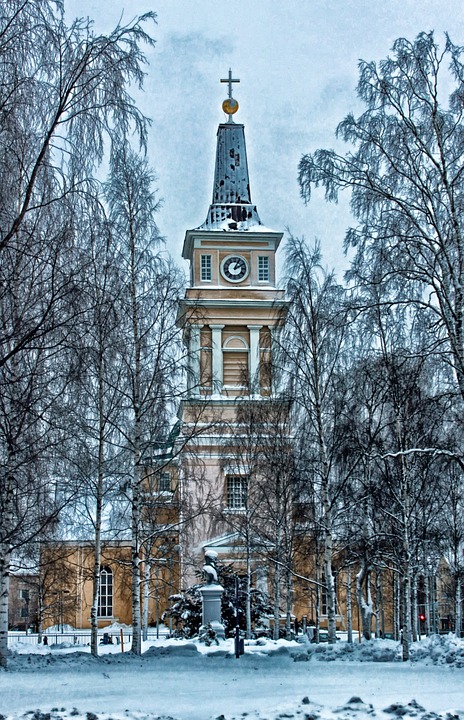
The churches themselves are uninteresting as buildings, although some of them are very old. The interiors are large and plain; the altars very simply adorned. The singing of psalms and hymns is accompanied by the organ. Some of these organs are rather old and curious, the bellows being blown by men treading on them, holding on meanwhile with their hands to a horizontal bar above their heads. Church bells ring on Saturday evening at six o’clock, not for service, but to tell people that Sunday is nigh. Services begin very early on Sunday morning, lasting, with an interval, till three o’clock; then the religious part of the day is over, and pleasure begins. About four o’clock parties of people on pleasure bent start off in boats, with hampers of provisions, to picnic in the neighbouring woods. Hammocks are a necessary adjunct, for a Finnish picnic would not be complete without them. The remainder of the day is spent in swimming, lying in the hammocks, rambling through the woods, or in any other way inclination may suggest. Ӓbo being the ancient as well as the ecclesiastical capital of Finland, it follows that the Cathedral there is interesting because of its associations and its tombs, some of which, indeed, belong to our own countrymen.
Archbishop Henry, who is regarded as the patron saint of Finland, was an Englishman. He was the crusading Bishop who, in the twelfth century, Christianized the Finns, and finally died a martyr’s death by the hand of one of them. This pagan Finn, after killing the Bishop, cut off his thumb for the sake of the valuable ring on it, and ever since a “thumb and ring” has been the crest of the Bishops. The spring at which this Bishop is said to have baptized the first converts is near the Cathedral. His tomb and those of many other noble dead stand inside the edifice. Two Scottish officers, Colonel Samuel Cockburn and General Wedderburn, who served Finland well in the seventeenth century, during the wars between Sweden and Russia, are buried here also, and monuments have been erected to tell of their distinguished services.
A very interesting tomb is that of the beautiful peasant-Queen, Katrine Månsdottir, who was always a friend to poor Finns, and much beloved by them, spending her last years amongst them, although she was a Swedish Queen. This Queen’s story is so full of pathos and romance that I must tell it to you here by the side of her tomb. Katrine was a young and lovely maiden, who sold fruit in the market-place.
One day when King Eric XIV. passed that way he noticed the pretty fruit-seller, and, being much struck by her grace and beauty, he took her to his Palace, to be cared for and educated. When she was grown up, he fell in love with and married her, this in direct opposition to his country’s wishes. His brothers and his nobles were furiously indignant at the marriage, and one of them sent the King a magnificent robe as a wedding-gift, with its beauty marred by a patch of “homespun” being let into the valuable fabric.
The gallant King had the patch embroidered in precious jewels and fine needlework, so that it became the most valuable part of the robe. He then returned it to the donor, who must have felt very small indeed when he received it. King Eric’s chivalry was not misplaced, for Katrine was a good and noble Queen, devoting her life to the King’s happiness, though it cost her so much, her life being anything but a happy one. This poor King was imprisoned by his brother, and, becoming mentally deranged, his Queen was the only person who could soothe him, so she spent much of her time in prison, too, and when the King died she gave up her crown, to find peace for her last years in Finland. A stained-glass window has been placed in the Cathedral, representing this Queen descending from the Swedish throne leaning on the arm of a Finnish page. Many interesting frescoes by Ekman also adorn the Cathedral. One of these depicts Bishop Henry baptizing the Finns. These frescoes and a mummified royal (?) baby, said to be 300 years old, complete the principal interests of the Cathedral. Another Englishman, Bishop Thomas, was Bishop Henry’s successor.
It is customary for the Finns to go to church at six o’clock on Christmas morning, the church being brilliantly illuminated with many candles. All the people attend this service, travelling from every hut or outlying farm by sleigh or on skis. The Finns are very musical, and the Finnish choirs are celebrated for their beautiful part-singing, their fame having travelled far beyond their own country. I heard one of these male choirs sing at a Scandinavian temperance meeting, held in the beautiful old island Castle of Olafsborg. There were delegates from all parts—Norway, Sweden, Denmark, and Iceland; and all who heard the singing of this choir in the old vaulted hall of the castle agreed that it was worth travelling many miles to hear such beautiful voices.
Their national anthem and songs are soul-stirring melodies, the words and tunes being very characteristic of Finnish patriotism, Jean Sibelius is a very well-known Finnish composer, his music often being played in England, and his symphonic poem “Finlandia” is very popular. Sibelius, Melartin, and Palmgren are the three best-known Finnish composers, though Menikants came to the fore lately by his opera, “The Maid of the North,” which was played in Helsingfors, and much liked.
The artists, like the composers, are patriotic in their subjects, the national life and character furnishing plenty of interesting episodes. Finnish art was practically unknown before the last century, but has made rapid strides of late years, there being now a splendid collection of wonderfully realistic pictures in the Athenaeum (the National Art Gallery) at Helsingfors. Ekman (1808-1865) is considered the father of Finnish art, for by his enthusiasm he stimulated his generation to cultivating a taste for refinement of expression of the romantic and national Finnish character. Albert Edelfelt (1854-1905) is the greatest and best-known Finnish artist, his historical and religious pictures being of world-wide fame.
Among the more celebrated artists are Viktor Vesterholm, Eero Jarnefelt, Gallen, Munsterhjelm, and others, who have pictures in the Finnish National Gallery, the people being justly proud of the patriotic spirit of their work.
Some good statuary by Finnish sculptors is also in this gallery, as well as many beautiful monuments scattered throughout the land, which testify to their ability. I must mention the poet Runeberg, a well-known national character. No book on Finland, however short, would be complete without his name. On the anniversary of his birthday all schools have a holiday, and his statue is decorated with flowers and laurels. The Academic Singers, “Akademiska Sångforēningen,” sing standing round his statue, and in the evening have a torchlight procession; all the houses and the larger offices are illuminated with candles, and everywhere his bust may be seen adorned with flowers. All the restaurants have festal dinners, and his plays are given at the theatres, over which the red and yellow flag floats, as well as over all other public buildings. Topelius was a poet and writer for children—“Uncle Topelius” the little folks call him, for they love him and his charming stories.
Thomson, M. Pearson. Peeps at Many Lands: Finland. Adam & Charles Black, 1909.
About TOTA
TOTA.world provides cultural information and sharing across the world to help you explore your Family’s Cultural History and create deep connections with the lives and cultures of your ancestors.