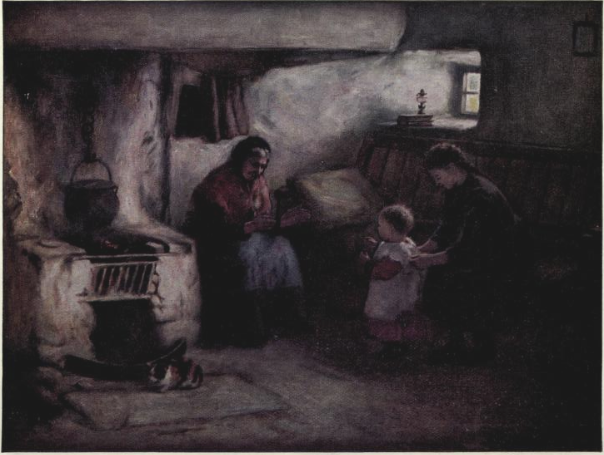

The Auld Folk
The Granny has played such a prominent part in Scottish song and story, that one might almost imagine that these old ladies were more plentiful in the past than they…

Note: This article has been excerpted from a larger work in the public domain and shared here due to its historical value. It may contain outdated ideas and language that do not reflect TOTA’s opinions and beliefs.
“The Auld Folk” from Scottish Life and Character, by William Sanderson, 1914.
The character and worth of a nation can be seen to some extent in the treatment which the aged members of the community receive at the hands of the younger generation. Judged from this stand-point Scotland ranks very high indeed, for even among the poorest great efforts are put forth to supply the wants of the old folks, the dread of the poorhouse being very strongly developed in the national heart. Those who are blessed with every comfort may sometimes be inclined to think that poverty has a hardening effect, but the gossamer thread is not more sensitive to the autumn breeze than are the hearts of the poor to the finer feelings.
The Granny has played such a prominent part in Scottish song and story, that one might almost imagine that these old ladies were more plentiful in the past than they are now. As we think of the old homes, we can hardly picture the family circle without the presence of Granny in her soo-backit mutch, spotlessly clean and carefully ironed in all its wonderful convolutions of snowy linen. She was generally known by the name she bore prior to marriage, for in days not so far distant wedded women in Scotland, especially if they were natives of the place where they spent their married life, continued to be called by their maiden names. To such an extent was this sometimes carried, that, in cases where the wife had a stronger personality than her husband, he was known as "Jean Tamson's man," or whatever her maiden name chanced to be, while the children also bore the mother's name. So common was this practice that anyone inquiring for a married woman or any of her children, by the surname which the marriage law had provided for them, would experience much difficulty in getting the desired information, as the neighbours were so unaccustomed to hearing the new name that it seemed quite strange to them.
Her thoughts turning naturally so much to the past, the Granny of course considered that there had been a great falling away in many respects since her young days; but this did not prevent her from taking a great interest in the living present, especially if that present included her own grandchildren. She belonged to a time when the belief in fairies, witches, ghosts, etc., had a firm hold upon the people, and so the stories she told the children, as they sat spellbound around her chair, were full of that poetic fire and imagination which are so often lacking in present-day tales.
To have expressed disbelief in those old-world tales and superstitions was enough to cause the doubter to be ranked among freethinkers and irreligious people, and cases are on record where the offending one has been brought before the Church courts to stand his trial for unbelief.
Though we cannot but rejoice at the advancing education which makes witches and warlocks impossible, we almost regret the disappearance of the fairies from our meadows, the brownies from our glens, and the kelpies from our streams; yet are they not still to be found in the imperishable pages of Hogg, the Ettrick Shepherd?
In all their little sorrows the bairns found a ready sympathiser in their grandmother, whose "Come to Granny" was an invitation understood and acted upon even by the youngest. Another great attraction for the children was the large pocket, often made of leather, which she wore under her dress, for in its capacious depths were stored a number of odds and ends which were a continual source of delight to the bairns.
In the households of the middle and upper classes the grandmother occupied a prominent position, and held the same opinions as her humbler sisters on modern matters. Seated in the drawing-room, arrayed in a stiff silk gown, black silk mitts, Shetland shawl, and white cap, the silver-haired old lady gave to the apartment that stately air which always accompanied the dames of the old regime. She spoke the "braid Scots" in all its purity, and the tones of our beautiful Doric seemed to be quite in keeping with her gentle and refined manners.
Although many of the older words used in Scotland are disappearing, it will be a long time before the common speech of the people is completely assimilated to English. When this is accomplished the world will have lost one of its most musical languages, for we have it on the evidence of the late Professor Max Miler, the greatest modern authority on language, that the lowland tongue of Scotland is the finest medium in the world for the expression of poetic sentiment. This being so, the greater is the pity that many of our present-day novelists and story-writers pay little or no attention to the proper spelling of the Doric, each one being a law unto himself. The results are absurd, not to say disastrous, and give point to the story of the proof-reader who applied for work at a large publishing house and was informed that they had dismissed all their proof-readers, as the firm was now publishing nothing but "Kailyard" stories.
Lord Brougham, in his installation address as Chancellor of the University of Edinburgh, said: "The pure and classical language of Scotland must on no account be regarded as a provincial dialect, any more than French was so regarded in the reign of Henry V., or Italian in that of the first Napoleon, or Greek under the Roman Empire. Nor is it to be in any manner of way considered as a corruption of the Saxon; on the contrary, it contains much of the old and genuine Saxon, with an intermixture from the northern nations, as Danes and Norse, and some, though a small portion, from the Celtic. But in whatever way composed, or from whatever sources arising, it is a national language used by the whole people in their early years, by many learned and gifted persons throughout life, and in which are written the laws of the Scotch, their judicial proceedings, their ancient history, above all, their poetry.
"There can be no doubt that the English language would greatly gain by being enriched by a number both of words and of phrases, or turns of expression, now peculiar to the Scotch. It was by such a process that the Greek became the first of tongues, as well written as spoken."
Whether it was that the grandfathers had less poetry in their natures, or that the hard toils through which they had passed had taken it out of them, it is a fact that they seemed to hold a subordinate place to the grannies, and are much less frequently mentioned in song and story. The old man was content to smoke the pipe of peace in the chimney corner, recall the Waterloo days, the year of the short corn, etc., or go out to the house-end occasionally to "look at the weather" and prognosticate coming climatic conditions. Spending much of his life in the open air, the grandfather had become weatherwise to a degree that might be the envy of the savants of our Meteorological Office, and his forecasts were in most cases quite as reliable as those which are now published daily in the newspapers. He did not depend for his data upon the highly sensitive instruments used by meteorologists, but by closely observing the natural objects around him he was enabled to foretell from the changes and modifications in their appearance the probable weather.
Frequently passing the "allotted span," the auld folk see one by one of their old friends disappearing from their view, and it is little wonder if there is a touch of sad regret in their voice as they say:
They're slowly slippin' frae oor ken
The freends we lo'ed sae weel,
As mists in autumn gloamin's fa'
Alang the valleys steal;
And though the day's last rosy beam
May licht some lofty Ben,
The shadows seem to deeper grow
Within the wooded glen.
Sanderson, William. Scottish Life and Character. Adam and Charles Black, 1914.
About TOTA
TOTA.world provides cultural information and sharing across the world to help you explore your Family’s Cultural History and create deep connections with the lives and cultures of your ancestors.