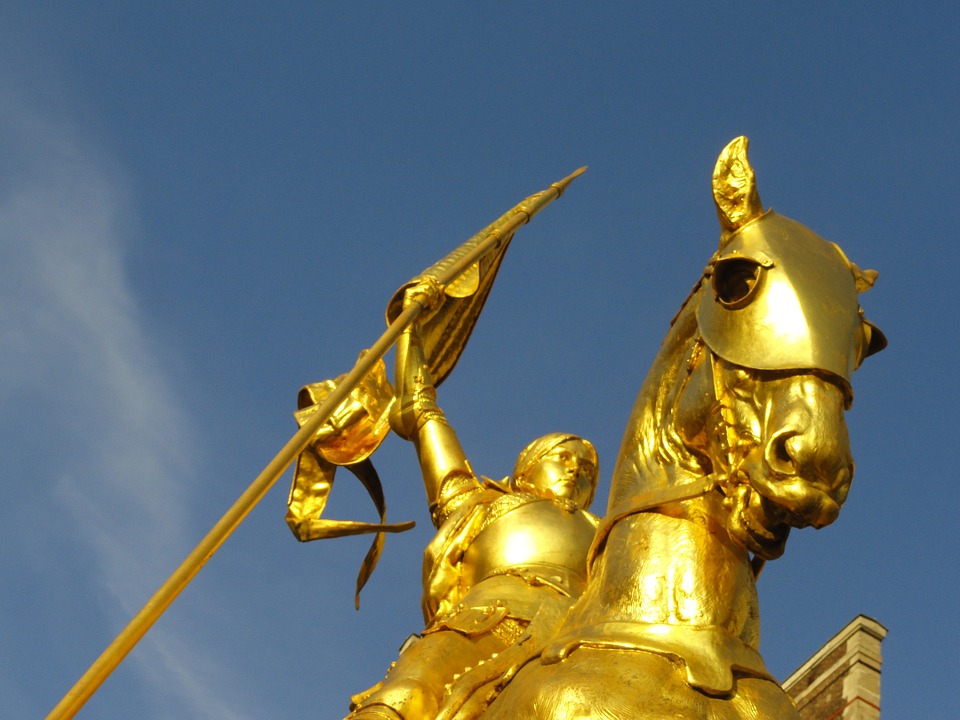

Joan d’ Arc
She declared the delight she experienced while sitting in the solitary forest and listening with rapt attention to the melodies of heaven, and seemed truly astonished at the fact that…
From: 1428 C.E. To: 1431 C.E.

Note: This article has been excerpted from a larger work in the public domain and shared here due to its historical value. It may contain outdated ideas and language that do not reflect TOTA’s opinions and beliefs.
“Joan d’ Arc” from Lives of Celebrated Female Sovereigns and Illustrious Women by Anna Jameson and Mary E. Hewitt, 1870.
Jeanne, or Joan d’ Arc, commonly called the Maid of Orleans, was the daughter of a poor peasant of Domremy, a town situated in the north-east part of France, upon the borders of Loraine. The poverty of her parents rendered her earlier years a scene of toil in menial services, and even the rudiments of education were denied her by the arbitrary power of circumstances.
Filled with that true piety which burns with so pure a flame in the hearts of many of the rural peasantry of the French provinces, her mother was a fit tutor in schooling her child in that knowledge which is so essential to the correct formation of human character, and she taught her the mysteries of revealed religion.
Joan was always of a very imaginative temperament; and, when yet a mere child, she would often stray away from her companions into the forest shades, and there hold imaginary intercourse with celestial visitants. The ruling passion of her life was religion, and upon that topic all her thoughts, and conversation, and actions hinged.
Although circumscribed by poverty to a narrow and humble sphere, yet, as she approached toward womanhood, her rare personal charms and strongly-developed intellect won for her the admiration and esteem of all. She left her father's house, and engaged as a seamstress in the neighboring town of Neufchateau, where she pursued her new avocation with industry for five years. Her beauty attracted universal attention, and many advantageous proposals of marriage were made, but by her promptly refused. Her affections were too firmly set upon religion to be disturbed by or divided with the things of earth, aud she sought no other intercourse than the presence of angels and saints. Her monomania in that respect increased with her years; and with asseverations of truth, she frequently declared that she had held audible conversation with the angels Michael and Gabriel, and saints Catherine, Margaret, &c.
She declared the delight she experienced while sitting in the solitary forest and listening with rapt attention to the melodies of heaven, and seemed truly astonished at the fact that none but herself were permitted to enjoy those celestial concerts. At the age of sixteen another passion, equally strong with religion, claimed a share of her affections.
This sentiment was patriotism pure, unadulterated love of country, and a sincere desire for the promotion of her country's welfare. Peculiar circumstances conspired to render this passion strong to its fullest extent, and opened a wide field for its perfect development. At this time, (1428,) England claimed the sovereignty of France, and by the power of the sword, and the right of might, held possession of a greater part of the kingdom. The Duke of Bedford, uncle to Henry VI., the reigning monarch of England, resided in Paris, and acted as regent for his nephew; while Charles VII., the lawful emperor of France, by birth possession of the throne and the almost undivided love of the people, was a refugee in one of the frontier towns. English troops were garrisoned in all the cities and considerable towns, and a powerful army was daily extending its unlawful encroachments. Cruel retribution followed every resistance of the inhabitants, and fields and vineyards, towns and hamlets, were destroyed by the invading foe.
These events made a strong impression upon the ardent imagination of Joan, and she conceived the bold idea that she was commissioned by heaven to be an instrument in effecting the deliverance of her country. Conscious of what was the proper sphere of woman, she felt that her sex was degrading to her spirit, for it denied her the privilege of engaging in the martial pursuits necessary to the fulfilling of her mission. But her enthusiasm broke down every barrier, and she engaged in every manly exercise calculated to invigorate her frame and give her that knowledge she so much needed in the enterprise in which she was about to embark. She soon became an unrivaled equestrian, and managed her horse with all the skill of the bravest knight. These exercises gave an increased glow to her beauty, and she became an object almost of adoration. The superstition of the times invested her with divine attributes, and the idea took possession of the minds of many of the lower class that she was the Virgin Mary, sent at this inauspicious moment to deliver France from a foreign yoke.
On the 24th of February, 1429, Joan first entered the royal presence, and offered her services in restoring to the emperor his crown, and to her country its liberty. Charles was at this time at Chinon, a little distance from Orleans. The latter city had warmly espoused his cause, and at the time in question was strongly besieged by the English, led on by the traitor Duke of Burgundy, who had been one of the most powerful vassals of the French crown.
The emperor had heard of the extraordinary young maiden now before him, but he had conceived her to be a tattered menial, urged on by fanaticism that had displaced weak judgment from a weak head, and at first refused her an audience. But, when assured that the applicant was no crazed mendicant, he gave her permission to enter. The emperor was filled with astonishment; nay, some secret impulse awakened feelings of awful reverence in his bosom, when the maiden, armed cap-a-pie, stood upright before him, without paying even that obeisance expected from every subject. She uncovered her head, and her dark hair fell in profusion upon her mailed shoulders. The excitement of the moment gave increased animation to her countenance, and she seemed to the astonished monarch as a lovely angel, truly commissioned by Heaven for some mighty deed. Joan first broke silence.
"I come," said she, "not in the strength of steel, but mailed in the panoply of righteousness, to offer my services to my king and country. I ask not the royal signet as a proof of my commission; my credentials are from Heaven my chief sovereign, the Lord God Omnipotent. I have heard a voice of wail go up from hill and valley. I have seen the rich vineyard trampled down by mercenary warriors. I have beheld the frequent glare at midnight of consuming villages and hamlets, and yet, amid all this desolation, I have been obliged to sit and sigh over the weakness of my countrymen, and the uncurbed strength of the foe. The darkness has deepened over my beloved land, but light now streams upon it. The arm of a woman, in the hands of God to effect a mighty deliverance; will an earthly sovereign refuse her permission to lead his armies? At this moment the walls of Orleans are giving way to the battle-axes of the enemy, and Chinon will be next invested by English soldiers, and thus the last hope of France will depart. Heaven has issued its mandate; be thine concurrent, and Joan d' Arc will on to the rescue.
Charles hesitated not a moment in granting the young enthusiast the boon she asked, and preparations were immediately made to execute the enterprise. The monarch was a man of much sagacity, and he employed every means to invest the maiden, and everything appertaining to her, with a supernal character, for he knew that the prevailing superstitions of the time would, in such a connection, give increased vigor to the soldiery. Everything being in readiness, the maid mounted a white steed, and with a banner of the same hue, dashed forward at the head of brave and enthusiastic troops for Orleans. She charged upon the enemy with terrible force, and despite the most desperate efforts of the foe, she succeeded in entering the beleagured city. Fresh courage animated soldiers and citizens, and on the eighth of May, the English, who had encompassed the city for more than six months, raised the siege, and retired in terror and confusion.
This was but a beginning of her achievement. A few days after, she was victorious at the battle of Patay, where two thousand five hundred Englishmen were slain, and more than twelve hundred taken prisoners, among whom was the generalissimo, the brave Talbot. This, with the capture of Orleans, was a death-blow to English power in France; and town after town now opened its gates to the French troops, led on by Joan d' Arc. Rheims at length surrendered, and on the 17th of July, scarcely five months after this extraordinary young woman first grasped the sword, in her country's cause, the dethroned monarch was solemnly consecrated and crowned in the cathedral of this last conquered city.
Having executed the mission which she deemed Heaven to have given her, Joan laid aside the panoply of war, again assumed the costume of her sex, and, in the character of a meek and humble woman, presented herself before the emperor, and petitioned his leave for her to retire to the quiet and obscurity of her native village. But the monarch, truly grateful, entreated and even commanded her to remain in public life. Honors were lavished upon her; letters of nobility were granted to herself and family; a medal was struck, in commemoration of her achievements, and the name of Joan, d' Arc became familiar in every place and cottage in Europe. At the earnest solicitation of Charles, she again took command of his troops, and for more than a year her career was one of brilliant exploits, in contending against the English, who yet lingered on the borders of stance with the vain hope of regaining the territory they had lost.
But how pure soever the spirit, however noble the soul, however valorous and great, wise and good, an individual may be, he invidious monster, jealousy, will ever be creating a progeny of calumniators, or worse foes, to frustrate his designs and eclipse his well-earned glory. Such was the case of the Maid of Orleans. When all was commotion when victory after victory, in rapid succession, was working out the political redemption of France, all were ready, from monarch to vassal, to bow the knee of reverence to the instrument of good. But the tempest at length subsided, and French generals felt themselves disgraced in being led on to battle by a woman; and even the French monarch forgot the services of a brave conqueror in restoring to him his crown, in the reflection that she was but a poor country girl!
On the 24th of May, 1430, while valorously defending Compeigne from the attacks of the army of the Duke of Burgundy, the treacherous governor shut her out from the very city she was gallantly defending; and after performing prodigies of valor, comparatively alone, she Was overpowered by superior numbers, and compelled to surrender to the enemy. She fell into the hands of John of Luxemburg, and a short time afterward, she was actually sold by him to the Duke of Bedford, for ten thousand livres! She was then taken to Rouen, and there arraigned
before the ecclesiastical tribunal, charged with being a sorceress. From the time of her capture till the moment in question, the ungrateful monarch to whom she had given a crown and a kingdom, made not a single effort for her liberation, and the poor girl was left entirely to the mercy of a personal foe, and a foe to her common country.
At that age, when even suspicion was sufficient to convict of heresy in religion, and with such powerful accusers as charged her with Sorcery, Joan had but little mercy to expect from a tribunal of corrupt bigots. Every device was used to afford sufficient testimony to give the coloring of an excuse to their unholy proceedings, and she was vexed with a thousand questions irrelevant to the subject, with the hope of eliciting some answer that might be construed into heresy. For nearly four months she was daily brought out of prison, where she was kept on bread and water, and obliged to pass the ordeal of severe questioning—questioning, often the most absurd. On one occasion she was asked, whether at the coronation of Charles, she had not displayed a standard, consecrated by magical incantation? She replied, "My trust was in the Almighty, whose image was impressed upon the banner, and having encountered the dangers of the field, I was entitled to share the glory of Rheims. I serve," continued she, with uplifted hands, " I serve but one master acknowledge but one sovereign, and he is our common Father. Ye have threatened me with excommunication ye have threatened me with stripes, and chained me in a dungeon, and now ye threaten me with the fire and fagot. Ye may burn this tabernacle, but the soul that dwelleth in it, ye cannot harm; and that God whose arm bears me up in this affliction, is also your Judge. My faith is in Christ the Lord, and your threatenings fall upon my ear and heart like idle words. Do with me as ye see fit your reward will soon follow."
During all of her examinations, she betrayed no weakness; and when at length she was excommunicated and sentenced to be burned at the stake, her strength failed her not. On the 12th of May, 1431, she was taken from the prison under an escort of one hundred and twenty armed men. She was clad in female apparel, and upon her head was placed a paper crown, inscribed, "Apostate, heretic, idolatress." She was supported by two Dominican friars, and as she passed through the thronged streets, she exclaimed, "Oh, Rouen! Rouen! must thou be my last abode!" She uttered blessings on the people as she passed, and supplicated Heaven to have mercy upon her accusers, judges, and executioners.
Seated upon the scaffold was the English cardinal of Winchester, the Bishop of Terouanne, Chancellor of France, Bishop of Beauvois, and the other judges. To these the heavily-fettered maiden was delivered, and she ascended the scaffold with her face bathed in tears. Her funeral sermon was then preached! yes, in view of heaven, a professed ambassador of the meek and merciful Jesus preached the funeral sermon of a living, weak, defenceless, innocent girl! And she was then handed over to the secular officers to be put to death. Before she descended to mount the fatal pile, she knelt down and prayed Heaven to forgive all. Nor was the ungrateful Charles forgotten in her last moments, and she invoked the blessing of Heaven upon him and her country.
As she arose from her knees, one of the judges said, "take her away!" and the executioner, trembling like an aspen, advanced, received her from the guards, and led her to the funeral pile. She asked for a crucifix, which being given her, she kissed it, and pressed it to her bosom. The fagots were lighted, and in a few moments she was surrounded with flames. An awful silence pervaded the multitude, and no voice was heard but that of the dying martyr, whose lips, until seared by flames, uttered the name of Jesus, mingled with the groans which the violence of her anguish extorted from her. By order of the Bishop of Winchester, her ashes were collected and thrown into the river.
Thus died this extraordinary maiden at the age of nineteen years, to whom, Hume justly observed, " the more liberal and generous superstitions of the ancients would have erected altars." This last tragedy in the drama of her wonderful career, is an eternal stigma, not only on the two nations immediately concerned, but upon the age in which she lived; and the actors in the scene, however much they may be robed in sacerdotal dignity and reverence, should receive the execrations of the good in all ages, as fit brethren for the Neros and Cali- gulas of ancient Rome. Twenty years afterward her mother demanded and obtained a reversal of her sentence, and by the Bishop of Paris her character was fully cleared from every imputation of guilt of the crimes of which she was accused. At Orleans, Rouen, and various parts of France, monuments were erected to her honor; and by a bull of Pope Calixtus III., she was declared a martyr to her religion, her country, and her king.
Jameson, Anna, and Mary E. Hewitt. Lives of Celebrated Female Sovereigns and Illustrious Women. Porter & Coates, 1870.
About TOTA
TOTA.world provides cultural information and sharing across the world to help you explore your Family’s Cultural History and create deep connections with the lives and cultures of your ancestors.