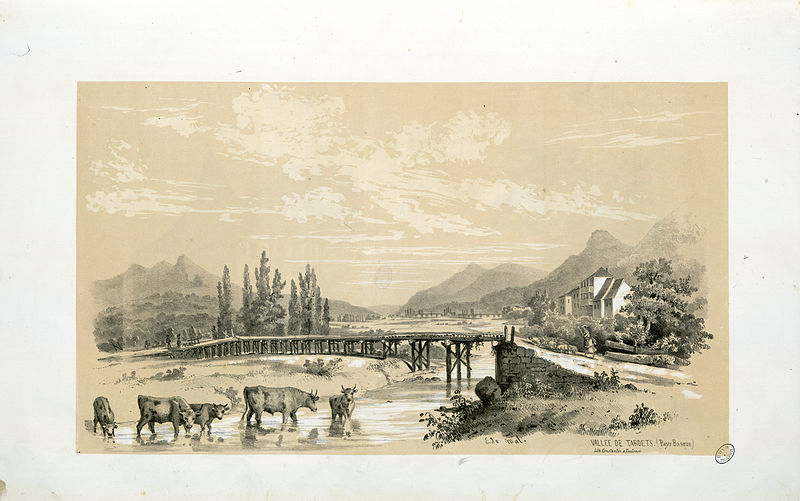

A Market Day in Tardets
If you take the steam train at Oloron for Tardets, you will find yourself started upon a most amusing journey, for you wander along with the utmost deliberation, making intimate…
Location: Tardets-Sorholus

Note: This article has been excerpted from a larger work in the public domain and shared here due to its historical value. It may contain outdated ideas and language that do not reflect TOTA’s opinions and beliefs.
“A Market Day in Tardets” from The Basque Country by Romilly Fedden, 1921.
Of the three Basque provinces in France, Basse-Navarre, Labourd and La Soule, the last is the one to which we must look as the stronghold of the ancient customs and traditions. When you say “La Soule,” you mean the valley of the Saison (Uhaitz-Handia), the river which rises in the high wild region of Bassa-Buria, tmder the pass of Ste. Engrâce, rushes through the deep gorge of Cacouette, passes the village of Ste. Engrace, which gives its name to the pass above, waters the narrow valley where lie the villages of Licq and Etchebar, Larrau and Lichans, and runs on to Tardets, the town on the first plain, then to Mauleon, the second town, and finally, as we have seen, passes beneath the walls of Sauveterre in Bearn, which guards the entrance to the valley.
If you take the steam train at Oloron for Tardets, you will find yourself started upon a most amusing journey, for you wander along with the utmost deliberation, making intimate acquaintance with barnyards and back-doors, meandering slowly across fields and through lanes, and threading village streets where you could shake hands with the smiling peasants in the cottage windows. As it is market day in Tardets there are crowds of peasants waiting at the stations, and you get delightful glimpses of life and manners as well as of the countryside itself. There is good excuse for the slowness of the train, for you are ascending the valley of the Baretous, and you continue to rise, past the villages of Aramits and Arette and Lanne, the first Basque village, till you reach the crest of the Col de Lapixe, From there you begin a slow and winding descent, enlivened by the information of a government traveller in wood, who is eager to point out every view, every peak and village. It was he who told us about the chien de Montory, and, as the train wound around the top of a hill, pointed out to us a farm far below and on the other side of the valley.
Already peasants were hanging out of the carriage windows watching for one of the pleasures of the weekly journey to market. We were not to be disappointed, for suddenly out from the farm shot a tiny black moving speck which took a mad course towards us, upward and across the opposite side of the valley. Delighted yells of recognition encouraged the moving spot, which soon resolved itself into a small and excited black dog, which came tearing up the hill below us and finally ranged himself alongside the moving train for what was evidently a glorious gallop. Barking and frisking, and positively laughing with intelligence, he kept even with us, only pausing to catch the offerings of sugar and biscuits which were thrown to him from the carriage windows. He accompanied the train across the valley, where it finally passed close to the door of the farm. There, with one laughing frisk, he left us, and the last we saw of him he stood before the farmhouse door, panting and wagging his tail, as he watched us out of sight.
From Montory, the railway follows the Gaslon down the valley to Tardets, However much you may grow in time to dislike the dust and dirt and noise of a market day, there are certain places where one should not miss the market, where the colour and movement add greatly to the picture. This is true of Tardets, where the market is held on a Monday. There the somewhat sad-looking triangular square surrounded by arcaded steep-roofed houses, grey and buff and mauve, was already filled with baraques, where the usual wares were on sale under cream-white or red awnings. Oranges and lemons from over the passes overflowed great baskets of Spanish weave. Dates, figs and raisins were heaped on large flat round woven trays. Set out upon a green canvas on the ground was the earthenware, pots and jugs and ecuelles of yellow and brown. Here, too, on the cobbles stood a massed array of brass and copper—cowbells and sheepbells and kettles. Goats’ milk cheeses and brown and cream-coloured eggs in large panniers waited for the wholesale produce dealer to come and buy them; red-faced, prosperous, oily young men with an urbane air, who arrive at all the markets in their small motor vans, joke with the women, lunch on the best at the inn, and then roll out of the square with waving hand to the prettiest girl.
To-day all the women were buying hats, large, flat-brimmed, conical-crowned shade-hats of fine black or white straw for wear under the hot sun of the high mountain sides. Many more were buying espadrilles , the rope-soled canvas shoe worn by the peasants everywhere in this country, and which are made with such skill by the village cordonmer. They are delightful footgear for these mountains, so light that you do not feel them, and yet strong and giving a secure hold on the hill-sides. The little square is crowded. Under the deep arcades, along two sides, the carts are ranged closely, wheel to wheel, while horses and mules stand and stamp, tied to cart-tails, or to rings in the walls under the arcades.
Wedged into every corner are the little grey donkeys with their huge panniers—the long-suffering, hardworked, clever little beasts, despised by their masters, who have a contemptuous proverb which says “The ass carries the wine and drinks water.” But the little mouse-coloured beast of burden is none the less the peasant’s best friend. The poorest can afford one, while mules are for the prosperous, and horses a luxury for the rich. Seeing the work they have to do, you wonder if ever they get a rest. Are the donkeys given a half-holiday in honour of St. Blaise, or does the Basque farmer, when he goes to the 'pardon of the patron saint of animals, take only a few hairs to burn from the tail of his more important farm friends—from his cows and his mules and his horses, considering the little ass not worth a mass at fifty centimes? You wonder.
The crowd itself is quiet. There is less gaiety, fewer jests than in Brittany. There is no vendor of songs. Here are men of typical Basque physiognomy. The young men are handsome, brown-eyed, with hair of deepest brown, fine foreheads, long noses, neat, well-shaped heads set on broad, rather square shoulders, with well-rounded throats, compact body on slim muscular legs, small hands and feet—the whole giving an impression of balance and flexibility. The older men, brown-faced with thick grey or white hair, have a crafty look in their sharp, long-nosed faces. All are clean-shaven. It is a good-looking race, which breathes self-reliance, dignity and freedom. Every man in the market carries a staff, the makila, and many carry the double-ended sack, bussac handwoven, generally of red and blue, which are heirlooms in the family. Most of them are dressed in short black jacket and velveteen trousers. All, without exception, wear clean white cotton shirts, open at the throat, and some have a scarlet sash folded tightly around their hips. A few wear a short linen blouse, falling from a yoke loose to the waist. The women, young and old, are dressed in neat black; the married women wear a black handkerchief folded about the coil of hair, with the addition of a gold chain and large brooch. The girls wear a lace mantilla.
Beyond the square by the street which is also crowded with carts and men drinking outside the wine-shops, you reach the cattle market. Pigs and cows and oxen fill the road which is already trampled to mire. Up the rocky hillside are the sheep and the long-haired mountain goats.
The Basque cows, like their masters, are small, quick and fine. They are full of intelligence and many are the tales told of their perspicacity. In summer time, when they go up to the high pastures, many hundreds from the villages of one valley are often in the care of one man. It happens that if the cows of the same collage or farm do not like the pasture, they take counsel amongst themselves and, early in the summer’s morning, quietly leave the mountain, following their leader sometimes as many as fifty or sixty kilometres down a way that they have only followed once and, when the evening shadows fall, the whole herd comes home.
The Basques are very fond of their animals and the cows are each called by name. The dog, however, though respected as the guardian of the house, the keeper of the flock and the family friend, is always called Nagarro.
The oxen, which stand yoked in pairs, are of great value. They are magnificent beasts, like the Lombardy oxen—powerful, well-trained, and of the same beautiful cream-fawn colour. Great care is taken of them. They always wear a heavy linen sheet, striped with dark blue at the sides, and a white sheepskin under the wooden yoke, while a net trimmed with red pompons keeps the flies from their faces.
Lunch at the Hotel des Pyrenees, which you enter under the arcade, was made interesting by the keen conversation of a table full of better-class Basque farmers, who talked of the relative merits of their sporting dogs—breed, training and exploits. The trout we had reminded us of the fishing fame of the little river Licq, which runs into the Saison a short way up the valley.
In the afternoon the atmosphere of the market, as usual, was one of slight inebriety; steps were unsteady, gestures vague and tongues fluent. The women kept to themselves in groups, or patronised a Spanish fortune-teller, whose blue-black hair escaped from an orange-coloured handkerchief. Even from the balcony above, it was easy to see by her expression and manner that she was a gipsy born.
With the home-returning market folk we followed the road as it winds by the river through the narrow valley between steep hills. The farther we went the thinner grew the line along the main road, as families turned aside to follow lanes and steep paths to the farmsteads far up on the mountain sides. The young men on foot swung along with a free, light stride, the coat thrown over the left shoulder, the beret on the side of the head. The poorer women rode sideways on their little donkeys ahead of the heavily laden panniers, their arms full of parcels and the inevitable umbrella. A Spanish side-saddle with a shelf for the feet, as seen in old pictures, made a comfortable seat for the woman on the back of ambling mules which carried the man astride behind. This, when the cavalier had a pretty girl seated before, was a very convenient arrangement for intimate conversation. The rich and elderly farmers, the beret pulled over the forehead to shade the face, were usually mounted on stout little horses, whose bridles and headstalls were of coloured leather ornamented with brass nails, and whose saddle-cloths were of homespun cloth-with initials and designs inwoven, or of velvet richly embroidered. Behind the saddle the brightly coloured bussac hung down on each side the horse’s flanks, and a sheepskin protected the rider’s legs from the cold and recalled the schaffes of the cowboy on the American plains.
At Licq we turned back. The sun, setting in a glory of rose and gold, flooded the valley in spaces of light, broken by deep purple shadows. The sky above was of turquoise blue, and where the last beams of the sun struck between the hills, it touched into transflguration every leaf and flower of the woodside—the wild box, the spikes of blue monkshood, the white of may, the cream of elder, the snow sprays of wild cherry, the rose of wild apple, the purple jewels of the columbine, and turned the swift-flowing river to aquamarine.
Tardets was not free of the exhilaration of the market until late in the night, when the last band of young revellers took their way homewards, breaking the mountain stillness by the wild and startling Irrezhia, the Basque war-cry, which has echoed down the centuries.
Fedden, Romilly. The Basque Country. Houghton Mifflin Company, 1921.
About TOTA
TOTA.world provides cultural information and sharing across the world to help you explore your Family’s Cultural History and create deep connections with the lives and cultures of your ancestors.