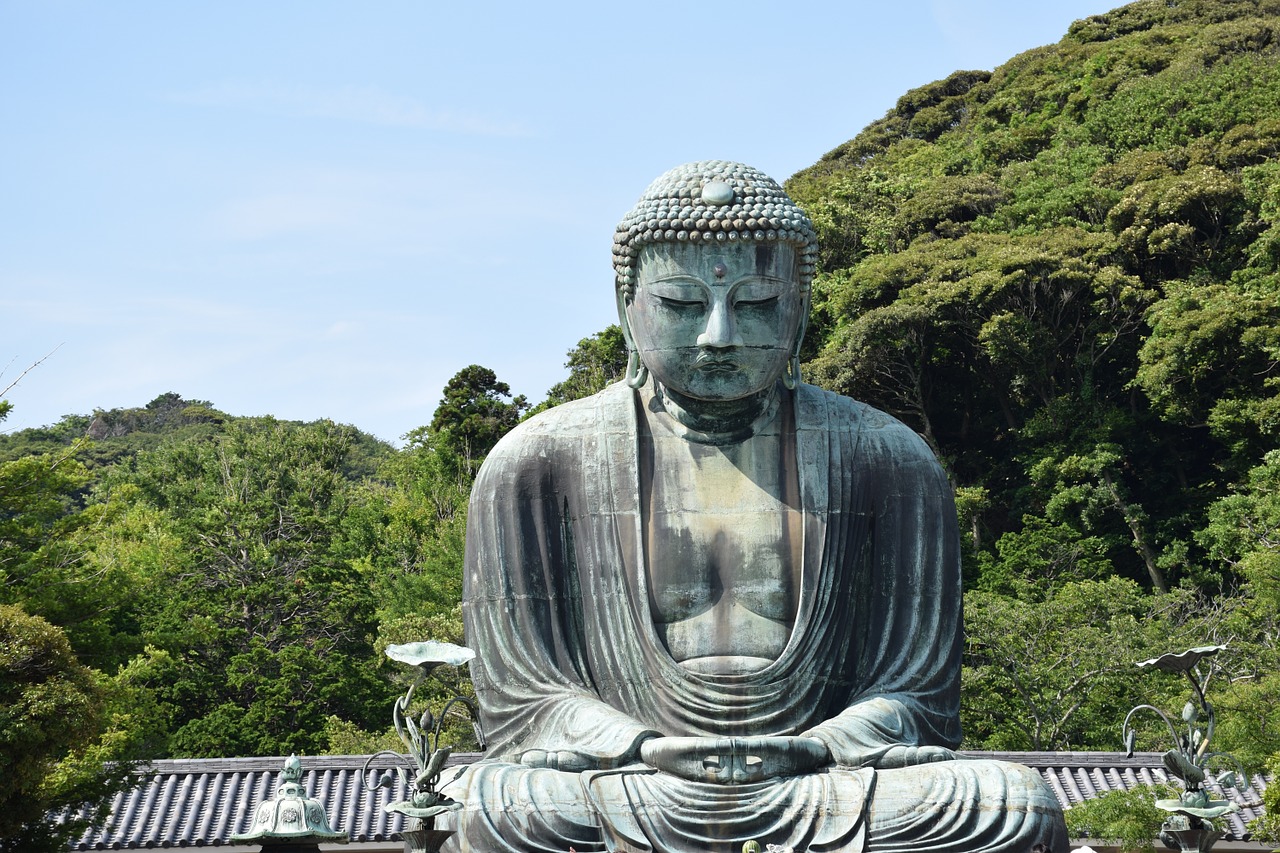

The Wonder of Bronze
It is not easy for anybody to think that such a wonder of human creation (Daibutsu great and eternal) ever stands quite near the station at Kamakura
Location: Kamakuru, Japan

Note: This article has been excerpted from a larger work in the public domain and shared here due to its historical value. It may contain outdated ideas and language that do not reflect TOTA’s opinions and beliefs.
“The Wonder of Bronze” from Kamakura by Yoné Nogushi, 1910.
We have also a time quite frequently when a little dissatisfaction at once turns even to a full-sized cynicism, and like a foreign traveller who has become suddenly sad, losing all excitement as things grow familiar, we feel even a ridiculous littleness in houses, in gardens, in everything, above all in the set manners. It is at such a time that we take the most indifferent attitude, as if we were not all in part responsible, and gladly speculate in cold blood upon the degradation of modern Japan. Where is artistic surprise, a thing wonderful and intense? There still in fact exists such, if one knows where to find it (Japan is not wholly lost); and if you see it at the unexpected corner, particularly when you are in a bad humour, your joy will be surely doubled. It is exactly my own case whenever I see the Daibutsu " O, holiness, holiness!" and it is singular enough that the place where the statue dwells always appears to me strange and sudden.
(I assure you, however, I have seen it a hundred times). And at least I make myself believe the place is sudden and strange to make my prosaic life interesting with a happy break. Indeed, Japanese life is not so romantic as it is written in a story.
It is not easy for anybody to think that such a wonder of human creation (Daibutsu great and eternal) ever stands quite near the station at Kamakura; it is not much more than one mile from there, taking the main thoroughfare at the right I am sure you would never think that you will come at the end to anything worthy, when you see about yourself a common sort of country town of modern Japan not much different from the others, perhaps less individual and striking, because ambition looks merely to going into commercialism; and you cannot, under the heaven, make yourself believe the town is connected with one of the greatest arts that today exists. If you are not sure the great idol of Buddha is waiting for you at a certain place, you will, I believe, turn back at the start as quick as you can. It is true it will wait for your coming, if necessary, even one thousand years.
This may be a proper place to tell you that this town of Kamakura, the great seat of the Shoguns from 1189 onward, and of the so-called Regents of the Hojo family during the troublous Middle Age, was the city of religious faith and art; and being taken by storm and burnt to the ground in 1455 and again 1526, it gradually lost its importance. You would see that the ancient city of Kamakura was not altogether uncongenial to your artistic temperament, and can well suppose that the great idol found quite a satisfactory home. Where is to-day a shop of picture cards and souvenirs there stood in olden day a mansion or castle of fighting heroes; where to-day we see a restaurant even with a sign-board in English may have been the home of an eminent sword-smith or painter. Kamakura is nothing if she has no history; for the sake of that history we try not to see the present.
I do not think it necessary to tell you to turn to the right after you have followed the main road; you can trust in your artistic impulse in turning right; and when yon once have turned right, you are already under the soft and gray Buddhistic atmosphere, and even feel the influence of the great idol. There is only ten or fifteen minutes walk before you reach the temple gate where the Niwo, the guardian gods, watch for any undesirable intruder. And you see face to face the great holiness right beyond the gate, having a long courtyard in good order between.
Professor Chamberlain says in "Things Japanese": "He who has time should visit the Daibutsu repeatedly; for, like Niagara, like St. Peter’s, and several other of the greatest works of nature and art, it fails to produce its full effect on a first or even on a second visit; but the impression it produces grows on the beholder each time that he gazes afresh at the calm, intellectual, passionless face, which seems to concentrate in itself the whole philosophy of Buddhism, the triumph of mind over sense, of eternity over fleeting time, of the enduring majesty of Nirvana over the trivial prattle, the transitory agitations of mundane existence."
That is said beautifully and truly. But if you know the Daibutsu’s real measurements you will be surprised at its large scale and great size; and yet you must have a power to perceive a wonder of its proportion. The measurements are as follows:
Height: 49 Ft. 7.00 In.
Circumference: 97 Ft. 2.20 In.
Length of face: 8 Ft. 5.15 In.
Width from ear to ear: 17 Ft. 9.20 In.
Round white boss on forehead: 1 Ft. 3.47 In.
Length of eye: 3 Ft. 11.60 In.
Length of eyebrow: 4 Ft. 1.98 In.
Length of ear: 6 Ft. 6.54 In.
Length of nose: 3 Ft. 9.22 In.
Length of mouth: 3 Ft. 2.08 In.
Height of bump of wisdom: 9.52 In.
Diameter of bump of wisdom: 2 Ft. 4.56 In.
Curls (of which there are 830):
Height 9.52 In.
Curls (of which there are 830):
Diameter: 11.90 In.
Length from knee to knee: 35 Ft. 8.40 In.
Circumference of thumb (say) 3 Ft.
The eyes are of pure gold and the silver boss weighs 30 pounds avoirdupois. The image is formed of sheets of bronze cast separately, brazed together and finished off on the outside with the chisel.
It is not out of place to tell a bit of its history, I believe. It is said that there has been a temple in the place since the 8th century; but its precise history is involved in obscurity. Tradition says that the Shogun Yoritomo, when taking part in the dedication of the restored Daibutsu at Nara in the 6th year of Kenkyu (1195), to which place he had been called by the Emperor to supervise the ceremony, conceived the desire of having a similar object of worship at his own capital of Kamakura, but died before he could put his plan into execution. Itano no Tsubone, one of his waiting ladies, undertook to collect funds for the purpose and the priest Joko assisted her with such devotion that in the 1st year of Gennin (1224) the first image which was of wood was begun to be built, and it was completed in the first year of Rekinin (1238). A splendid chapel was also constructed here in the first year of Kwangen (1243); but in the autumn of the 2nd year of Hoji (1248) the chapel was overthrown by a storm, and the image badly damaged. And Itano no Tsubone was called to action, being assisted by the Shogun Prince Munetaka, who provided the metal to cast a bronze image and restored the temple in all its former splendor. The image was commenced in the 4th year of Kencho, and the maker was Goroyemon Ono, an artificer of Yanamura of the Kadzusa province. It is indeed sad that nothing is known about him; but his glorious work remains as it is. It was the first time that such a marvelous piece of metal work had been success fully attempted in Japan, and the perfect mastery of form and beauty andgrandeur of outline is a great triumph of Japanese art.
It is in the words of a true friend that John La Farge said: "Like all work done on archaic principles, the main accentuations are overstated, and saved in their relations by great subtleties in the large surfaces. It is emphatically modeled for a colossus; it is not a little thing made big, like our modern collossal statues; it has always been big, and would be so if reduced to life-size."
Further he remarks: "Astounding success of the artist in what he has really done, for there is no trace of means; the sum of realism is so slight, the conventional has so great a part; each detail is almost more of an ornament than of a representation. One almost believes that the result may be partly accidental, that as one cannot fathom the reason of the expressiveness of a countenance, or of the influence of a few musical notes, so it seems difficult to grant that there were once many paths opened before it.
"And still more do I believe that the accident of the great tempest has given a yet more potent and subtle meaning to the entire figure. Once upon a time its details indeed, if not its entirety, must have looked more delicate in the reflected light of the temple building, when the upper part of the figure glittered in answer to the opening of the doors. But could anything ever have rivaled the undecidedness of this background of veiled sky and shifting blue, which makes one believe at times that the figure soon must move? As one looks longer and longer at it, with everything around it gently changing, and the shadows shifting upon its surface, the tension of expectation rises to anxiety. The trees rustle and wave behind it, and the light dances up and down the green boughs with the wind; it must move but there is no change, and it shall sit forever."
Indeed, it is far better to see this gigantic divinity of bronze with folded hands, and head inclined in ecstatic contemplation, in the open air rather than in the house, because we can go straight, with its presence right before our faces, now looming above the trees, then almost appearing to move through their openings into the true heart of Mother Nature, the hills, the sky (what depth!), the sunshine and air ; to truly understand it is the very way of one’s own salvation. When you look upon the Daibutsu’s unwinking, changeless face perfectly free from all the disturbance of the world which is always subject to time and change, you are entering into the state of Nirvana already on the spot. It is here that once I wrote:
I that sit in your haven am a sea-tossed boat;
I lay my body and sail under your breath.
You that pitied me, you that greeted me,
Oh, what a scent that is the Lord Buddha’s!
Here the air, mist-purple, is laden with prayer;
Ah, let me join to your prayer and soul!
(Ah, Holiness, Holiness!)
Touch me, heal my sea-wounded heart!
Your hand, blessed, is but the Nirvana’s.
It has been my joy now for many years to see it and linger about it in Spring or Autumn, under the sunshine or rain; I see its soft gray and violet tone when a faint but lovely Autumn fills fully the little hollow the haven of peace and prayer; and when the hot Summer light falls on it, its color is curiously pale. I again agree with Mr. La Farge that it was just as well not to have any imposing monuments like the great cryptomeria round here, as the whole impression comes only from the statue; he was always right in the matter of art.
Noguchi Yoné. Kamakura. Kelly & Walsh, 1910.
About TOTA
TOTA.world provides cultural information and sharing across the world to help you explore your Family’s Cultural History and create deep connections with the lives and cultures of your ancestors.