
Seattle Laid Off and Named
Toward spring Bell, Boren and myself began to look for claims. We had looked up the coast toward Puyallup during the winter and did not like the prospect. In the…
From: 1852 C.E. To: 1857 C.E.
Location: Seattle, Washington, United States of America

Note: This article has been excerpted from a larger work in the public domain and shared here due to its historical value. It may contain outdated ideas and language that do not reflect TOTA’s opinions and beliefs.
From Pioneer Days on Puget Sound by Arthur A. Denny, 1908.
Seattle Laid Off and Named.
"Now the work goes bravely on." — Richard III.
Toward spring Bell, Boren and myself began to look for claims. We had looked up the coast toward Puyallup during the winter and did not like the prospect. In the month of February we began exploring around Elliott Bay, taking soundings and examining the timber. Piles and timber being the only dependence for support in the beginning, it was important to look well to the facilities for the business.
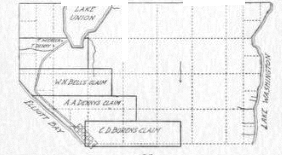
After a careful examination of the harbor, timber, and feed for stock, we, on the 15th of February, 1852, located and marked three claims in one body.
The southern boundary we fixed on the point at what is now the head of Commercial street, and on the north where Bell and D. T. Denny, who soon after located his claim, now join.
We had left our stock in the Willamette valley to winter, and our plan was to get the stock over and then divide and move onto our claims.
First three claims in Seattle. Images from text.
On the 23d of March the "Exact" came in on her return from the gold expedition, having failed to find anything of interest. Boren and my brother took passage on her to Olympia on their way to the valley for the stock, leaving Bell and myself in charge of the claims and families.
I am under the unpleasant necessity of again speaking of the inconvenience of illness, situated as we were. During the winter we did not shake with ague, but had not fully recovered, and before the return of the boys with the stock we were all down again, shaking every other day, and so continued until August. This was a very embarrassing situation for me, but I do not now remember that I ever felt particularly despondent or like giving up the struggle, for struggle it truly was.
On the 31st of March Dr. D. S. Maynard arrived at Alki in company with Seattle and a number of his tribe, who had been stopping at Olympia during the winter. Their object was to establish a camp for fishing, and the Doctor was intending to pack salmon when the season for them came.
After an examination of the point, now called Milton, and other places on the bay, they selected the southern point on our claims. Maynard at first declined to take a claim, stating that he only wanted a temporary location to pack fish for the season, but on further consideration he concluded to accept our offer and make a permanent location. We accordingly moved our boundary north to what is now the south line of Mill Street in order to accommodate him with a claim.
On April 3, 1852, Bell, Boren's family and Maynard moved over, leaving myself and family too unwell to move until a house could be built.
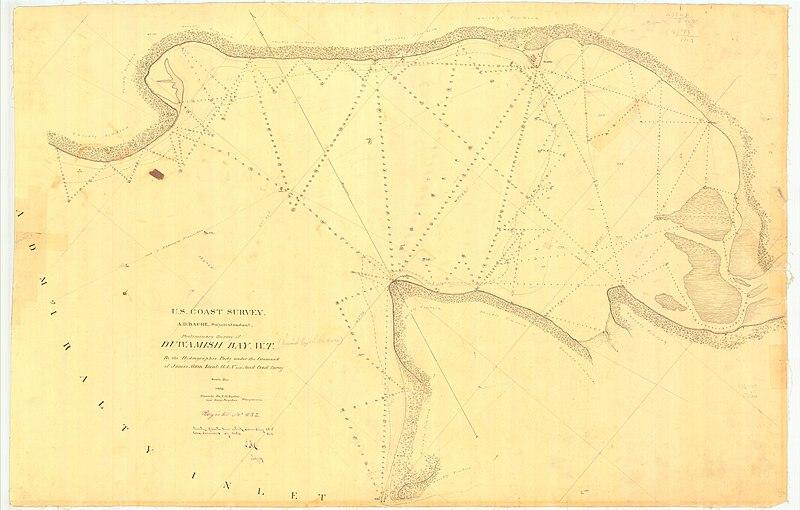
*The survey that produced this chart was conducted by the USCS Active in 1854. Duwamish Bay would later be known as Elliott Bay, and what is referred to as Admiralty Inlet here is now considered part of Puget Sound. Image by James Alden Jr. *
Bell camped on the north and Boren on the south side of our territory until they could build cabins for themselves. They then built one for me on the bluff at the mouth of the gulch which runs to the bay in front of where the Bell Hotel now stands and moved us over. The front of our territory was so rough and broken as to render it almost uninhabitable at that early time. I dug a well forty feet deep in the bottom of the gulch and only got quicksand with a very limited amount of water.
Direct communication with the bay, by which we received all our supplies at that time, was next to impossible, owing to the height of the bluff, and I next built where Frye's Opera House now stands. We divided the territory so that each could have access to the water and make the claims as nearly equal as possible.
In October, 1852, H. L. Yesler arrived from Portland, looking for a location for a steam saw mill. He was pleased with the situation where Boren and Maynard joined, and as there had not yet been any claims filed in the land office, which at this time was in Oregon City, they each agreed to give him a portion of their territory in order that he might also obtain a claim.
These several adjustments were all amicably made, as all were anxious to enlarge the settlement as much as possible. The policy of laying off a town, and the name, had been discussed and agreed upon by us before Yesler came, which accounts for the fact that he does not appear as one of the proprietors in the first plat which was filed for record.
All had gone smoothly until the time when we (Boren, Maynard and myself) were to record a joint plat of the town of Seattle, when it was found that the Doctor, who occasionally stimulated a little, had that day taken enough to cause him to feel that he was not only monarch of all he surveyed, but what Boren and I had surveyed as well. Consequently Boren and I, on the 23d day of May, 1853, filed the first plat of the town of Seattle. When, in the evening of the same day, his fever had subsided sufficiently, the Doctor filed his also. Thus it will be seen that the ground had been occupied for more than a year before the town was laid off.
Early in 1853 J. N. Low sold his interest at Alki Point to Chas. C. Terry and moved to the neighborhood of Olympia. Terry's brother having previously returned East, he thus became sole owner at the Point. On the 18th of April, 1855, he and Edward Lander bought the front half of the Boren claim, and he soon after opened business in and became a resident of Seattle, and on July 11, 1857, exchanged his Alki property for a portion pi the Maynard claim, and Maynard took up his residence at Alki.
Denny, Arthur Armstrong. Pioneer Days on Puget Sound. A. Harriman. 1908.
About TOTA
TOTA.world provides cultural information and sharing across the world to help you explore your Family’s Cultural History and create deep connections with the lives and cultures of your ancestors.