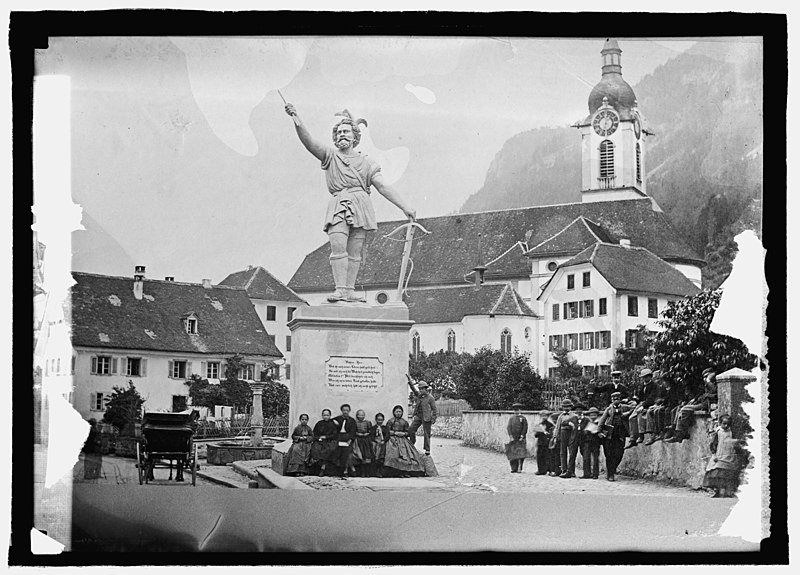

The Story of William Tell
From Peeps at Many Lands: Switzerland by John Finnemore, 1911.
From: 1307 C.E. To: 1307 C.E.
Location: Altdorf, Uri, Switzerland

Note: This article has been excerpted from a larger work in the public domain and shared here due to its historical value. It may contain outdated ideas and language that do not reflect TOTA’s opinions and beliefs.
From Peeps at Many Lands: Switzerland by John Finnemore, 1911.
The Lake of Lucerne, as we have said, has not only a great name in the story of the beauties of Switzerland, but it has even a greater in the story of Swiss history; for on its shores lie the Forest Cantons, the divisions which saw the beginnings of the Swiss Republic.
About six hundred years ago the Swiss were in subjection to the rulers of Austria. They were treated so harshly by their Austrian masters that at length the Swiss resolved to throw off the Austrian yoke, and it is said that William Tell was among those who first struck a blow for freedom.
Every Swiss child knows the story of William Tell, and he is the great hero of Swiss legend. One day an Austrian Governor named Gessler, a cruel and wicked tyrant, set up a pole in the market-place of Altdorf, a small town near the lake. Upon this pole he set his hat, and gave orders that every Swiss who passed should bow down before it, and thus do homage to his Austrian masters.
Tell came by and did not bow. He walked proudly on, and refused to take notice of this insolent order. Gessler was full of wrath, and ordered him to be seized and bound.
Now, Gessler knew that Tell was a very famous archer. It was said that Tell’s arrow never missed the mark. So the Governor bade his soldiers seize Tell’s son and set the boy against a tree. An apple was placed on the child's head, and Tell was bidden to shoot at that tiny mark. If he should refuse to do this, he was to be put to death at once.
Tell knew not what to do, for he feared that he might shoot his child. But at length he took two arrows, placed one on his bow-string, and took careful aim. He shot the arrow, and it cleft the apple in two, and both he and his child were safe. Then Gessler demanded of the great archer that he should say why he had taken two arrows. At first Tell refused to give any reason; but when Gessler promised that his life should be spared whatever the answer might be, Tell at once said: "If the first arrow had injured my son, the second would soon have pierced thy heart."
Gessler was full of fury when he heard this bold reply. "I have promised thee thy life, Tell," he said, "but thou shalt spend it in utter darkness, in a dungeon, where neither sun nor moon can shine upon thee."
Tell was bound and placed in the Governor's barge, and the boat was rowed across the lake. When the barge was far from the shore, one of those sudden storms which sweep down from the hills lashed the waves of the lake to fury. The crew of the boat became in danger of their lives, and they called upon the Governor to allow Tell to steer, or all must be lost. They knew that Tell was the most expert boatman of them all.
Gessler ordered that Tell should be unbound, and the hero took the tiller and steered the boat through the storm to safety. He guided the barge to a certain spot where a broad flat rock forms a natural landing-place. Here he ran the boat ashore, at the rock which is called Tellsplatte to this day.
Crash went the boat against the rock, and Tell, seizing his bow and arrows, made one leap to land, and was off and away. He escaped, but he bethought himself that he was not in safety so long as Gessler lived to pursue him; so he turned to a thicket beside a "hollow way," through which Gessler must ride to gain his castle.
At last Tell heard the tramp of horses, and he looked out from his hiding-place and saw Gessler riding towards the spot where he lay among the bushes. The arrow was ready on the bow-string, and as the Governor was riding past, the shaft was loosed and sent through Gessler's heart. The Governor felt certain who it was that had dealt this fatal stroke. His last words were, "This is Tell’s shaft." And so, with the death of the Austrian tyrant, the first great blow was struck on behalf of Swiss liberty.
Finnemore, John. Peeps at Many Lands: Switzerland. Adam & Charles Black, 1911.
About TOTA
TOTA.world provides cultural information and sharing across the world to help you explore your Family’s Cultural History and create deep connections with the lives and cultures of your ancestors.