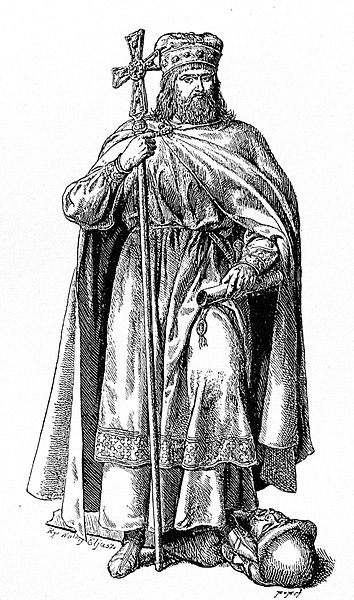

The Sagas of Early Polish History
For our knowledge of early Poland and its people we have only a confused mass of legends. Since these stories have been examined critically, historians are agreed in regarding everything…
From: Unknown To: 962 C.E.
Location: Poland

Note: This article has been excerpted from a larger work in the public domain and shared here due to its historical value. It may contain outdated ideas and language that do not reflect TOTA’s opinions and beliefs.
“The Sagas of Early Polish History” from Poland by W. R. Morfill, 1893.
For our knowledge of early Poland and its people we have only a confused mass of legends. Since these stories have been examined critically, historians are agreed in regarding everything as more or less fabulous till we come to the reign of Mieczyslaw I. (962-992).
The first Polish chroniclers, Callus, Kadlubek, Dlugosz, and Kromer, who were ecclesiastics and used the Latin language as their literary medium, handling it with considerable dexterity, have treated these stories as genuine history. The more sober criticism of modern times, as shown in the writings of Lelewel and others, has relegated them to their proper place. We are hardly likely to believe in the existence of a Duke Lech or a beautiful princess named Wanda, who flourished in the eighth century; or in Cracus, said to have been the founder of Cracow. All these are obviously only generic and national names individualised.
Many of the quaint stories about these princes have done duty in the legendary history of other countries. They recall to us Tarquin and the poppies; Zopyrus and Babylon; Tell and the apple; and other quaint traditions which may be claimed by so many lands. Thus the mythical hero, Przemyslas (Przemyslaw), forms clay figures of men with lances, swords, and bucklers; the rays of the sun are reflected upon them, and the Hungarians, with whom he was contending, scared at the sight of these imaginary soldiers, beat a precipitate retreat. The same story is told in Kent of the invasion of William the Conqueror. So also with reference to the horse race, in which the crown was to be the prize of the victorious candidate.
It is an old story of classical times, Lescus (Leszek) was of humble origin, became an excellent prince, and loved to gaze upon his former ragged habiliments, which were preserved, that he might be reminded of the lowly estate from which he had been called. In the same way the shoes of the peasant Premysl, the husband of Libusa, are said to have been long preserved in the Hradschin at Prague; one of the many points of identity between the Chekh and Polish legends.
Leszek was succeeded by his son of the same name, of whom in defiance of all chronology, Vincent Kadlubek tells us that he overcame Julius Caesar in three battles, and received his sister Julia in marriage, and that he also subdued Crassus, king of the Parthians(!). We thus see Polish history rivalling the most absurd fictions of Geoffrey of Monmouth. The same may be said of the story of Popiel and the rats. This duke was a vicious man and had become, so the legend goes, so hateful to the whole nation that a conspiracy was formed against him, headed by his uncles, This he discovered, but concealing the information he had received, invited them to an entertainment and caused them to be poisoned. Moreover, he refused to allow their bodies to be buried, and from the corpses sprang rats in countless numbers, which destroyed Popiel and all his family. This is a variant of the well-known legend of Bishop Hatto, which Southey has versified in so spirited a manner.
Equally legendary is the account of the holy peasants, the parents of Piast; the visit of the gods to their humble cabin; their constantly replenished store, and the ultimate election of their son to the sovereignty. Whatever may have been their origin and the amount of truth contained in this strange story, it is matter of history that the Piasts ruled the country not less than six hundred and thirty years. The date fixed for their half-mythical ancestor is 842, but we cannot say any more with confidence than that the Piasts first came to power at some time during the ninth century.
Now that we have dealt in a somewhat summary fashion with these sagas, before we begin with the real historical period, the reign of Mieczyslaw I, a few words may be said as to what philologists and ethnologists have been able to discover of the origin of the Poles.
There seems reason to believe with Schafarik that their name is found in that of the Bulancs, who are mentioned by the geographer Ptolemy, who lived in the second century A.D. The name implies the dwellers of the plains (pole, a field); we can see by the map that Poland is a flat country. In its more fertile parts it reminds us of our own midland counties, but we rarely come upon the bolder features of nature. Jordancs (A.D. 552) speaks of Slavs as inhabiting the banks of the Vistula, but he has no distinct name for them. In the sixth or seventh centuries some people settled on that river are called Lekhs, a word which has never been satisfactorily explained. The older form probably had a nasal: hence we get in the Latin chroniclers Lenchitæ in Lithuanian, Lenkas, and In Magyar, Lengyel. The name Lekh gradually made way for that of Polianc or Polaki. Nestor, the old Russian chronicler, or at all events the chronicle which goes under his name, speaks of the Poliane Liakhove on the Vistula and the Poliane Rusove on the Dnieper. When we first become acquainted with the Poles we see them living in their village communities, a purely agricultural people. They are found grouped about Gniezno, Kruszwica, and Cracow.
We can only make a passing allusion to the view of Szajnocha that the organisation of the Polish race, began like the Russian, from colonies of Norse settlers. He endeavoured to support this opinion by the interpretation of some of the names, but is not considered to have succeeded, although few persons at the present time would deny its truth in the case of the Russians. Here and there in the old Polish stories, as in the Russian, we seem to come upon versions of Scandinavian sagas, but by far the greater portion of them can be shown to be replicas of old Bohemian legend; thus Cracus reminds us of Krok and Premysl of his Bohemian namesake, and we find many similar instances in the pages of Cosmas, the old Bohemian chronicler. The parallel is further strengthened when we sec that .so much of the earliest Polish literature which has come down to us is modelled upon that of the Chekhs; thus the Polish hymn to the Virgin has its Bohemian prototype, and the early Polish translations of the Bible were modelled upon Bohemian.
Morfill, W. R. Poland. T. Fisher Unwin, 1893.
About TOTA
TOTA.world provides cultural information and sharing across the world to help you explore your Family’s Cultural History and create deep connections with the lives and cultures of your ancestors.