The Coming of Flint and of Tuina
This is a Yana story. The Yanas lived in Sacramento Valley and previous to August 1864 numbered 8000. The second week of August 1864 the whole tribe were massacred by…
From: Unknown To: 1922 C.E.
Location: Sacramento Valley, California

Note: This article has been excerpted from a larger work in the public domain and shared here due to its historical value. It may contain outdated ideas and language that do not reflect TOTA’s opinions and beliefs.
From Ancient Tales From Many Lands by Rachel M. Fleming, 1922.
This is a Yana story. The Yanas lived in Sacramento Valley and previous to August 1864 numbered 8000. The second week of August 1864 the whole tribe were massacred by the white people, and only a scattered few escaped who happened to be away at the time. These did not number more than fifty. This hideous occurrence was the more reprehensible as the Yanas were a most harmless and industrious tribe, very willing to work in the fields for the settlers.
Long ago the chief of the very first people in the world said to them, "Sweat and swim to-day, for tomorrow you must go hunting."
Well, the next day they went hunting, but could not kill so much as one deer. This was because they had no good arrow points; their points were just made of common stone. When they went back to their chief, Jupka, that night and told him they had caught nothing, he said, "There is an old man in the south who kills a great many deer. His name is Kaltsauna. I must bring him up here to show you how he kills them."
Jupka sent a very swift messenger to the south to find Kaltsauna. The old man was sitting inside the door with his legs crossed, making flint arrow points. The messenger stepped in quickly and surprised old Kaltsauna, who at once drew a flint knife from his side and made a thrust at the intruder.
"Stop, uncle, you mustn't kill me." "Why do you call me uncle," said Kaltsauna, hiding his arrow points quickly. "I have come for you, uncle. The chief Jupka has sent me to invite you to come to our Round Mountain Place. We cannot kill deer with stone arrow points, and we have no other kind. The chief knows that you will kill deer all the time, and wants you to come and show his people how to do it."
Kaltsauna rubbed his hands clean and got all the flint dust off them. Then he rolled his flints in a skin very carefully. Next he mixed flint dust and rubbed it on his face, and made paint and rubbed that on his face too. He took a sharp piece of flint and thrust it through the middle of his nose. He looked very threatening and fierce now that he was dressed for the road.
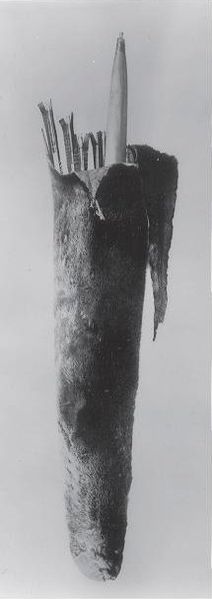
"You go on and tell Jupka to make a huge fire of wood, and I will come later by myself," said Kaltsauna. Then he took his quiver of grizzly bear skin and his bows and arrows of black oak. He put flints under his left arm and took bows and arrows in his right hand. Jupka had made a huge fire of wood, and all the people were waiting. "He is coming, he is coming," they shouted when they saw Kaltsauna in the distance. But when he came near, they didn't dare to look at him. They hung their heads. "Make way for me. Make way. I will strike unless you give me room," said Kaltsauna, as he came near the crowd of people. "Spread out a skin," said Kaltsauna to chief Jupka.
The skin was spread and Kaltsauna emptied his robeful of arrow points on it. He sat down and gathered each kind of flint into a heap by itself. He pushed the white flint away, and ordered it to go to Hakamatu, and to this day there is plenty of white flint in Hakamatu.
He sent the blue flint east, and the yellow flint to a creek not far away, and to the west he sent flint with fine black, blue, and white stripes. Then he put plenty of flint in Round Mountain Place where Jupka's people were living, and told them that people would find flints in these places whenever they wanted them and went to look for them. Besides flints, Kaltsauna gave each of Jupka's people a wedge made of deer horn and a piece of stone, and showed them how to dress the flint and to make arrow points. Then Kaltsauna went back home.
On the second day after he had gone, Jupka called his people together and said, "Sweat to-night, swim early in the morning, and go out on a great hunt to-morrow." They had very different fortune on this hunt, now that they had their flint and arrow points, for every one of them killed a deer.
The whole party returned to the Round Mountain Place then with great rejoicings. Jupka himself never went out to hunt. He just lay in the house and told all what they were to do, and showed them how to do it. He never ate anything himself, but just smoked and smoked all the time. When his people came in from hunting, they put down before him all the deer they had caught. The chief took his flint knife out, and cut the meat into pieces and roasted it. When it was cooked, all the people sat down and ate together, except Jupka. The women prepared acorns and mice. Jupka placed three very large baskets of mice in three different places, and in front of each basket were people to deal out the mice to each person that wanted them.
Next time they wanted to go hunting they chose a clever man to sing and dance and dream about the deer, and the best place in which to find them. His name was Ahalamila. When evening came, Ahalamila took his pipe and made a fire. He blew smoke in every direction, and then put down his pipe. He took fir leaves and threw them on the fire. While these were burning, he sang, "A white rock, a quartz rock," over and over again, and he put a beautiful white quartz rock on the ground.
On the north, south, east, and west of the quartz rock he thrust a small twig of fir, and one of blue beech, into the ground. Ahalamila kept looking at the twigs, which rose quickly, grew up and became little trees. He walked around them and sang, and pinched off a leaf or a bud from one limb or another as he walked. Soon the piece of quartz rock began to move of itself, and swelled and changed shape, until at last it turned into a white fawn. Just at daybreak the white fawn began to walk round among the trees, and sniff as though it smelt something.
Ahalamila picked up the little fawn and blew smoke from his mouth, blew it about on all sides. Then he put the fawn down again, and it changed back into a piece of white quartz rock. Soon daylight came, and Ahalamila stopped singing.
"I have finished now," said he. "It will be better for us to hunt in the south." So the people went hunting in the south, because Ahalamila had dreamed that they would find deer there. Alas! no deer were found, and one of the men began to taunt Ahalamila and to say that he could never find deer however much he sang and danced. This angered Ahalamila, and he answered that the deer had been in the south, but the other men had frightened them away. On this the people fell to fighting fiercely with their new weapons, and many of them were killed, including poor Ahalamila. This was the first battle in the world, and the people who were killed were changed into rocks, which are to be seen there to this very day.
Now all this time Jupka had been lying at home in the Round Mountain Place. Presently he heard the dreadful noise and shouting. "My people are fighting," said he; "I must stop the battle." Then he rushed out towards the south into the middle. "I want both sides to stop," shouted Jupka. That put an end to the battle, and all the people followed Jupka home. Next morning they went hunting in the north and found plenty of deer, so they didn't fight among themselves. The morning after this hunting in the north, Jupka heard loud shouting in the east. A great giant of Jupka's race thrust his head above the edge of the sky. This person had beautiful feathers streaming out in every direction from his head. Jupka had ordered him to shout, and had told him in the morning that when he raised his head above the edge of the sky he was to shout.
Jupka gave this person the name Tuina. Now Tuina had to start from the east on his travels across the sky every morning. A path had been made for him across the sky from east to west. In order to make himself ready for his journey he dressed and put on his armour, and took a very tiny dog and put it under the hair on the top of his head and tied it there. Before he was dressed and armed, and had put the dog in his hair, Tuina had no brightness, but when he started, he filled the whole world with light, just as he does now in the daytime.
Tuina went straight along the road in the sky from east to west, till he reached the great water. When he was ready to plunge into the water, a water grizzly bear was coming out and saw him. Tuina spread cut his arms as if they were wings, and poised himself ready for jumping into the water. "Tuina is coming," shouted the grizzly bears of the water. "It will be too hot here if he comes, so let us go to the high mountains."
A great crowd of water grizzlies came hurrying out of the ocean and went away to the high mountains. Tuina jumped into the water, and it rose on all sides, boiled up, rolled over the shore, and every kind of shell of the ocean went to land at the time. Tuina went to the very bottom of the ocean, deep under the water and under the ground, and back again to the east. He was able to do this because long ago Jupka had turned the earth bottom upward, and made a path right through it from west to east for Tuina to travel along. Jupka ordered Tuina to go along the path in the sky from east to west every morning, and to travel back along the path under the earth from west to east every night. This he still does. Can you guess who Tuina is, and who the water grizzlies are?
Fleming, Rachel M. Ancient Tales From Many Lands. Frederick A. Stokes Company, 1922.
About TOTA
TOTA.world provides cultural information and sharing across the world to help you explore your Family’s Cultural History and create deep connections with the lives and cultures of your ancestors.