
Norse Account of Creation
In the beginning of things, there was neither sand nor sea nor frozen waves, nor heaven nor earth, nor grass upon the earth.
From: Unknown To: 1922 C.E.
Location: Scandinavian Peninsula

Note: This article has been excerpted from a larger work in the public domain and shared here due to its historical value. It may contain outdated ideas and language that do not reflect TOTA’s opinions and beliefs.
From Ancient Tales From Many Lands by Rachel M. Fleming, 1922.
In the beginning of things, there was neither sand nor sea nor frozen waves, nor heaven nor earth, nor grass upon the earth. There was, however, a great giant named Ymir. From his flesh the earth was formed. The sea was his blood, and the hills were his bones. The skull of the huge ice-cold creature became the vault of heaven. His hair changed into trees and plants. His eyebrows became a pleasant dwelling place for men, whilst his brains became the heavy clouds which drift across the sky.
The gods who brought about these wonderful changes were named the Aesir, and they formed nine great kingdoms, three above the earth, three upon the earth, and three beneath the earth. The very lowest of these kingdoms was a place of everlasting cold, and fog, and mist, and it was a dreadful punishment to be sent there.
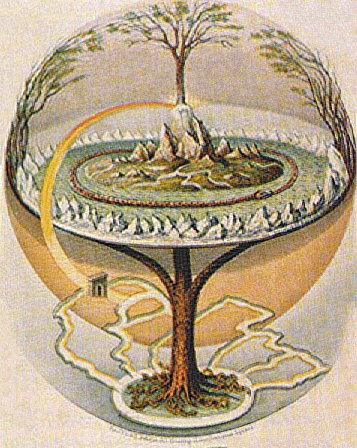
Growing under and through and above and around these nine kingdoms was the great ash tree named Yggdrasil. From its branches fell the gentle dews that made the valleys fertile. Its three roots had grown very far back in the dim past. Under one root dwelt the goddess of death; under another lived the first giants; and mankind dwelt under the third. As soon as the Aesir had made the noble earth and the great vault of the heaven, the sun shone from the south over the rocks, and the earth became covered with delicate green herbs.
But the sun and the moon did not know their powers, nor did the stars know their places in the heavens. So the Aesir met together in council by the ash tree Yggdrasil and fixed how the sun and the moon were to shine, so as to enable men to reckon in days and months and years. They created two beautiful horses, one to draw the sun across the sky and bring each day, and one to draw the night across the sky and give men time to rest in pleasant sleep. A wild wolf ran across the sky before the chariot of the sun, and another wolf chased the setting sun into its home in the west.
At first there were no men and women created, but there was a race of huge giants created in a very curious way. From the lowest of the nine kingdoms, the place of everlasting cold and fog and mist, there flowed poisonous cold streams, and some of the drops that were thrown out of these streams grew into the form of a mighty giant formed of ice. Then from the south there flew sparks of fire, which fell upon the ice giant and gave him life, and thus the race of giants came into being.
The Aesir next created the race of dwarfs out of the rocks of the earth. One of these dwarfs was the god of sleep, and he and the sun god never got on together very well. Then the three greatest of the Aesir, among whom was the god Odin, created a man named Ask and a woman named Embla. These two were in the first place mere pale shadows, with neither soul nor sense, nor power to move, nor goodly colour. One of the Aesir gave them blood and goodly colour, another gave sense, and then Odin, the greatest of the Aesir, gave them spirit. Thus was the race of human beings created.
Now each day the Aesir met in their pleasant home, Asgard, and tried their strength in many ways. They learnt to make and use furnaces to forge precious things to make fine tools. They built beautiful altars and high temples. They played great games together, and were very happy indeed. They did not care at all that they were not rich in gold, for they did not even know of its existence.
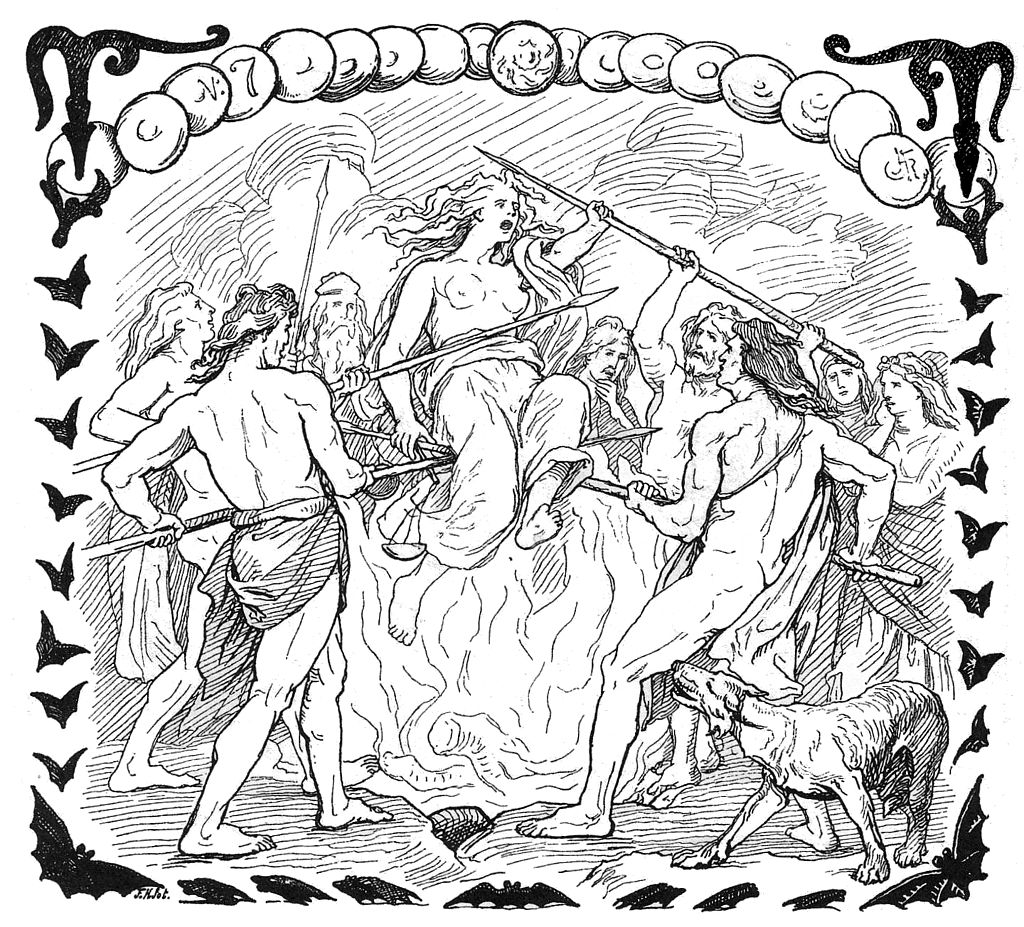
Then alas! there came to the halls of the gods three maidens from the homes of the giants, who were the children of that first giant who had been made out of ice and fire. One of these was named Gullveig, and she knew the use of gold. Because she had plenty of gold, she had been able to tame wild wolves, to practise many magic arts, and had always been the joy of evil people. After she had brought gold to the Aesir, and made them realise how useful it was, all sorts of dreadful things happened. Neither men nor giants nor Aesir kept their promises. For the first time war broke out upon the earth, and the Aesir ceased to be happy any more. They were so grieved and troubled about all these things that they met together to consider how to punish Gullveig for her sin in having introduced the use of gold. They pierced her with lances, and three times they tried to burn her, but every time she escaped, and she still lives. There is no doubt about that, for to this day men and women still break their promises, and fight and do many evil things for the sake of gold.
Now, after all these things there came a very severe and dreadful winter, which lasted for three years. At the end of the three years' winter many terrible things happened. Wars broke out everywhere; a monster wolf escaped and ate the sun and moon. The waves of the ocean danced wildly and the waters rose in flood. The great tree, Yggdrasil, trembled and caught fire, and the flames attacked and burned the heavens and all the stars fell from the sky. Meanwhile the earth had been drowned in the mighty rushing waters. It seemed in that dark time as if all things were at an end.
After a time, however, the fire died down, the waters of the ocean sank, and the earth arose once more in all its green beauty. Happily, the daughter of the sun had escaped when her mother was devoured by the monstrous wolf. She now took her mother's place in the sky, and shone upon the green earth. The frozen streams were unbound, and fell in pretty waterfalls among the rocks. Birds flew in the air, fish swam in the streams. The fields brought forth great harvests.
Of all the men and women on earth, only two had escaped in this dreadful time. They had found a safe corner in which to hide themselves, and had been fortunate enough to be able to keep themselves alive by feeding on the morning dews. Their children were ancestors of the race of men.
A great hall, brighter than the sun, and adorned with gold and jewels, was created so that heroes who had died in battle might dwell there and be happy for evermore. There they could spend each day in fighting and feasting, and this seemed to them a very pleasant way of passing the years.
Fleming, Rachel M. Ancient Tales From Many Lands. Frederick A. Stokes Company, 1922.
About TOTA
TOTA.world provides cultural information and sharing across the world to help you explore your Family’s Cultural History and create deep connections with the lives and cultures of your ancestors.