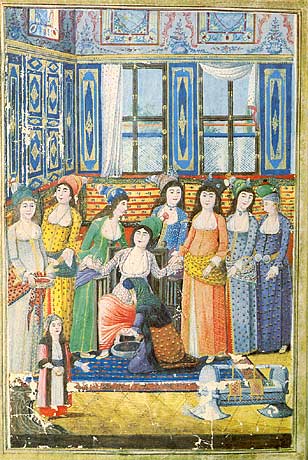

Birth and First Years in the Life of a Prince and Princess
Although the birth of a prince or of a princess with us was not announced by the salute of guns, it was nevertheless always an event of importance, which caused…
From: 1844 C.E. To: 1888 C.E.
Location: Stone Town, Zanzibar, Tanzania

Note: This article has been excerpted from a larger work in the public domain and shared here due to its historical value. It may contain outdated ideas and language that do not reflect TOTA’s opinions and beliefs.
From Memoirs of an Arabian Princess: An Autobiography by Emily Ruete, 1888.
Although the birth of a prince or of a princess with us was not announced by the salute of guns, it was nevertheless always an event of importance, which caused much joy, but I regret to say much envy also. Our father and the respective mother were of course delighted at the birth of a child, and we little ones fully shared their joy. A newborn brother or sister had to go through all manners of ceremonies, and as such births occurred five or six times annually in our family, they were the welcome cause of as many family festivities to us.
No Mahometan will suffer the assistance of a medical man in such cases; midwives alone are allowed and admitted, and they are ignorance itself. The majority of them come from Hindustan, and are much preferred to native women; I do not know for what reason, for a midwife from Hindustan knows as little or less of her business than those from Arabia or from the Suahely country. In fact, mother as well as child may thank God alone, and their constitution, if they survive at all or keep well afterwards, for they owe no thanks to their stupid and foolish nurses.
After a warm water bath a kind of bandage is wound round the child's body, its neck and armpits are powdered with some strongly perfumed vegetable powder, and it is dressed in a calico shirt of an ingrain dye, or in a muslin one. The little thing is then placed on its back, its hands and feet are straightened out to the utmost, and it is swathed in a swathing-band up to the shoulders, the tiny arms and legs being thus firmly confined. In this state the child remains for forty days, except while the band is removed twice a day to give it a bath. By this process the child's body, it is thought, will be made straight and faultless for life.
The mother always watches over the child herself, and never leaves it to the care of any of her servants. Slaves are set to rock the cradle incessantly, which is of East Indian workmanship, and made of the finest wood beautifully carved. She rarely, however, nurses the child herself, except for a pastime, for each child has one or two wet nurses up to the age of two.
If it be a girl, she has holes pricked in her ears on the seventh day with a needle and thread of red silk, generally six in each ear, to which heavy gold rings are attached forever when she is two months old. I say "for ever," because females who do not wear earrings either mourn a deceased relation or they have no holes pierced.
On the fortieth day a ceremony is performed to which European children could not be subjected; all the hair is shaved off the child's head. This may appear incredible, but many things in the South are different to what they are here. A bald-headed child would be considered as great a curiosity as a child born with a few tuffes of hair is in this country. My Hamburg nurse was quite surprised when she saw my newborn daughter for the first time, whose black hair came down to her neck; nor was she satisfied until she had made my late husband bring home a small soft brush, with which she delighted in curling the baby locks two days old.
The shaving is done by the chief eunuch under certain ceremonies, in which fumigation with a species of a gum-arabic (somewhat similar to the incense used in Roman Catholic churches) plays an important part. The first hair is considered of much moment—it must not be burnt, nor carelessly thrown away, but buried, in the ground, thrown into the sea, or hidden in some crevice of a wall. Twenty to thirty persons are always present during this ceremony, and the chief eunuch, who only on this occasion acts as barber, runs a great risk of crushing the soft and tender skull of the infant. He, as well as his numerous assistants, then receive a valuable present from my father.
The swathing band is removed on this day, rings are put on the arms and legs, and attached to the ears, and the child is dressed in a silk shirt and the kofije, a cap of gold stuff with ear-flaps. After this day everybody may go and look at it, for up to that time no one but the parents, the slaves on duty, and a few of the most intimate of the mother's friends were allowed to do so. This precaution is taken on account of the widespread belief in the evil eye and other dreaded species of witchcraft.
Little children of this age in the East look, beyond a doubt, much better than European ones, in whose dresses white predominates. My opinion remains unchanged on this point even after my long residence in Europe, and my own children looked hideous to me in their baby clothes when I compared them with my little brothers and sisters in their pretty attire.
The smallest children are already strongly perfumed, and everything they use and wear—dresses, sheets, bath-towels, and swathing clothes—are covered all night with jessamine (different from that known here), fumigated with amber and musk, and sprinkled all over with ottar of roses before they are used. It must be remembered that windows and doors are open nearly all day throughout the year, which mitigates to a certain extent any bad effect arising from this curious partiality for strong scents.
Several charms are also attached to the child's body on the fortieth day to protect it against the effects of the evil eye. They are called "Hamaje," or "Ilafid," and consist of all sorts of things; the lower class using an onion, or a bit of garlic, or small shells, a piece of bone stitched up in leather and worn on the upper part of the left arm. In the upper classes these kinds of charms are replaced by gold or silver plates, worn on a chain round the neck, upon which sentences from the Kurȃn are engraved. The boys wear them only up to a certain age, the girls generally a longer period.
The favourite charm consists of a gold or silver locket of pretty workmanship, likewise worn on a chain, two inches long by one inch wide, enclosing a miniature of the "hurs" (guardian). No person wearing a charm like this, bearing the holy name of the Lord, may enter an unclean place—a proof surely of the great reverence of a true Mahometan for his Lord and Creator!
From a very early age the child is fed (besides mother's milk) from a long spouted cup several times a day with milk soup, boiled with rice flour and sugar; the sucking bottle was quite unknown in my time. It receives no other kind of food until it teethes; after that it may eat anything. It is not customary to carry the children about, they are put on the carpet and then left to their own devices.
Another festivity follows at the first attempt of the child to sit up by itself, for the exclusive benefit of its little brothers and sisters. To celebrate this festive event in befitting style, extra cakes and other good things are provided. The mother, the nurses, and the child are dressed in their best, and wear their finest jewels. The child is then put into a small square carriage on low wheels, stuffed with cushions. The little legs are steadied upon a board fixed perpendicularly to the poles, and the other children gather all round.
Grains of Indian corn, which have been roasted in a peculiar way, till they get as large as a thimble and soft as wadding, are then mixed with a quantity of small silver coin, and this compound is poured over the child's head; this done, the children rush upon their little brother or sister to obtain the coins, not seldom endangering the infant's life. The children of friends are sometimes invited on this occasion.
The child runs about barefooted until it is strong enough to wear sandals. Those worn by boys (watje) are much lighter than the kubkab of the girls, and the latter are generally allowed to wear boys' sandals until they are able to put on the kubkab. Stockings are not worn by either sex; ladies of rank use them at times upon riding excursions, as custom requires the ankles to be covered.
Besides the nurses, two or three slaves are appointed as personal attendants to each child when three months old, after which they are its property. The number of slaves is gradually increased as the child gets older, and in the case of death of any of them the vacant place is filled up by another, or a certain sum of money is paid instead by my father. The little girls wear boys' caps in the house up to a certain age.
Until their seventh year the princes live among the women; they then solemnly embrace the Mosaic faith, the ceremony being followed by great festivities, in which the state dignitaries and all high officials take part. This, if possible, is enacted in the country and in the presence of our father, and ends in public rejoicings of three days' duration.
On this occasion the boy is presented with a quiet mare, and with mounted attendants. The boys are thus taught to ride from early youth, and in time attain the dexterity of circus riders. It requires, of course, a great deal more skill to gain a firm seat on horseback without the good saddles and stirrups used in this country. So great was the importance my father attached to perfect horsemanship, that the slightest mishap while out riding would call forth a severe reprimand not only on his sons, hut on their incompetent riding masters.
Indeed not one of us was spoiled in the least. My father's high sense of justice and unparalleled generosity was combined with great and firm consistency. We were expected to obey strictly our tutors and teachers, be they Arabs, Abyssinians, or Negroes. He was deaf to our entreaties or complaints if ever we made any—a severity which taught us to respect those in authority over us, and to appreciate that authority when we had come to years of discretion.
The nurses, even those whose term of service had been but short, were highly esteemed and honoured as long as they lived. They are always slaves by birth, but as a rule they are freed in reward of their fidelity and devotion. Especially the black nurses distinguish themselves by their great attachment to their charges; the most anxious mother may quietly leave her child with such an one who considers herself a second mother to the child and treats it accordingly. What a difference there is between them and the half-hearted interest shown by the nurses in this country! Many a time have I been unable to resist interceding in behalf of poor little nurslings when some flagrant carelessness forced itself upon my notice.
The contrast which exists between the wet nurses of these parts and our Arab nurses may possibly be explained by the fact that in most cases the former are compelled to forsake their own children in exchange for a perfect little stranger—a sacrifice for which, every mother will admit, no consideration of mere money will compensate.
The position of a black wet nurse with regard to the child entrusted to her by her mistress is quite a different one. She has been in the latter's service for years, may even have been born in her house: thus her own interests and those of her master's are closely knitted together. And farther, there may be added a circumstance of much weight—a black nurse is not required to part with her child, but frequently, if not always, she retains it. The child of the nurse receives
the same nourishment as its little foster brother or sister, shares its pap, its fowl, its bath, wears its old dresses, and by and by shares its toys. The child grows up into a slave, but always preferred to others except by very badly disposed people who can forget their foster relation.
This patriarchal state of things generates more faithful and devoted nurses than any European system could achieve. I have often reflected how very hard it must be for these poor women to part with their own children for the sake of lucre, though I have repeatedly been told that they are by no means so sensible of this as I supposed. This, however, I cannot understand. Could I ever entrust my poor helpless child to a perfect stranger, and with the greatest indifference too? Not for the world!
These black nurses, however, have one very bad habit: they are acquainted with all sorts of dreadful and absurd stories, which they tell the little children of three to five years to amuse and to keep them quiet. The lion (simba), the leopard (tschni), the elephant (tembo), and numberless witches (watchawi) of course play a prominent part in these fairy tales, some of which are really blood-curdling. It is perfectly impossible to break them of this noxious habit.
Bearing children is unquestionably much easier in the South than in Northern countries: colds, coughs, and the other numerous assailants of European children are unknown there; yet although the climate is very hot, and indoor life is replete with enticing comforts, the children are not given to sluggishness and indolence; they are allowed to roam in full liberty, and from the mode of their garments their limbs are nowise fettered. Gymnastics are unknown, but boys from ten to twelve go in greatly for high jumping, some of their flying leaps taking them over two horses.
Swimming in the sea is practised as eagerly, and the boys teach themselves. At an early age they learn to shoot, and very passionately too, sham fights being very favourite pastimes. In spite of boys always going about armed to the teeth, provided with as much ammunition as grown-up men, one hardly ever hears of an accident arising from want of precaution.
I have already mentioned that the young princes live in their fathers' houses up to a certain age, after which a residence of their own is assigned to each, in which they generally keep house with their mother if she be living. They have a certain monthly allowance, fully sufficient to supply all their wants. In the event of marriage or an increase to the family, or even after a time of irreproachable conduct, an extra allowance may be looked for, but in no other case. However, on the arrival of our father's ships once a year with new goods, all our brothers and sisters living by themselves appeared with the whole of their family to claim their individual share, whether they required it or not. If any of them had the misfortune of exceeding their allowance they found it no easy matter to extricate themselves, as my father never countenanced the fact, and none would transgress more than once if he could help it.
In case of war, which was unfortunately rather frequent in Oman, all the princes, the half-grown included, were expected to join and take their part in the fight like the common soldier.
They were subjected to a very strict discipline, but this only caused the sons to look up to their father with greater respect and veneration. I often watched, as a child, how my elder brothers would hurry to the door, in advance of the slaves, to put the sandals my father had left there in readiness for him.
There is but little to say about the education of a princess: the first years of her life resembles that of her brothers, with the exception that the latter were allowed much more liberty out of the house after completing their seventh year. The only thing which deserves mention is, that at the birth of a princess—to suit the hairdress in our country—a broad comb, generally of silver, is placed under the back of the newborn child's head, to give it a flat shape. When a princess is married to one of her numerous cousins, either in Oman or in Zanzibar, she quits her paternal home, of course, in exchange for that of her husband. The former, however, remains open to her at all times, as the sole and real place of shelter against any vicissitudes of life, though she may go and live with a brother if she prefers it. Each sister has her favourite brother, and vice versa; they maintain a fast friendship in good and in bad times, and advise and help each other to their utmost. Though this might prove a source of deep joy in one way, it often gave rise to bitter jealousies which the stoutest heart had difficulty in overcoming—neither were the opportunities very rare in so large a family as ours.
It often happened, too, that a sister would intercede with our father in mitigation of some foolish deed of a favourite brother, and succeed entirely on the strength of his evident preference for his daughters, and his usual inability to refuse any of their requests. He was particularly kind and courteous to his elder daughters, walking towards them and seating them by his side on a sofa, while the elder sons and the little people stood by respectfully.
Ruete, Emily. Memoirs of an Arabian Princess: An Autobiography. D. Appleton & Company, 1888.
About TOTA
TOTA.world provides cultural information and sharing across the world to help you explore your Family’s Cultural History and create deep connections with the lives and cultures of your ancestors.