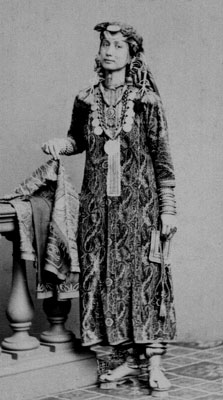

Woman's Position in the East
From Memoirs of an Arabian Princess: An Autobiography by Emily Ruete, 1888.
From: 1844 C.E. To: 1888 C.E.
Location: Stone Town, Zanzibar, Tanzania

Note: This article has been excerpted from a larger work in the public domain and shared here due to its historical value. It may contain outdated ideas and language that do not reflect TOTA’s opinions and beliefs.
From Memoirs of an Arabian Princess: An Autobiography by Emily Ruete, 1888.
Before proceeding with the account of my personal adventures, I desire in this place to include some chapters describing various phases of Eastern life. I do not intend enumerating all our customs and habits, as I am not writing strictly for instruction; I only wish to enable the European reader to form a more correct idea of the prominent features on the general aspect of Eastern life. I hope I may not be led away to speak of matters wholly uninteresting—though I would like to come as near as possible to completing a picture that will impress itself on the mind.
I will turn at once to the most momentous of all these questions, to the description of woman's position in the East. I find it rather difficult to speak of this matter. I am convinced that, as a woman born in the East, people will be apt to think me partial, and I fear I shall not succeed in eradicating altogether the false and preposterous views existing in Europe, and especially in Germany, on the position of the Arab wife to her husband.
In spite of the easier ways of communication in these days, the East is still too much considered the land of fairy-tales, about which all sorts of stories may be told with impunity. A traveller making a few weeks' tour to Constantinople, to Syria, Egypt, Tunis, or Morocco, sets about at once to write a big book on the life and the customs of the East. He has been able to judge only quite superficially of these, and has seen absolutely nothing of domestic life. He contents himself with setting down the distorted stories and second-hand accounts of the French or German waiters at his hotel, or from sailors and donkey boys, and considers these sources of information perfectly reliable and trustworthy. But even from these there is not much to learn, and accordingly he throws the reins over the neck of his imagination, and gallops away into fable-land. The only necessary merit of his book, he thinks, is amusement and entertainment, which are the sugar-plums between the pages, and lure the reader on, and his production is pronounced "such a success!"
My own experience, I admit, was somewhat similar—for I myself judged things in Europe at first by their outward appearance only. When I first met in European society faces beaming all over with smiles, I was, of course, led to believe that the condition of husband and wife must be much better regulated, and that connubial happiness was a thing much more frequently met here than in the Mahometan East. When, however, my children had outgrown the age when a mother's continual presence is more desirable than her absence, and I was able to go more into society, I soon perceived that I had completely misjudged men as well as the general state of affairs.
I have watched many cases of what is called "wedded life," in which the parties seemed to be chained together expressly to make each other suffer excruciating torments. I have seen too many of such unhappy cases to make me believe that Christian wedlock stands on a higher level or renders people much happier than the Mahometan. To my mind married life, in the first instance, cannot be made more or less happy by any particular religion, or by existing views or habits alone; matrimonial happiness can alone depend upon real congeniality and harmony between husband and wife. Where these exist, happiness and peace will always predominate, and from them will spring in time that harmonious sympathy which wedlock truly ought, and is intended to be.
Taught by this experience I will try not so much to give my own opinion, but to define simply the position of women—and of married women in particular—in the East. I admit that I know intimately only the state of affairs in Zanzibar, and tolerably well that existing in Oman. But it is just in Arabia, and with the Arab people, that the true Mahometan spirit, upon which the views of other Eastern nations are founded, has maintained itself most pure, and for this reason my description may claim to be applicable to the entire Mahometan East, with the exception, of course, of such cases of degeneracy which have arisen from, and grown out of, a closer connection with the Christian Occident.
In the first instance, it is quite a fallacy to think that woman in the East is placed socially on a lower level than man. The legitimate wife—the purchased Sarari are of course to be excepted—stands in all respects on a par with her husband, and she always retains her rank, and all rights and titles emanating from it, to their full extent.
The mere circumstance of her retired way of life makes the Arab woman appear more helpless and possessing fewer rights. But this is a custom existing with all Mahometan (and also with many non-Mahometan) nations in the East, and the higher the rank the more rigorously it is observed. Only her father, her sous, brothers, uncles and nephews, and her slaves are allowed to see her. When she appears before a stranger, or has to speak to him, the law requires her to be shrouded and veiled; part of the face, the neck and chin, and, above all, the ankles, must be completely covered.
As long as she keeps to this rule she may move about freely, and walk abroad in open day. Poor people, who have but few or no slaves at all, are obliged, on this account alone, to go abroad more in the daylight, and consequently enjoy more liberty. Ask a woman of this class whether she does not mind exposing herself so freely, and she will reply: "Such laws are only made for the rich, and not for poor women!"
I must say that ladies of higher rank often envy their poorer sisters on account of their advantages, of which especially the women in Oman avail themselves, who, owing to the poverty of their country, are prevented from keeping many slaves.
I have already stated that the lady of rank too may walk abroad in the daytime. For instance, if one of her near relations falls sick she may visit the invalid veiled; in the same way she may appear before a judge to plead her cause in person, for luckily we know nothing of lawyers. But custom requires that this right be only put into force in most urgent cases, and vanity has a good share in upholding it, as the veil disfigures women to a degree, and makes them look like walking mummies.
I fully admit now that this swaddling in the East is carried too far, though I cannot say that I find the European customs any better. In my opinion the leant of dress in the ball costume of a fashionable lady is carried much further still.
It is true that a single woman is an object deserving pity. Shut out completely by precept and custom from any intercourse with men, and without any protection, her position frequently becomes a painful one. As she is not allowed to see or speak to her own officials and managers, if these be Arabs, she is often robbed by them; and I am myself acquainted with several ladies who only married to save themselves from being at the mercy of these frauds and impostures.
This proves that the seclusion of women has its unmistakable drawbacks, and that this also is carried too far. There is, on the other hand, a great deal of sentimental pity wasted on the Eastern woman. She is perfectly unaware that any constraint is put upon her, and habit makes the greatest inconveniences bearable after a time.
Pity is also lavished upon her because she has to share her husband's love with one or many others. By law the Moslem is permitted to have four legitimate wives at one time, and to marry a fifth if one of the former dies or gets divorced from him. Sarari, or concubines, he may buy as many as he pleases, and can pay for. But I have never met with any man who really had four wives at once. Of course a poor man can only afford to have one; the rich man restricts himself to two at most; who live apart and keep house separately.
In the East there are, of course, women too who know how to take care of themselves; who first take the precaution to inquire whether the suitor to their hand has a wife already, and who stipulate the clause of a formal promise in the marriage-contract that he will wed no other wife or purchase a Surie.
Practically, and in most cases, monogamy predominates. Whenever a man avails himself of the full liberty granted to him by law, the relations between the different wives become rather uncomfortable. Ruffled tempers and envy soon turn into raging jealousy with the hot-tempered southern women. Apathy and indifference do not create jealousy; this comes only when we have reason to doubt our power over the object we love and want to keep to ourselves alone. Do not these frequent outbursts of passion sufficiently prove the fact that women in the East can love more deeply than her cooler northern sister?
By jealousy polygamy is turned into a source of great vexation and torment—and that is well. Many a man of sufficient wealth to facilitate this has a horror of daily scenes, and therefore he prefers monogamy, which acts as a further check to this bad custom. No sensible man, and surely no woman, can excuse or defend polygamy. But now comes another question. How is it with Christians? how about wedded life in civilized Europe? I will say nothing of the fact that in a Christian state the Mormons, a sect who call themselves Christians, are publicly and openly avowed polygamists. Is wedlock always considered a sacred institution in moral Europe? Is it not bitter irony and delusion to talk of only "one" wife?
The Christian may, of course, marry one woman only, and that is the great superiority of Christianity; the Christian law requires the just and the good, the Mahometan allows the evil; but custom and practice mitigate to a great extent in the East the evil consequences of the law, while sin is rampant here in spite of it. I should say the only difference in the position of a married woman in the East and in Europe to be, that the former knows the number as well as the characters of her rivals, while the latter is kept in a state of considerate ignorance about them.
Of course only a wealthy man can purchase Sarari. Slaves by birth, they become free as soon as they have children. It happens very rarely, and then only in the case of very hard-hearted men, that the Surie is resold by her master after the death of her child, from necessity or because he is weary of her. In case of the husband's death, his Sarari are absolutely free and have no other master. And if they are married again to a brother or to any relation of the deceased, they become, as free women, the legitimate wives of such.
It is an absolute myth that the Arab husband treats his wife with less regard than is the case here. This is already provided for by religion, which, though neglecting the wife in some points, recommends her, like a helpless child, to the protection of the husband. The believing and pious Mahometan has as much humane feeling as any highly-civilized and moral European; he is perhaps even more strict and rigorous to himself, believing in the ubiquity of the Lord, who made the laws, and carrying the firm conviction to the grave that his good acts and his bad will by and by meet with just retribution.
Certainly there exists in Zanzibar as well as in this country the uncomfortable character known as the domestic tyrant. But I may state upon my conscience that I have heard here a good deal more of loving husbands who sometimes think fit to establish their argument by physical manipulation. Any decent Arab would feel ashamed and dishonoured by such an action. It is different with negroes, for I have frequently had to separate couples fighting on my plantations and make peace between them.
Neither is the wife obliged to submit unconditionally and for ever to all the whims and humours of her husband; in such cases she always finds shelter with her relations, or, if she stands alone, she has the right to make a complaint to the Kadi in person. Frequently, too, she has recourse to the law.
A lady, with whom I was very intimate, married at the age of sixteen a cousin of hers, who was many years her senior, but by no means worthy of her. Continuing to lead his former gay life, he thought he could treat her as he pleased; but he was not a little surprised when he found one evening on his return home a very strongly-termed letter instead of his wife.
I had always been accustomed to go to my friend's estate without being first announced, as I knew that her amiable husband was never at home, and preferred the pleasures of the town to his wife's company. After the above-mentioned occurrence, however, my friend called upon me one day to tell me that I could no longer visit her without being announced, as her husband was again living with her on the estate. Remorseful and repenting, he had followed and implored her pardon; and having once learned what a determined little wife he possessed, he took good care to mend his ways. I could speak of many instances of this kind.
When married people meet they kiss each other's hands, and they take their meals in company with their children. The wife performs all kinds of friendly services for her husband. She fastens on his weapons when he goes out, and takes them off again on his return; she refreshes him with cool drinks; in fact, shows him all those trifling acts of attention which make life more pleasant and affectionate. But all these services are voluntary, and by no means the duties of bondage.
The household stands entirely under the control of the wife, and there she is absolute mistress. She does not receive a certain sum for house-keeping, as is customary in Europe—she has full liberty to dispose of her husband's funds. When the latter has two wives living apart, his income is equally divided between them.
Of course much depends upon the individual disposition of husband and wife, how far the latter may venture in using her authority. I had once invited a large party to one of my plantations, but the invitations had been issued too late to allow all the ladies to order their riding donkeys in time, and I was afraid, therefore, many of them would have to decline. In this plight a young married lady, a friend of mine, at once placed a large number of fine donkeys, fully harnessed, at my disposal. Before accepting her generous offer I wanted her to ask her husband's permission first—upon which she very quietly replied that she was not accustomed to let her husband interfere in such trifles as these.
Another lady of my acquaintance in Zanzibar had still greater control over the household and all the property. She managed quite by herself all her husband's large estates and his town-houses. The latter was not even aware of the extent of his income, nor did he consider it, derogatory to his dignity to ask her for money whenever he wanted any; he knew well enough that he could not do better than leave the entire management of his affairs to his prudent and sensible wife.
The education of the children is left entirely to the mother, whether she be legitimate wife or purchased slave, and it constitutes her chief happiness. Some fashionable mothers in Europe shift this duty on to the nurse, and by and by on the governess, and are quite satisfied with looking up their children or receiving their visits, once a day. In France the child is sent to be nursed in the country, and left to the care of strangers. An Arab mother, on the other hand, looks continually after her children. She watches and nurses them with the greatest affection, and never leaves them as long as they may stand in need of her motherly care; for which she is rewarded by the fondest filial love. Her children repay her in a great measure for all the disadvantages of polygamy, and their affection renders her life more happy and contented.
If foreigners had more frequent opportunities to observe the cheerfulness, the exuberance of spirits, even, of Eastern women, they would soon and more easily be convinced of the untruth of all those stories afloat about the degraded, oppressed, and listless state of their life. It is impossible to gain a true insight into the actual domesticity in a few moments' visit. And the conversation carried on on those formal occasions hardly deserves that name; there is barely more than the exchange of a few commonplace remarks—and it is questionable if even these have been correctly interpreted.
Notwithstanding his innate hospitality, the Arab has the greatest possible objection to having his home pried into by those of another land and creed. Whenever, therefore, a European lady called upon us, the enormous circumference of her hoops (which were the fashion then, and took up the entire width of the stairs) was the first thing to strike us dumb with wonder; after which the very meagre conversation generally confined itself on both sides to the mysteries of the different costumes; and the lady retired as wise as she was when she came, after having been sprinkled over by the Eunuchs with ottar of roses, and being the richer for some parting presents.
It is true, she had been to and entered a Harem, she had seen the much-pitied oriental ladies (though only through their veils), she had with her own eyes seen our dresses, our jewellery, the nimbleness with which we sat down on the floor—and that was all. She could not boast of having seen more than any other foreign lady who had called before her. She is conducted upstairs and downstairs again by the Eunuchs, and is watched all the time. Barely she sees more than the reception room, and more rarely still can she guess or find out who the veiled lady is with whom she conversed. In short, she has had no opportunity whatsoever of learning anything of domestic life or the position of Eastern women.
It is essential to know another fact in order to understand oriental wedded life properly. The marriage of a girl neither changes her name nor the rank she has held previously. The wife of a prince, descended from the family of a simple citizen, will never think of demanding equality of rank with her husband—she remains always the daughter (bint) of N. or M.
On the other hand, an Arab prince or chief often allows his daughter or sister to marry one of his slaves. He reasons thus: "My servant will remain her servant, and she will always be his mistress." Only he ceases to be a slave after marriage, but he, of course, addresses his wife as "Highness" or "mistress."
If a man has occasion to mention his wife in the course of conversation, which he avoids doing if be can, he never calls her, "my wife," but always "the daughter of N. N." At best he uses the expression, "Um Ijali," i.e., " mother of my family,” whether she has children or none.
It stands to reason that people who marry, being previously unacquainted with each other, do not always agree; or there may arise difficult and painful circumstances from other causes, such as I mentioned in the cases of my father and Schesade and of Madjid and Asche. In cases like these the Mahometan law has the great advantage of facilitating a divorce. It is decidedly preferable that two people completely at variance in their views and disposition should be able to separate in peace, to being compelled to remain chained together—often a cause for crime. In such a case the wife has her whole dowry returned, the disposal of which also rests with her during her wedded state. If the divorce has been moved by the husband, she also retains the marriage settlement made by him, which, however, she cancels on sueing herself for the divorce.
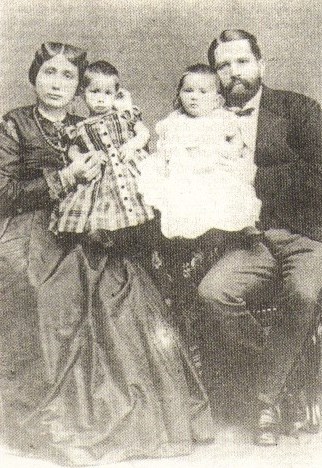
I trust the above will suffice to demonstrate that woman in the East is not at all the degraded or oppressed and outlawed being she is generally believed; she is by no means a cypher. What power and how great an influence some women may gain I have already pointed out in speaking of my stepmother, Azze bint Suf. She ruled our father completely, and court and public affairs depended in most cases on her verdict. All attempts on the part of her step-children to weaken her influence completely failed, although their efforts were, if at no other time, perfectly united in this aim. Any request of ours, made to our father in person, was invariably referred to her final decision, even in matters that might be thought to have been beneath her consideration. While my father lived she ruled with a rod of iron.
Here is a case in point: The daughter of the commanding officer of one of our fortresses in Oman came over to Zanzibar with her husband. They were pretty well off, and had no children— "fortunately," as the lady told me herself. She was very clever and witty (wit is nowhere more valued than with us) but frightfully ugly. Her husband, nevertheless, adored her, and bore all her whims and humours with an angelic patience. When she walked out he had to accompany her, whether he liked it or not. He could never dispose of his time himself, and in the morning after prayers he had to wait for orders from mistress Asche, to know if she deigned to remain at home with him or intended to go out for the day. He was altogether her slave.
I will only speak of one more member of our family, whose history contradicts better than anything else all the fabrications about the inferiority of Eastern women. My great-aunt, my grandfather's sister, is to this day held up as the model of a clever, courageous, and energetic woman. The history of her life and of her deeds is told over and over again to old and young, and listened to with awe.
My grandfather, the Sultan Imam, of Mesket, in Oman, left at his death three children: my father Said, my uncle Sálum, and my aunt Asche. My father was only nine years old at the time, and a regency had to be established. Contrary to all custom, my great-aunt at once declared in the most decided manner that she would carry on the government herself until her nephew was of age, and she suffered no opposition. The ministers, who had never anticipated such a thing, and who had already in secret congratulated themselves on the prospect of ruling the country for some years, could do nothing but submit. They had to make their reports to her, and to receive her instructions and commands every day. She closely watched and knew everything, and nothing could remain concealed from her, to the great vexation and annoyance of all the disloyal and idle officials.
Personally, she put aside all rules of etiquette; regardless of what people might say, she merely wore her schele in the presence of the ministers, and went her own way with energy and firmness.
Her courage was soon put to a very severe test. Not long after she had taken up the reins of government a very serious war broke out—unfortunately, a frequent occurrence in Oman. Some of our next of kin had thought it an easy affair to overthrow the government of a woman, to extinguish our house, and possess themselves of power. Their hordes ravaged the country with fire and sword, and advanced close to the gates of Mesket. Thousands of country people from the sacked provinces had already fled for shelter and protection into the city, leaving all their goods and chattels behind. Mesket is strongly fortified, and well able to stand a siege, but of what use are the strongest walls when provisions and ammunition are exhausted?
But in this terrible distress my great-aunt proved herself equal to the occasion, and she even gained the admiration of the enemy. Dressed in man's clothes, she inspected the outposts herself at night, she watched and encouraged the soldiers in all exposed places, and was saved several times only by the speed of her horse in unforeseen attacks. One night she rode out, oppressed with care, having just received information that the enemy was about to attempt an entrance into the city by means of bribery that night, and with intent to massacre all, and now she went to convince herself of the loyalty of her troops.
Very cautiously she rode up to a guard, requesting to speak to the "Akid" (the officer in charge), and did all in her power to seduce him from his duty by great offers of reward on the part of the besiegers. The indignation of the brave man, however, completely allayed her fears as to the fidelity of the troops, but the experiment nearly cost her her own life. The soldiers were about to massacre the supposed spy on the spot, and it required all her presence of mind to make good her escape.
The situation, grew, however, to be very critical at Mesket. Famine at last broke out, and the people were well-nigh distracted, as no assistance or relief could be expected from without. It.was, therefore, decided to attempt a last sortie in order to die at least with glory. There was just sufficient powder left for one more attack, but there was no more lead for either guns or muskets. In this emergency the regent ordered iron nails and pebbles to be used in place of balls, the guns were loaded with all the old iron and brass that could be collected, and she opened her treasury to have bullets made out of her own silver dollars. Every nerve was strained, and the sally succeeded beyond all hope. The enemy was completely taken by surprise, and fled in all directions, leaving more than half their men dead and wounded on the field. Mesket was saved, and, delivered out of her deep distress, the brave woman knelt down on the battlefield and thanked God in fervent prayer.
From that time her government was a peaceful one, and she ruled so wisely that she was able to transfer to her nephew, my father, an empire so unimpaired as to place him in a position to extend the empire by the conquest of Zanzibar. It is to my great-aunt, therefore, that we owe, and not to an inconsiderable degree, the acquisition of this second empire.
She, too, was an Eastern woman!
Ruete, Emily. Memoirs of an Arabian Princess: An Autobiography. D. Appleton & Company, 1888.
About TOTA
TOTA.world provides cultural information and sharing across the world to help you explore your Family’s Cultural History and create deep connections with the lives and cultures of your ancestors.